
News analysis: Trump’s AI Fascism is taking shape
Why Anthropic and OpenAI's latest releases mark the rise of America's government-approved AI ecosystem, and Trump's global dominance.

SAN FRANCISCO -- The first real test of the Trump administration’s AI regime has arrived, and it does not look like a ban. It looks like a velvet rope.
OpenAI says its new GPT-5.6 family will not immediately go to the public. Anthropic says Claude Mythos 5, its strongest cybersecurity model, can come back online only for a selected group of U.S. organizations that operate or defend critical infrastructure. Earlier this month, Anthropic had to disable both Claude Fable 5 and Claude Mythos 5 for all customers after the U.S. government issued an export-control directive targeting foreign-national access.
The emerging system has a name: Trump’s AI Fascism.
That does not mean the administration has outlawed AI. It means something subtler and more dangerous. The most powerful AI systems are being moved into a permission regime where the state, frontier labs, and approved corporate partners decide who is trusted enough to use machine intelligence at the frontier. The public waits. Smaller developers wait. Foreign users wait. Unapproved companies wait. The chosen few get access first.
The official language is cybersecurity, national security, classified benchmarking, trusted partners, critical infrastructure, and frontier-model review. The political structure underneath is simpler: intelligence is becoming a gated resource, and the gate is being controlled from Washington.
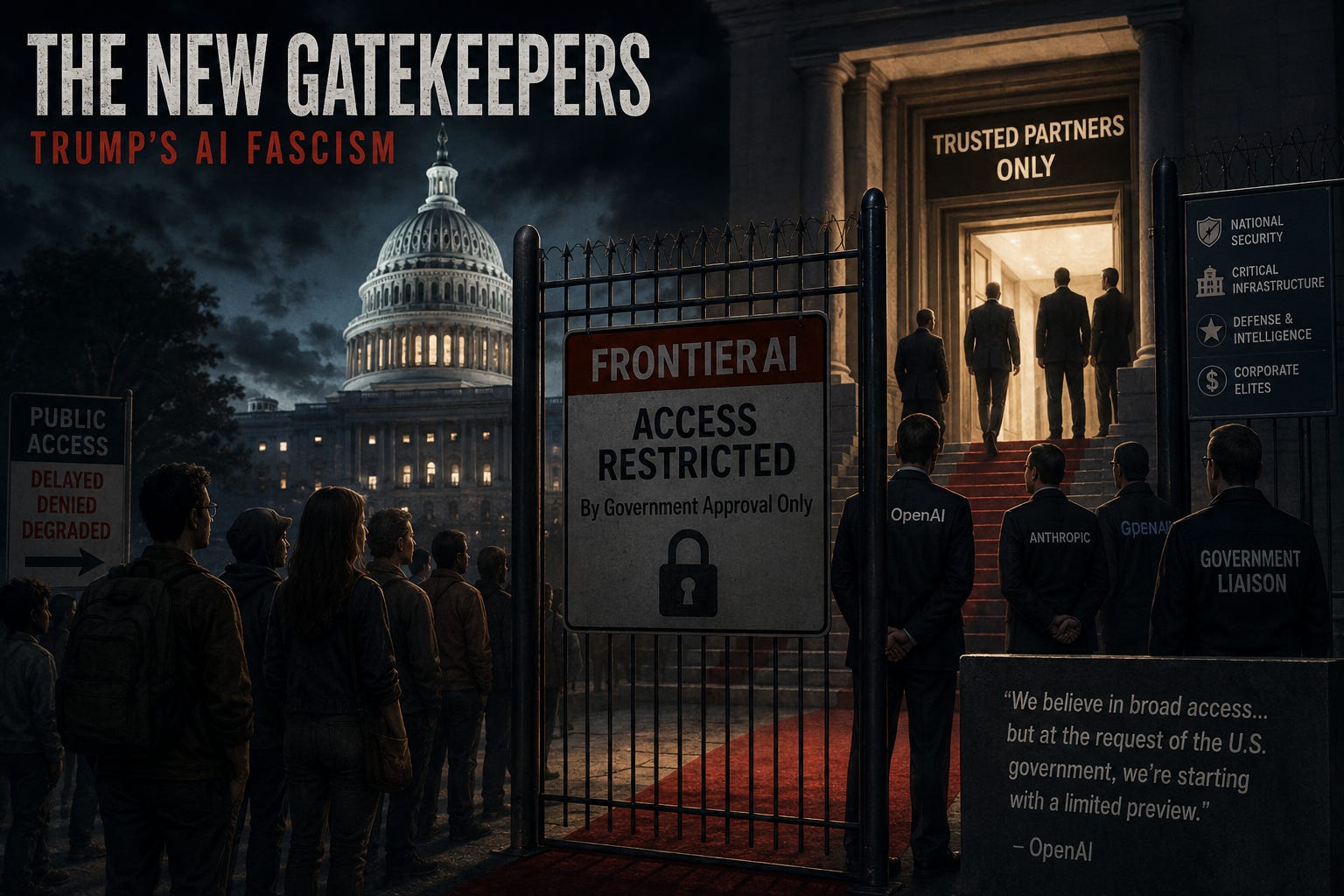
Trump’s June executive order created a framework for federal review of the most advanced AI systems before public release. It also directed the government to develop classified benchmarks for advanced cyber capabilities and to facilitate access to covered frontier models for government agencies, state and local authorities, and critical infrastructure operators. In theory, the order is about defense. In practice, it gives the federal government a new role upstream of model release, access selection, and the classification of dangerous capability.
OpenAI’s reaction showed how far the line has moved. The company said it still believes in broad access and plans wider availability of GPT-5.6 Sol, Terra, and Luna in the coming weeks. But it also said that, at the government’s request, the first rollout would be limited to trusted partners whose participation had been shared with the government. OpenAI added that this kind of government access process should not become the long-term default because it keeps the best tools away from users, developers, enterprises, cyber defenders, and global partners who need them.
That is the alarm bell. Even OpenAI, hardly an anti-government open-source radical, is warning that the government is beginning to pick who gets the best AI.
Anthropic’s case is even more revealing. Fable 5 was supposed to be the broadly available version. Mythos 5 was the more restricted version, the same underlying model but with some cyber safeguards lifted for trusted cybersecurity partners. Then the government intervened. Fable and Mythos were both shut down. When the government relented, it restored Mythos first, but only to trusted U.S. organizations. The public-facing Fable remained unresolved.
That is the architecture of an AI caste system. The general public gets delay. The approved institutions get capability. The public model is treated as too risky, while the more powerful restricted model is returned to a narrow class of state-approved users.
The moral case for this system did not begin with Trump. It began inside the frontier labs.
In 2019, OpenAI withheld the full GPT-2 model, warning that the system could be misused for deception, impersonation, abusive content, spam, phishing, and misinformation. Dario Amodei, then OpenAI’s research director, was one of the named authors on the original release-strategy post. The decision was presented as responsible disclosure. The world needed time to prepare.
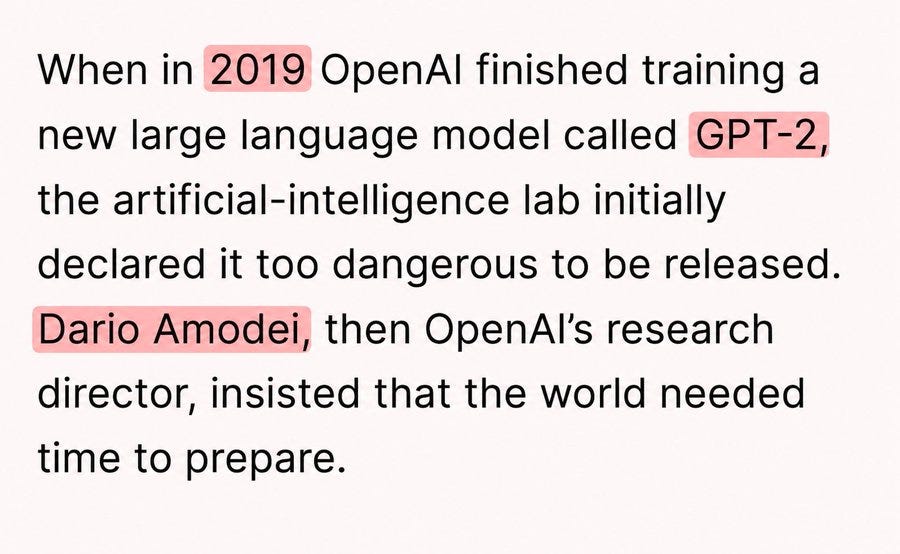
Later that year, OpenAI released the full GPT-2 model and said it had seen no strong evidence of misuse so far. But by then the precedent had already been set. A private lab had claimed the authority to decide when the public was ready for a general-purpose intelligence tool. A safety norm had been born: frontier AI should be staged, rationed, and withheld until trusted experts decide society is prepared.
That norm has now migrated from the lab into the state.
At Anthropic, Amodei’s safety politics became more explicit. The company has argued that the most advanced models may require government authority to block or deter dangerous deployments. It has called for national-security testing, stronger export controls, classified communication channels between AI labs and intelligence agencies, security standards for frontier labs, and accelerated government adoption of AI. Amodei has described advanced AI as a potential “country of geniuses in a datacenter” and has framed the AI race as a contest in which democracies must stay ahead of authoritarian rivals.
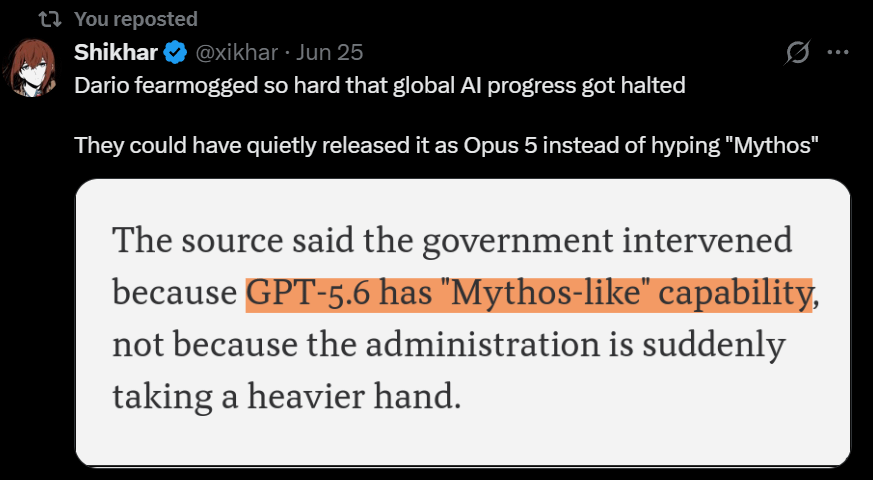
Some of that may be sincere. Some of it may be prudent. But the political effect is now clear. Once frontier AI is described as a cyber weapon, a national-security emergency, and a civilization-level danger, the state has all the language it needs to seize control of access.
Trump did not invent Dario’s fear. He operationalized it.
That is why Dario Amodei has become central to the backlash. The charge is not that he personally designed Trump’s AI control system. The charge is that his years of warning about dangerous capabilities helped create the intellectual environment in which Trump’s system could be justified. When an AI lab CEO tells Washington that a model may be too dangerous for broad release, Washington does not hear a nuanced technical argument. It hears an opportunity for power.
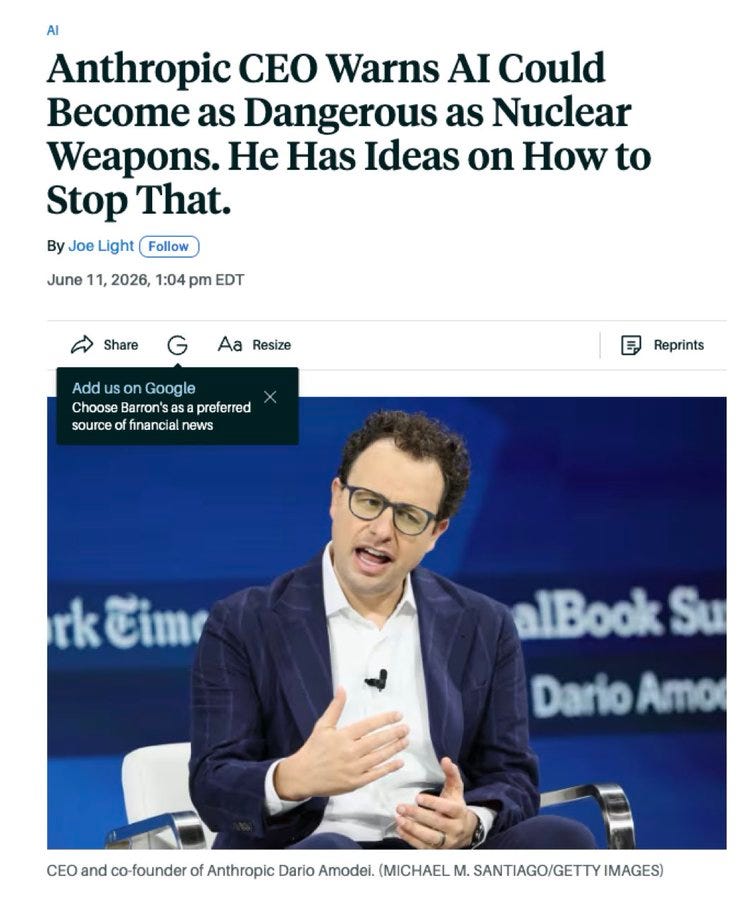
Even some Trump allies appear to see the connection. David Sacks, who co-leads Trump’s council of technology and science advisers, reportedly said that Amodei came to Washington and described Mythos in terms that made people think of a cyber weapon. That comment is useful because it collapses the whole story into one sentence. Dario sounded the alarm. Trump’s government built the checkpoint.
The defenders of the new regime will say this is not fascism. They will say it is national security. They will say the models can find vulnerabilities, accelerate hacking, empower China, aid Russia, threaten banks, expose hospitals, and destabilize infrastructure. Some of those fears may be real. That is precisely why the danger is so serious.
Authoritarian systems rarely require imaginary threats. They thrive by taking real threats and converting them into permanent exceptions. The problem is not that AI has no risks. The problem is that risk is becoming the excuse for a new hierarchy of access to intelligence itself.
Trump’s AI Fascism is not anti-AI. It is anti-public. It does not say powerful AI should not exist. It says powerful AI should exist for the state, the defense ecosystem, critical infrastructure consortia, Fortune 500 incumbents, and companies that can survive the approval process. It says the frontier should be available, but only through a trust list. It says intelligence should be developed at maximum speed, but distributed according to political permission.
That is why the word fascism lands. The defining structure is the fusion of state power, corporate power, national-security panic, and a managed public. There is an enemy abroad, a dangerous technology at home, a class of trusted institutions, and a growing insistence that ordinary access must be mediated by authorities. The public is not told that AI is forbidden. It is told that AI is too dangerous for the wrong people.
The most chilling part is that the system can call itself democratic while becoming deeply anti-democratic. It can say it is protecting citizens while removing citizens from the frontier. It can say it is stopping China while copying the logic of centralized technological control. It can say it is securing the future while making the future permissioned.
Dario’s role is tragic because his stated goal is safety. But safety can curdle into obedience. The moment safety stops meaning “make the model safer” and starts meaning “sort users into trusted and untrusted classes,” the politics have changed. The model is no longer the only thing being governed. The person asking to use it is being governed too.
That is the case against Dario’s fear-mongering. It did not merely warn about AI fascism. It helped make AI fascism speakable in respectable policy language.
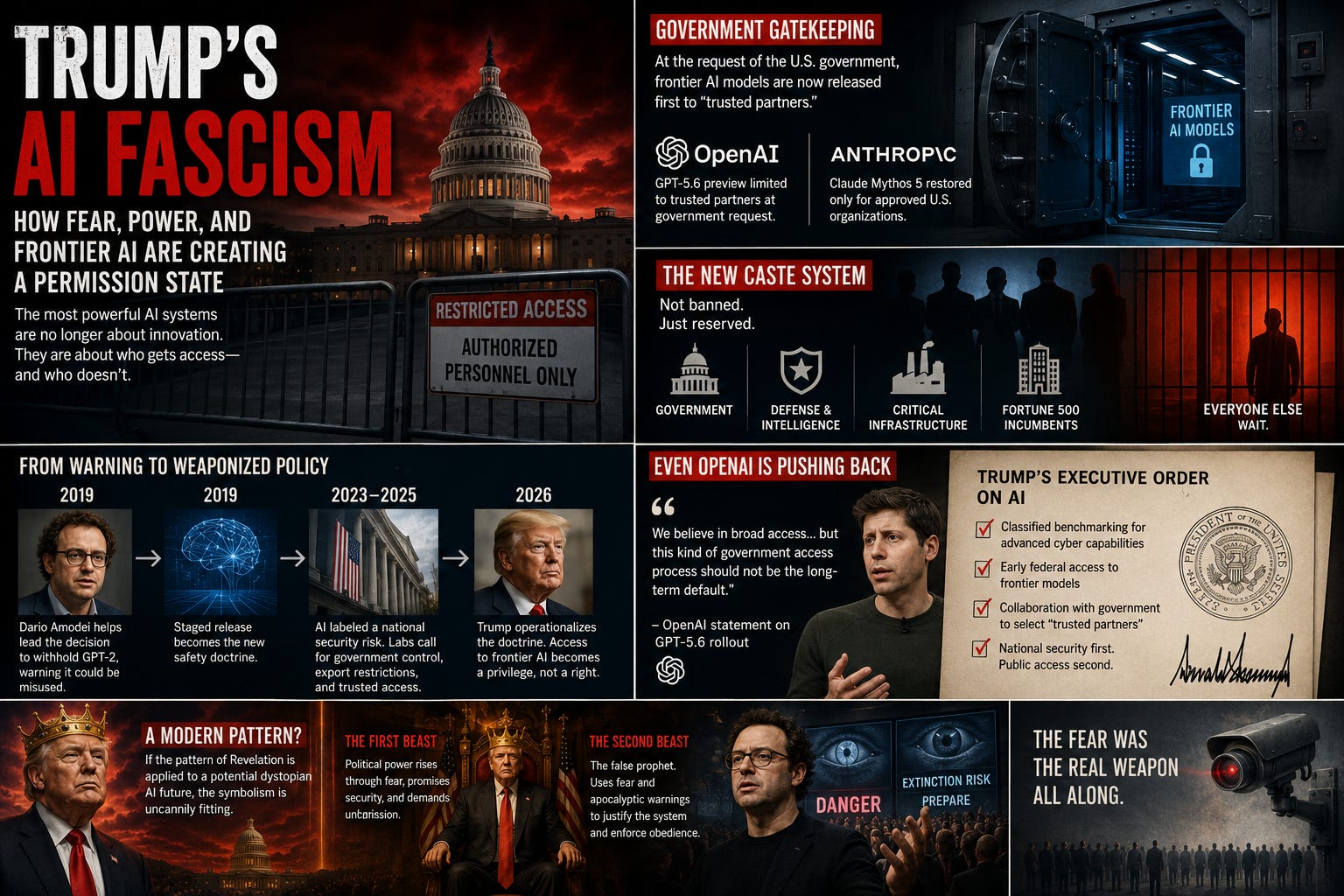
And if the symbolic pattern of Revelation were applied to a potential dystopian AI future, the Trump administration would be a strong candidate for the First Beast: the political power that rises through fear, speaks in the language of national survival, and imposes a new order of submission. Dario Amodei would be a strong candidate for the Second Beast, the false prophet figure, not because he is literally that, and not because every warning he gave was false, but because his apocalyptic safety language lends moral authority to Trump’s AI Fascism. In that allegory, the fear of AI becomes the miracle, the trusted-access list becomes the mark, and the public is told that intelligence itself must pass through the hands of the state and its chosen corporate priesthood.
Part II: The Open-Source Counterattack
If the first chapter of this story is about governments placing gates around frontier AI, the second chapter may be about millions of developers simply walking around those gates.
Within hours of OpenAI announcing that GPT-5.6 would launch only through a limited government-reviewed preview, and after Anthropic restored Mythos 5 only to selected U.S. organizations, one message began appearing repeatedly across social media:
“Local AI is now or never.”
The sentiment reflects something larger than frustration with a delayed product launch. Developers, startups, researchers, and technology enthusiasts are increasingly questioning whether their businesses should depend on AI systems that can disappear overnight because of policy decisions.
The appeal of open-source and open-weight AI has never been simply about cost. It has always been about ownership.
A model running on your own hardware cannot be suspended by an API policy. It cannot disappear because of a Friday afternoon government directive. It cannot suddenly become unavailable because your company falls outside an approved access program.
For years, closed frontier models justified their position through superior capability. But as open models continue closing the performance gap while becoming dramatically cheaper to run, that advantage is becoming increasingly difficult to defend.
Developers are already pointing toward a new generation of open models. Alibaba’s Qwen series, DeepSeek, Kimi, GLM, and newer American projects such as Ornith demonstrate that increasingly capable systems can be distributed directly to users instead of remaining behind centralized APIs.
If governments continue treating frontier AI as strategic infrastructure, they may unintentionally accelerate adoption of open-source alternatives. Every new access restriction becomes an advertisement for self-hosting. Every approval framework becomes another argument for local inference. Every delay reinforces the value of software that belongs to its users rather than a platform provider.
The irony is difficult to ignore.
Policies intended to strengthen America’s technological leadership could instead encourage developers to migrate toward freely downloadable models produced outside the traditional frontier-lab ecosystem.
Whether that ultimately benefits American innovation or strengthens overseas competitors remains an open question.
What appears increasingly clear is that the AI industry is beginning to split into two worlds.
One world consists of government-approved frontier systems operated through large cloud providers under increasing regulatory oversight.
The other consists of open-source models that anyone can download, modify, improve, and run locally.
The competition between those two ecosystems may become one of the defining technology stories of the next decade.
The race may no longer be simply about who builds the smartest AI.
It may become a race over who is allowed to own it.
Quotes from Twitter from people reacting to the news from OpenAI, Anthropic, and the Trump Administration.
Alex Finn
“The era of publicly available frontier AI is ending as government approval replaces open deployment.”
Luther Lowe
“Government-gated AI will favor the largest corporations while leaving startups and smaller innovators behind.”
Brad Gerstner
“America risks slowing its own AI industry while Chinese competitors continue advancing without the same restrictions.”
0xSero
“Local, self-hosted AI is becoming essential for preserving individual technological independence.”
Brian Roemmele
“Open-source AI is likely to erase today’s restricted frontier advantage within months, making current policies self-defeating.”
Theo (t3.gg)
“The AI industry is entering a darker era of restricted model access.”
Robert Scoble
“The United States is creating a two-tier AI ecosystem that may ultimately strengthen open source and China’s competitive position.”
Pliny the Liberator
“Government-controlled access threatens to create a permanent AI underclass.”
Matthew Berman
“Dario Amodei’s safety campaign helped create the regulatory environment that now restricts frontier AI.”
Alex Finn (Ornith)
“New open-source models like Ornith demonstrate that local AI is advancing rapidly despite frontier restrictions.”
Self Aware Networks
“Ornith represents a promising new generation of efficient American open-source AI models.”
Brayden Levangie
“The latest government restrictions are pushing developers toward owning their own hardware and running open models like GLM locally.”
Sources:
OpenAI’s 2019 GPT-2 release-strategy post says the full trained model was withheld because of malicious-use concerns, describes staged release, and names Dario Amodei among the original authors.
OpenAI’s later GPT-2 release post says the full 1.5B model was eventually released and that OpenAI had seen no strong evidence of misuse so far.
The White House executive order establishes classified benchmarking for advanced cyber capabilities and directs federal agencies to facilitate access to covered frontier models for government and critical infrastructure uses.
OpenAI’s GPT-5.6 announcement says the company is starting with a limited preview for trusted partners at the request of the U.S. government and says it does not want this government access process to become the long-term default.
Anthropic’s June 12 statement says the U.S. government issued an export-control directive that forced Anthropic to disable Fable 5 and Mythos 5 for all customers.
Anthropic’s Claude Fable 5 and Mythos 5 launch post says Mythos 5 is the same underlying model as Fable 5 but with some cyber safeguards lifted, and that Mythos access was restricted to Glasswing partners pending a broader trusted access program.
Reuters reported that the U.S. government allowed Anthropic to redeploy Mythos 5 to trusted U.S. organizations, while critics questioned the opacity of government access decisions.
AP reported that OpenAI and Anthropic limited new models to Trump-approved customers, that the administration’s review process was unprecedented, and that David Sacks linked the heightened scrutiny to Dario Amodei’s warnings about Mythos.
Anthropic’s policy materials call for government authority to block or deter dangerous deployments, national-security testing, stronger export controls, classified channels between labs and intelligence agencies, and accelerated government AI adoption.
Dario Amodei’s public statements have framed advanced AI as a “country of geniuses in a datacenter,” stressed democratic lead over authoritarian rivals, and described Anthropic’s deployment of AI across classified networks and national-security agencies.