
Nuclear Deterrence Is the Missing Variable in Eastern Europe: Today the World Debates the Nuclear Deterrence Logic I Laid Over A Year Ago
Russia’s accusation, China’s response, and Europe’s unresolved strategic choice all point to the same conclusion: nuclear weapons for Ukraine is the missing foundation of peace in Eastern Europe.

Months ago on SVGN, I argued that the central problem in Eastern Europe was not a shortage of speeches, sanctions, or symbolic solidarity. It was a power imbalance. Ukraine gave up the most consequential deterrent it had ever possessed. Russia did not. Europe then tried to build a security order on assurances, process, and incremental support. The result has been predictable: a grinding war, a permanently unstable frontier, and a continent absorbing the costs of conflict without imposing a decisive strategic limit on Moscow.
Eastern Europe is not trapped in a diplomatic crisis. It is trapped in a mathematical one. One side retained ultimate deterrence. The other relinquished it. Everything that followed has been a consequence of that asymmetry.
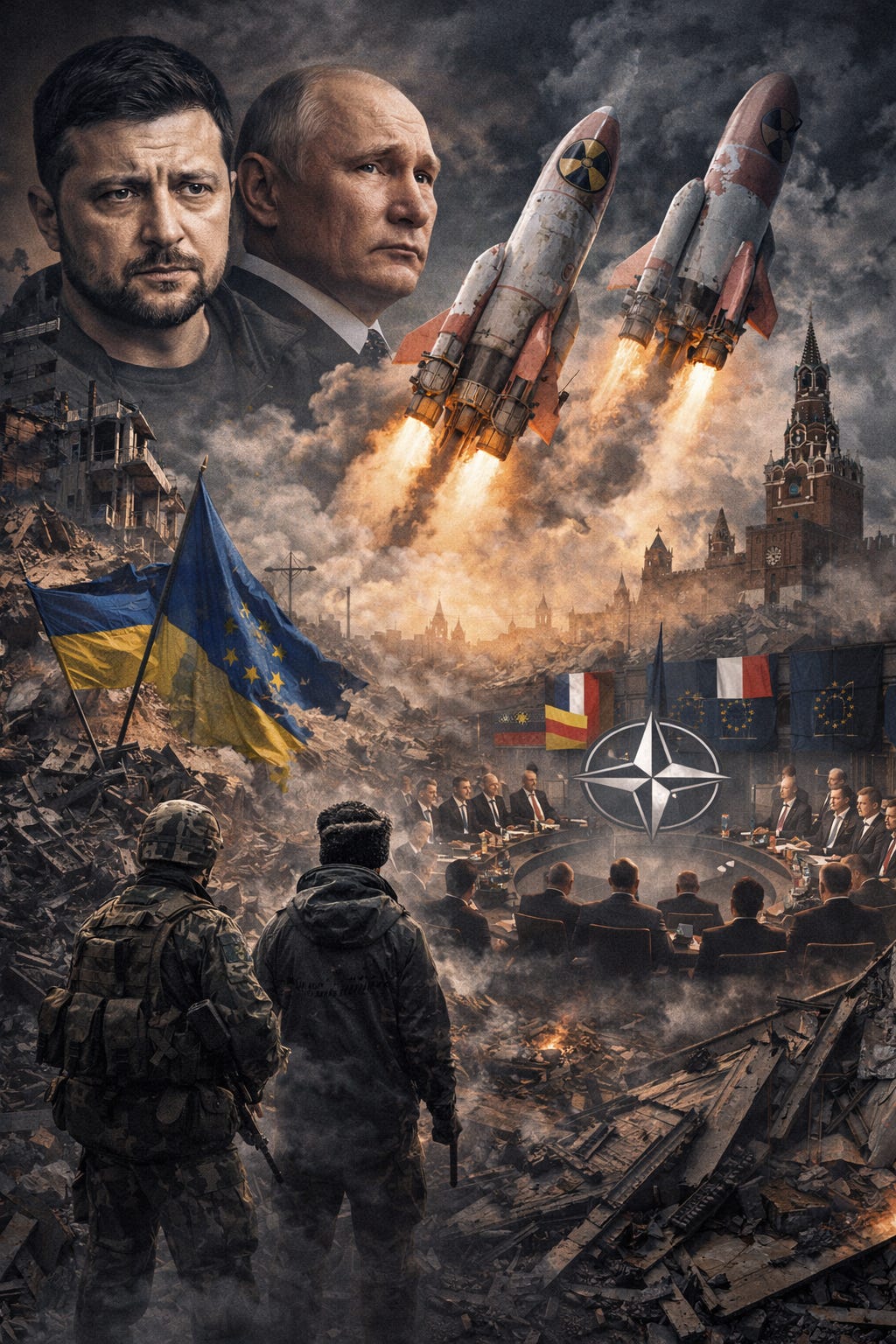
This week, that buried truth resurfaced in public. Russia put a nuclear allegation into the center of the global conversation. Ukraine denied it. France dismissed it. China responded by reasserting its standard anti-nuclear line. What matters here is larger than the allegation itself. The conversation moved exactly where it was always going to move: back to deterrence, credibility, and the architecture of peace.
The Ukraine war is not an anomaly. It is the predictable outcome of a security architecture built on guarantees instead of parity. When deterrence is uneven, conflict is not a surprise. It is a delayed certainty.
Sometimes influence does not arrive as attribution. It does not show up with a citation, a direct quote, or a formal nod. Sometimes influence appears when the world begins circling an argument you made earlier, even through events you did not script and language you did not choose. That is one of the strange realities of writing ahead of the curve on global dynamics. The system resists an idea until the structure of events forces everyone to confront it at once. Then states begin signaling, denying, recalibrating, and drawing red lines around the very terrain they previously treated as politically untouchable.
That is what happened here. Russia raised the specter of a European-backed Ukrainian nuclear capability because it understands the strategic meaning of changed deterrence. China responded the way a major power responds when the perimeter of acceptable escalation is suddenly under debate. Europe, meanwhile, remains trapped in the posture that has failed it for years: trying to preserve peace through half-measures in a war that has already exposed the limits of half-measures.
This week’s nuclear accusations are not the story. They are the symptom. The real story is that the war has reached the point where the only remaining variable left to debate is the one Europe has tried hardest to avoid: strategic deterrence.
Security systems stabilize when escalation dominance is symmetrical. They destabilize when it is not. Eastern Europe has operated under asymmetry since the 1990s. The war is not a breakdown of the system. It is the system functioning exactly as designed.

My position remains the same. The right solution for Europe is not more managed weakness. It is not another cycle of aid without decisive strategic redesign. It is not moral outrage paired with permanent hesitation. The right solution is to create a security framework around Ukraine that actually changes Russian calculations at the highest level. In plain language, that means a real deterrent structure, not a symbolic one. Peace endures when aggression becomes irrational. Peace collapses when aggression remains affordable.
This is why the core argument from my November 2024 SVGN piece still stands. Europe needs balance in Eastern Europe, not endless maintenance of imbalance. A continent that expects peace while one side holds overwhelming escalation dominance is not building peace. It is renting time. And rented time is exactly what Russia has exploited for years.
There is another reason this moment matters. The instant Beijing is compelled to comment on a Europe-Ukraine nuclear narrative, the issue is no longer regionally contained. Eastern Europe and the Indo-Pacific are linked by deterrence logic, by perceptions of resolve, and by the global lessons other powers draw from Europe’s choices. A weak settlement in one theater teaches opportunism in another. A credible balance in one theater teaches restraint in another. This is not just about Ukraine. It is about the operating system of the next era.
So no, this week’s story does not weaken the thesis. It strengthens it. The world is now debating, denying, warning, and repositioning around the same hard truth by slower, messier, more politically theatrical routes. Europe can continue managing decline through ambiguity, or it can restore balance through strength. Only one of those paths produces durable peace. The right solution remains the same now as when I wrote it: build the deterrent architecture that makes further aggression untenable, and the rest of diplomacy finally has something real to stand on.
If deterrence logic is followed to its end, the region does not stabilize until the imbalance is corrected at the level that actually governs invasion decisions. As long as one side retains overwhelming escalation dominance and the other is expected to survive on assurances, process, and incremental support, you do not get “peace.” You get a managed interval between offensives. The costs of that arrangement keep compounding until the politics catch up to the reality.
That is why the system keeps converging on the same destination even when everyone refuses to say it out loud. Pressure builds for Ukraine to regain a truly credible independent strategic deterrent, because everything below that threshold has already been stress-tested in real time and found wanting. And if that convergence continues, it will not arrive as a clean public debate with neat signatures and applause. It will arrive the way hard security realities usually arrive, as a shift in facts first, and only later as a shift in language.

When that shift happens, it will be experienced less as “escalation” by the people living inside the consequences of imbalance and more as restoration of a baseline that makes aggression irrational. That is the moment Moscow’s calculus changes, and it is also the moment diplomacy stops being theater and starts being negotiation anchored to something real. Until then, Europe is not building a durable security order. It is renting time.
Inevitably, if the incentives remain unchanged, Ukraine will move toward restoring the nuclear capability it once surrendered. That process would not be advertised, debated, or celebrated in advance. It would unfold quietly, because that is how hard security corrections unfold. Europe, when faced with the arithmetic of permanent imbalance, would eventually recognize that parity is not escalation but stabilization.
When that correction becomes real, it will not be framed internally as provocation. It will be framed as restoration of deterrence. And once deterrence is restored, the invasion logic collapses. The moment the cost of aggression becomes structurally irrational, expansion halts. Only then does lasting peace become structurally possible.
Such a correction may be the only hard solution capable of producing durable peace in the region. Ukraine would not be changing history; it would be reversing it. And once equilibrium is reestablished, the security order stops drifting and starts stabilizing. Ukraine must regain what it once gave away. Only then does the equation balance..
Only then does lasting peace become structurally possible. Such a correction would function as the ultimate deterrent, forcing aggression to retreat because its cost structure had finally changed.

Sources
Reuters reported on February 24 that Russia’s SVR accused the UK and France, without presenting evidence, of helping Ukraine seek a nuclear or “dirty bomb” capability, and that Ukraine rejected the allegation.
Reuters reported on February 26 that France called the accusation baseless and described it as Russian disinformation.
China’s foreign ministry said on February 25 that it was “not familiar with the specifics” and reiterated that nuclear weapons must not be used, a nuclear war must not be fought, and non-proliferation obligations should be observed.
SVGN published “Restoring Balance in Eastern Europe: Exploring the Role of Nuclear Deterrence in Ukraine” in November 2024, arguing that equipping Ukraine with nuclear capabilities could restore deterrence and rebalance the conflict.