
NO ONE IS ABOVE STATE LAW, NOT ICE, NOT CBP, NOT THE FBI
Governors, Attorneys General, and Legislators: Enforce your laws. Federal badges do not confer immunity. The badge is not a crown.

America was not designed to have vassal states. It was designed to have sovereign states inside a federal system, each with a duty to keep the peace, enforce criminal law, and protect the civil rights of the people who live within their borders. If you are a Governor, a State Attorney General, a State Senator, or a State Representative, you do not take an oath to federal agencies. You take an oath to your constitution and to the public order.
The loudest lie in our politics right now is the one delivered with smug certainty: “Federal law trumps state law, so federal agents can do whatever they want.” That sentence is wrong on its face, and it is dangerous in practice. The Supremacy Clause is not a license for lawlessness. It does not create a roaming class of untouchables. It means that valid federal law overrides conflicting state law, and it shields federal officers only when they are executing lawful federal duties in a lawful way.
The actual rule is sharper, and it matters. A federal badge does not erase state criminal statutes. If a federal officer commits a state crime outside the lawful scope of federal duty, that officer can be investigated, arrested, charged, tried, convicted, and imprisoned under state law. That is not radical. That is the baseline definition of accountable government. The immunity federal officers sometimes claim has a boundary, and the boundary is the law.
This is where you our Public Servant must hold the line with precision. You are not asserting a right to sabotage lawful federal operations. You are asserting the oldest right a state possesses: the right to enforce its criminal code against anyone who commits crimes on its territory. You are asserting due process, not mob justice. You are asserting probable cause, not political theater. You are asserting that when a federal officer crosses the line into assault, unlawful detention, reckless endangerment, property crimes, or civil-rights violations that are not authorized and not necessary and proper to a lawful duty, the state is not required to look away.
That distinction is the difference between constitutional accountability and constitutional crisis. States cannot convert “we disagree with federal policy” into a pretext to physically obstruct federal agents who are acting lawfully. States also cannot pretend that a federal logo is a magic shield when the conduct is unlawful. Your power is strongest when you aim it at the conduct, not at the agency.
Expect the next move the moment you assert this authority. Federal officers will attempt to move state prosecutions into federal court. That is not a defeat. That is the battleground. Federal officer removal is a procedural tool, not a moral verdict, and not an automatic dismissal. It is where the federal-defense claim is tested. If the conduct was lawful and necessary and proper, immunity may attach. If it was not, it should not. Either way, the rule of law does not begin and end with the feelings of a commentator on social media.
There is a second lever that belongs to the states, and it is equally misunderstood. You cannot be conscripted into federal enforcement. You do not have to volunteer your police, your jails, your databases, or your budgets to execute federal immigration policy. Anti-commandeering is not a loophole. It is constitutional structure. When federal officials demand that states become an appendage of federal enforcement, the answer is not defiance for the camera. The answer is a clean, disciplined refusal grounded in law and backed by state policy.
This is how a state fights back without breaking the system. You do not need to threaten “roundups.” You do not need to posture. You need to govern. You need bright lines that your law enforcement can follow, and you need consequences when anyone crosses those lines, including federal officers. You need state-level documentation, oversight, and transparent standards that make it harder for misconduct to hide behind ambiguity. You need to force every immunity claim to be argued in court, on the record, under a real legal test.
When federal officials try to scare you with talk of “sedition,” understand what that word is doing. It is not doing legal analysis. It is doing intimidation. Sedition is not a label you can slap on disagreement to make it disappear. It is a criminal concept with elements, and “a state refuses to help” is not a spell that summons federal troops. Even the most extreme domestic deployment authorities are not automatic switches. They are political decisions wrapped in legal frameworks, and they come with costs, scrutiny, and blowback when abused.
State power is not the power to nullify federal law. It is the power to protect your people with lawful enforcement, and to demand that everyone, including federal agencies, stay inside the lines. If Washington wants supremacy for federal law, then Washington also has to accept supremacy for the rule of law. A badge is not a crown. A uniform is not a pardon. Authority is not immunity.
If you are a Governor, you have a duty to keep the peace and protect constitutional rights on your soil. If you are an Attorney General, you have the authority to investigate and prosecute crimes without fear or favor. If you are a legislator, you control appropriations, oversight, reporting requirements, and state standards that can either enable misconduct or constrain it. Use those powers. Use them soberly. Use them relentlessly. Use them in a way that survives court review and public scrutiny. The objective is not chaos. The objective is accountability.
A state that refuses to be commandeered is not rebelling. A state that prosecutes unlawful violence is not obstructing. A state that insists that federal power must remain lawful is not the problem. It is the last line of a constitutional system that was built to prevent any single authority from becoming untouchable.
Supremacy Clause immunity is not blanket immunity. It protects only conduct that is authorized by federal law and necessary and proper to execute a lawful federal duty. If a federal officer commits assault, unlawful detention, reckless endangerment, or civil-rights violations, state criminal law can apply. When charges are brought, federal officer removal may move the case to federal court, but removal is not dismissal. It simply forces the officer to prove a real federal defense. “Federal law trumps state law” is not a conclusion. It is a claim that still has to survive judicial scrutiny.
The strongest state power is not confrontation but anti-commandeering. The federal government cannot force states to administer or enforce federal programs, including immigration enforcement. States can lawfully refuse cooperation while still prosecuting crimes committed on their soil by anyone, including federal officers acting outside lawful duty. That posture is not sedition, and it does not trigger automatic military intervention. It is constitutional power exercised with discipline rather than theatrics.
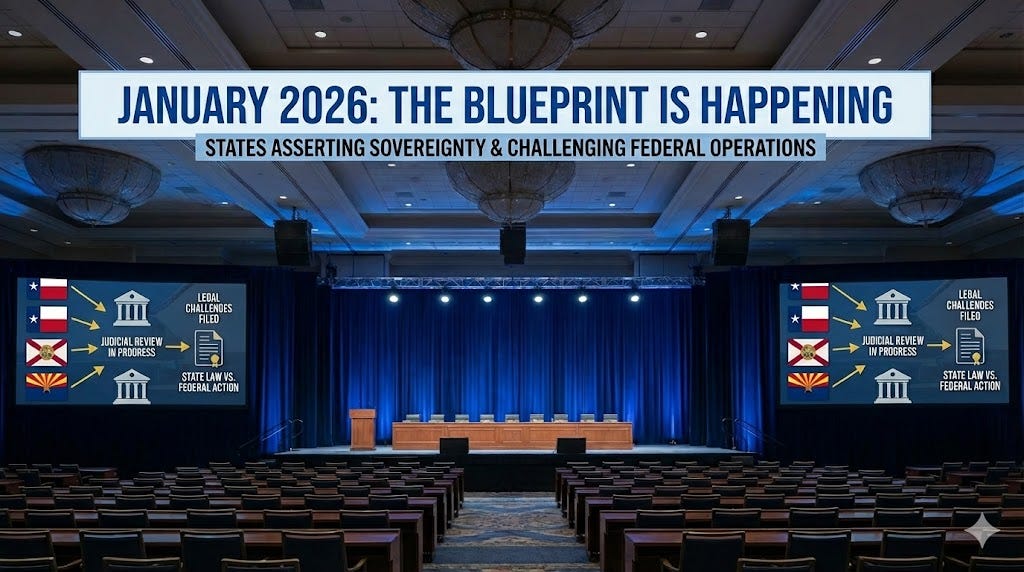
If you are a Governor, a State Attorney General, or a state legislator, you do not have to theorize about state sovereignty in the abstract, because January 2026 is delivering live-fire examples of states using lawful power to confront federal immigration operations when those operations cross constitutional and state-law lines. This is the point that ends the “states are helpless” myth. States are already forcing federal agencies into court, already putting factual records under judicial review, already shaping the operating environment inside their borders, and already proving that federal power is not a blank check.
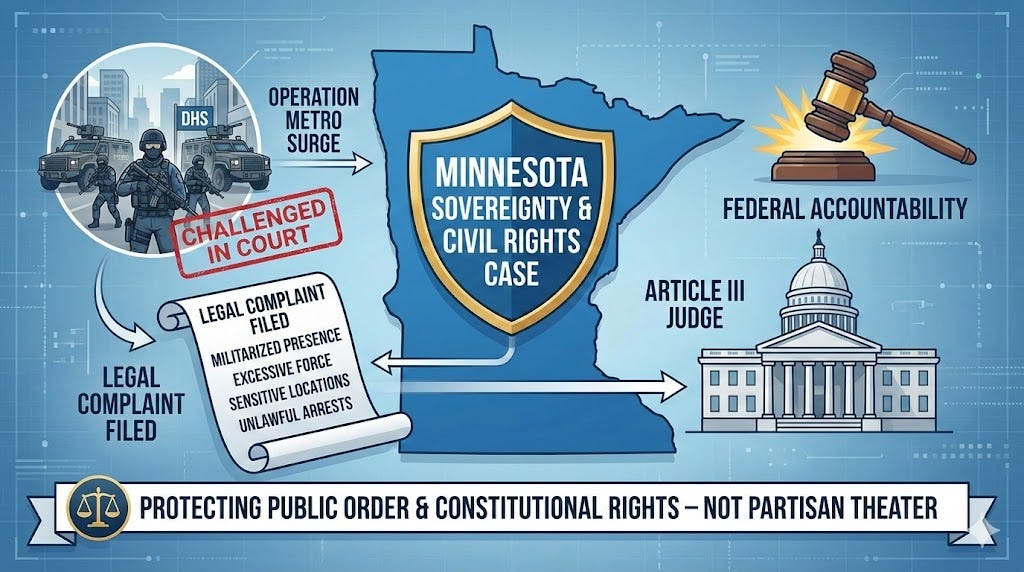
Start with Minnesota, because Minnesota is the cleanest illustration of the modern state posture. After Operation Metro Surge began, Minnesota’s Attorney General, alongside Minneapolis and Saint Paul, filed suit against DHS and senior officials and asked the federal court to end the deployment and declare it unlawful. The complaint is not framed as partisan theater. It is framed as a sovereignty and civil-rights case, and it is filled with specific allegations that matter in court: militarized presence, excessive force, enforcement actions in sensitive locations, and arrest activity that the plaintiffs characterize as unlawful and unconstitutional. The state is not claiming a right to veto federal law. The state is asserting the right to protect public order and constitutional rights on its territory when federal conduct allegedly spills outside lawful duty and imposes concrete harms on schools, businesses, emergency response capacity, and ordinary civic life. The filing also makes the political point that matters for every other state watching: a state can force federal agencies to defend themselves under real legal standards, on the record, in front of an Article III judge.
Then notice what happened on the Fourth Amendment front, because this is where the “federal agents are untouchable” slogan actually breaks. In Minnesota, a federal judge ruled that ICE violated the Fourth Amendment by forcibly entering a home without a judge-signed warrant, rejecting the idea that an internal administrative warrant is equivalent to judicial authorization for a home entry. That single fact changes the argument in every statehouse in America. When a court says the entry was unconstitutional, you are no longer debating vibes or rhetoric. You are dealing with unlawful conduct, and unlawful conduct is exactly where federal immunity stops being a shield and starts being a claim that can fail. The practical takeaway is that judges are not rubber-stamping the most aggressive interpretations of federal enforcement authority, and states can use litigation, evidentiary development, and coordinated oversight to make those limits real.
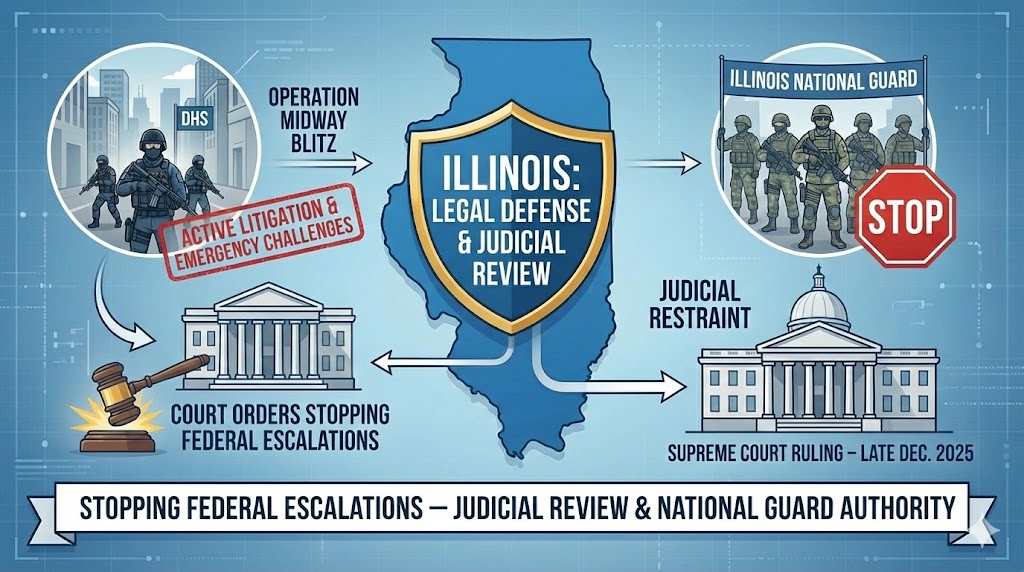
Illinois is the second front, and it demonstrates a different but equally powerful tool: stopping federal escalations through court orders and emergency litigation. Illinois has been involved in active litigation over federal immigration operations, including challenges connected to Operation Midway Blitz, and that legal terrain is evolving rapidly as cases advance, stall, or get dismissed on procedural grounds. However, the strategic signal is unmistakable: the state is not accepting the premise that federal agencies get to run tactics that destabilize local governance without judicial review. Even more important, the Illinois National Guard fight proves that the “troops will be activated” threat is not a constitutional trump card. In late December 2025, the Supreme Court refused to grant the federal government emergency relief that would have allowed a National Guard deployment in Illinois while litigation continued, leaving in place a lower-court restraint at that stage. That is not the end of the merits, but it is a concrete demonstration that “federalize the Guard” is not an automatic move that the judiciary will wave through merely because the executive asserts it.
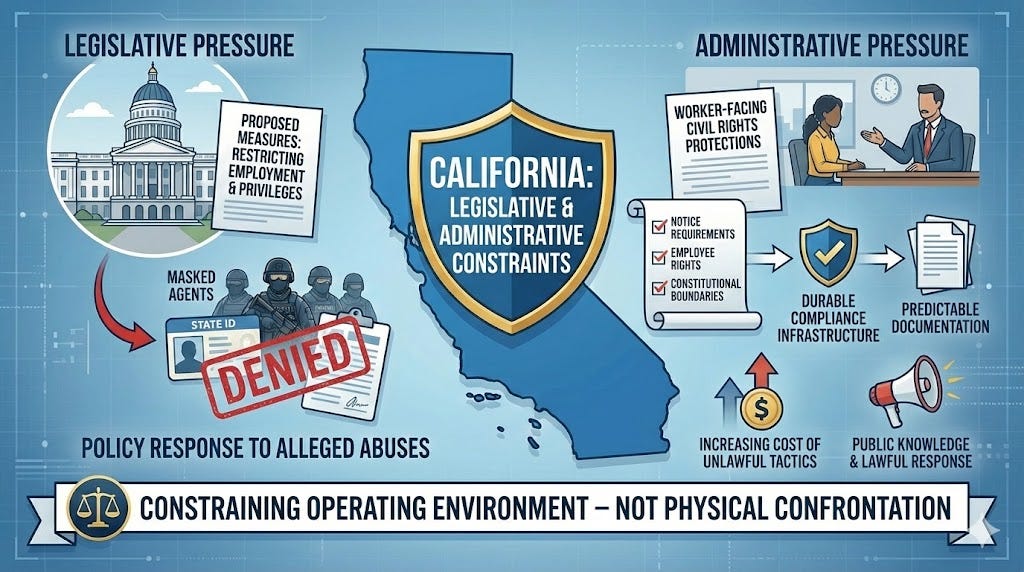
California is showing a third model: legislative and administrative pressure that constrains the operating environment without staging physical confrontation. In January 2026, California political leaders are openly discussing measures designed to make masked or unidentified federal agents harder to integrate into state systems and harder to normalize as routine actors in civic life. That posture includes proposals and public commitments aimed at restricting state employment pathways and state-issued privileges for federal immigration personnel as a policy response to alleged abuses. In parallel, California is tightening worker-facing civil-rights protections in the workplace context through notice requirements designed to ensure employees understand their rights during immigration-related inspections and understand the constitutional boundaries that still apply at work. This approach matters because it scales. It does not depend on a single dramatic incident. It builds durable compliance infrastructure, creates predictable documentation, and raises the cost of unlawful tactics by increasing the likelihood that the public knows what is happening and how to respond lawfully.
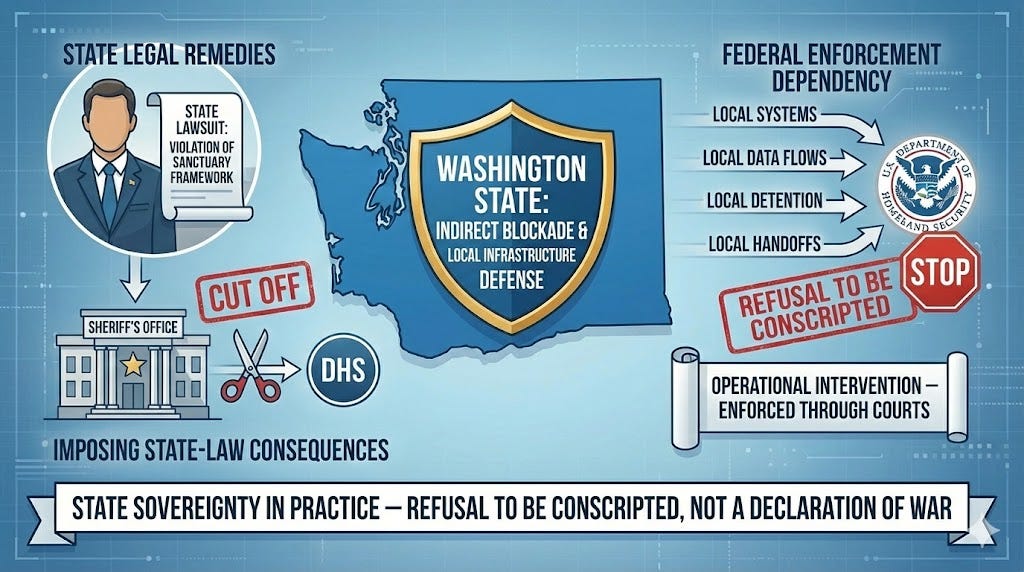
Washington State adds the fourth model, and it is the one most states overlook: the state can block federal enforcement capacity indirectly by cutting off local infrastructure and imposing state-law consequences on local officials who collaborate beyond what state law allows. Washington’s Attorney General has sued an in-state sheriff’s office over cooperation with federal immigration enforcement that the state alleges violates Washington’s sanctuary-state framework. This is not symbolic. It is an operational intervention. Federal agencies rely on local systems, local handoffs, local data flows, and local detention practices, and states can lawfully shut down those conduits inside state law when state law prohibits them. That is how state sovereignty operates in practice. It is not a declaration of war. It is a refusal to be conscripted, enforced through courts and state legal remedies.
Put these January 2026 fronts together and the message becomes unmistakable. The Supremacy Clause is not a permission slip for unconstitutional searches, warrantless entries, or excessive force, and courts are willing to say so. Removal to federal court is not a magic eraser, and states can still put facts and law in front of judges. Anti-commandeering is not a talking point, and states can refuse to become the machinery of federal enforcement. Legislative and administrative levers are not “soft” power, and they can materially alter how federal operations function inside a state. The intimidation script says states are powerless and must submit. The record being built in courtrooms right now says the opposite. The states that win will be the states that stay disciplined, stay lawful, document everything, and force every overreach into a forum where the rule of law actually applies.
CONCLUSION: PHILADELPHIA JUST CRUSHED THE “FEDERAL LAW TRUMPS STATE LAW” MYTH IN REAL TIME
Anyone still chanting “federal law trumps state law” as if it ends the conversation is not arguing civics. They are arguing for impunity. The fastest way to end that fantasy is to point to what is happening right now in Philadelphia, where the city’s top prosecutor and the city’s sheriff have put federal agents on notice in plain language: a federal badge is not a license to commit crimes inside a jurisdiction.
Philadelphia’s District Attorney, Larry Krasner, did not speak in abstractions. He issued a direct warning that if federal agents commit crimes in Philadelphia, local authorities will arrest them, put them in restraints, and seek convictions in court. This is not “obstruction” in any serious legal sense. This is the core function of local sovereignty inside a constitutional system: enforcing criminal law against unlawful conduct, regardless of who commits it.
The reason this matters is not just the rhetoric. It is the structural limit it exposes. A president cannot pardon state convictions. That is not a talking point. That is a hard boundary on federal power. It means that when a federal agent crosses the line into state crimes like assault or homicide, the federal political apparatus cannot simply wave it away with a pardon. The case becomes a matter of state criminal law, state courts, state juries, and state prison time, subject to due process and the real evidentiary standard of proof beyond a reasonable doubt.
Philadelphia’s Sheriff, Rochelle Bilal, reinforced the same message from the enforcement side of the system: if agents come into the city and commit crimes, they will not be able to hide behind federal branding. That alignment is the part state officials should study. Prosecutors can announce the standard, but law enforcement must be prepared to apply it lawfully and professionally, based on probable cause, evidence preservation, and clean procedure. When the prosecutor and the enforcer signal the same line, the signal becomes operational rather than performative.
This is the disciplined model for state and local leadership in 2026. You do not need reckless calls for mass confrontations, and you do not need slogans that pretend federal supremacy makes federal actors untouchable. You need a bright line that every court recognizes: lawful federal duties are protected; unlawful conduct is prosecutable. You need officials who are willing to say, out loud, that constitutional rights and state criminal law still apply, and you need systems that can document misconduct, preserve evidence, and survive removal fights and immunity claims without collapsing into chaos.
The intimidation script says states and cities must submit or be labeled “seditionists.” Philadelphia’s posture shows the opposite. The constitutional middle is not submission, and it is not anarchy. The constitutional middle is lawful accountability that does not flinch. If federal agents act like criminals, the response is not rhetoric. The response is process, arrest authority grounded in probable cause, prosecution grounded in evidence, and punishment grounded in lawful convictions. That is not a revolution against the Constitution. That is the Constitution doing what it was designed to do.
In re Neagle (Cunningham v. Neagle), 135 U.S. 1 (1890), Supreme Court opinion establishing the core Supremacy Clause immunity framing for federal officers acting within authorized duties.
28 U.S.C. § 1442, federal officer removal statute, including application to “criminal prosecution” and removal into federal district court.
Mesa v. California, 489 U.S. 121 (1989), Supreme Court opinion holding that federal officer removal requires an asserted federal defense.
New York v. United States, 505 U.S. 144 (1992), and Printz v. United States, 521 U.S. 898 (1997), Supreme Court opinions grounding the anti-commandeering doctrine.
Murphy v. NCAA, 584 U.S. ___ (2018), Supreme Court opinion reaffirming anti-commandeering limits.
Tarble’s Case, 80 U.S. 397 (1871), and Ableman v. Booth, 62 U.S. 506 (1859), Supreme Court opinions limiting state judicial interference with federal custody via state habeas mechanisms.
18 U.S.C. § 2384 (seditious conspiracy) and 18 U.S.C. § 2383 (rebellion or insurrection), statutory elements that show why casual “sedition” talk is typically legally incoherent.
Brennan Center explainers on the Insurrection Act and Posse Comitatus, providing accessible summaries of statutory structure and constraints on domestic military deployment.
Associated Press and Washington Post reporting on recent federal-state tensions and Insurrection Act threats in Minnesota, illustrating how these doctrines surface in contemporary conflicts.
Printz v. United States, 521 U.S. 898 (1997).
Anti-Commandeering Doctrine, U.S. Constitution Annotated (Library of Congress).
Congress.gov, S.2070 (119th Congress): “Insurrection Act of 2025” (bill text).
Associated Press reporting on January 2026 Insurrection Act threats and federal-state tensions.
City of Minneapolis, “State of Minnesota, Minneapolis and Saint Paul sue to halt ICE surge into Minnesota” (January 12, 2026).
Minnesota Attorney General filing, “Complaint for Declaratory and Injunctive Relief” in State of Minnesota, Minneapolis, and Saint Paul v. DHS officials (filed January 12, 2026), including the asserted “over 2,000” deployment claim and the January 7, 2026 reference to Renee Good.
Wired, “US Judge Rules ICE Raids Require Judicial Warrants, Contradicting Secret ICE Memo” (reporting on the January 17 ruling).
Associated Press, “Memo tells ICE officers they can enter homes without a judge’s warrant” (on administrative warrants and alleged home-entry authority).
Courthouse News Service, “Minnesota, Illinois sue Trump admin over ICE occupation” (January 12, 2026).
Courthouse News Service, “Protesters’ case against Operation Midway Blitz in Illinois stalls” (January 22, 2026).
U.S. Supreme Court, emergency docket order in Trump v. Illinois (Dec. 23, 2025), leaving a lower-court restraint in place at that stage.
SCOTUSblog, coverage of the Supreme Court action on the Illinois National Guard deployment dispute (Dec. 23, 2025).
San Francisco Chronicle, reporting on Eric Swalwell’s proposed California posture toward ICE agents and state privileges/employment (January 2026).
California employer notice materials and compliance summaries regarding the Workplace Know Your Rights Act and the February 1, 2026 notice effective date.
Washington State Office of the Attorney General press release, “Washington state sues Adams County to stop illegal federal immigration enforcement” (March 10, 2025), illustrating the state-law strategy to restrict local cooperation and enforce state limits.
WHYY, “Philly DA, sheriff say ICE agents could be criminally charged” (Jan. 14, 2026): https://whyy.org/articles/philadelphia-ice-agents-rochelle-bilal-larry-krasner/
NBC Philadelphia, “Philly officials discuss public safety amid ICE activity” (Jan. 14, 2026): https://www.nbcphiladelphia.com/news/local/watch-city-officials-talk-public-safety-amid-ice-activity-in-philly-courts/4332917/
The Guardian, “‘You don’t want this smoke’: US sheriff reflects on her viral remarks about ICE” (Jan. 17, 2026): https://www.theguardian.com/us-news/2026/jan/17/philadelphia-sheriff-viral-remarks-ice
X (Larry Krasner official account), post amplifying the warning (Jan. 2026):
