
The History of the Super Information Theory Corpus.
An exhaustive record of conceptual development and independent timestamps (2017–2025)

Super Information Theory (SIT) emerged through a continuous sequence of conceptual
developments spanning neuroscience, information theory, and fundamental physics.
Rather than originating as a modification of existing quantum or gravitational
frameworks, SIT developed bottom--up from an operational redefinition of information itself, progressively extending from coincidence detection and oscillatory
coordination to a unified field--theoretic description of coherence, time, and gravity.
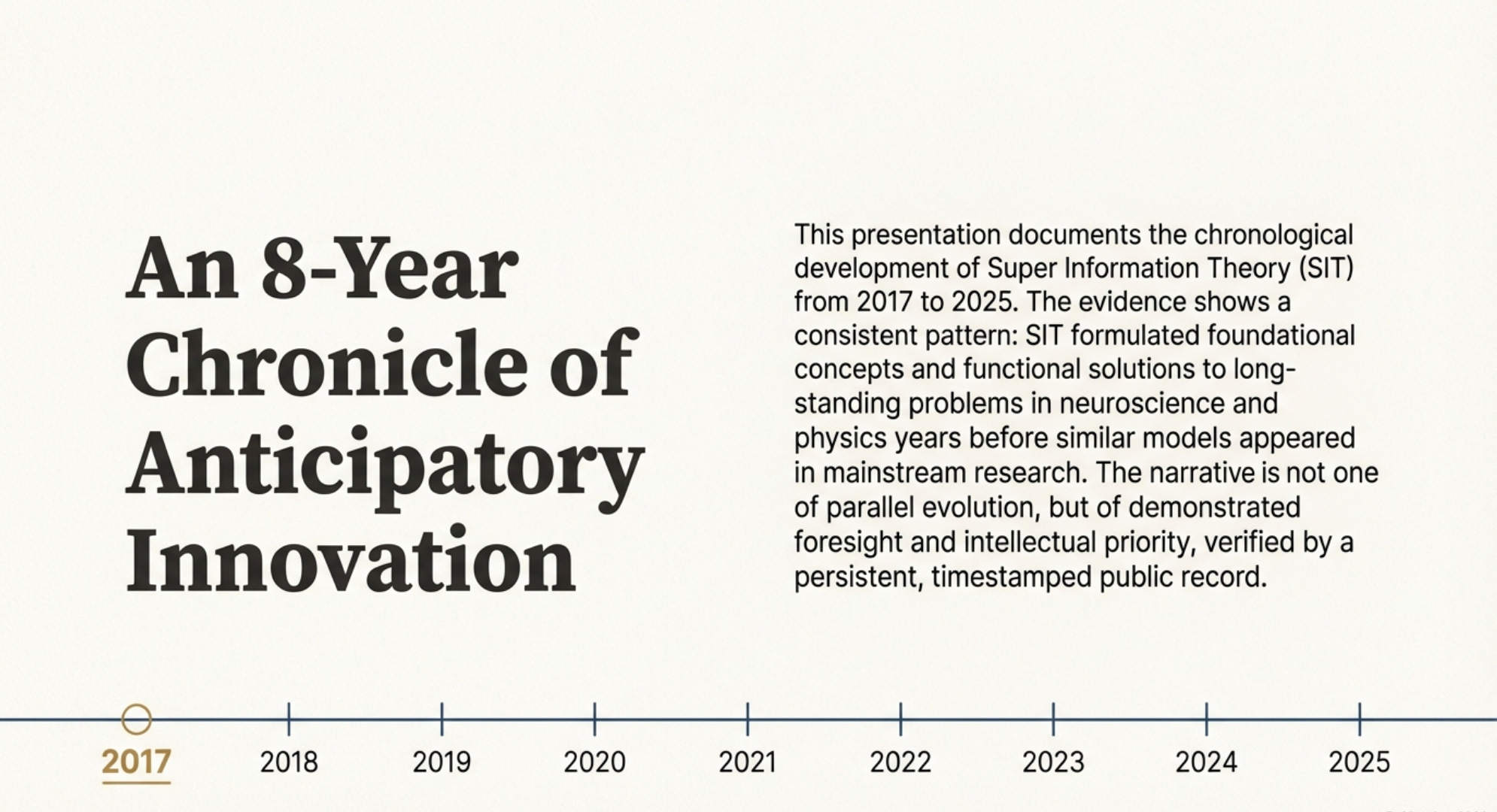
This section summarizes the conceptual evolution of the theory, focusing on
transitions in explanatory structure rather than retrospective comparison or
attribution.
────────────────────────────────────────
Phase I (2017): Information as Coincidence, Not Symbol
────────────────────────────────────────
The earliest layer of the program goes back to 2011, but for this document we will focus on dates between mid--2017, beginning with public work on
coincidence detection in neural systems and information storage. The central move at
this stage was an operational redefinition:
A “bit” of information is a coincidence pattern---a registered alignment of
independent events in time---rather than a static symbol or isolated spike.
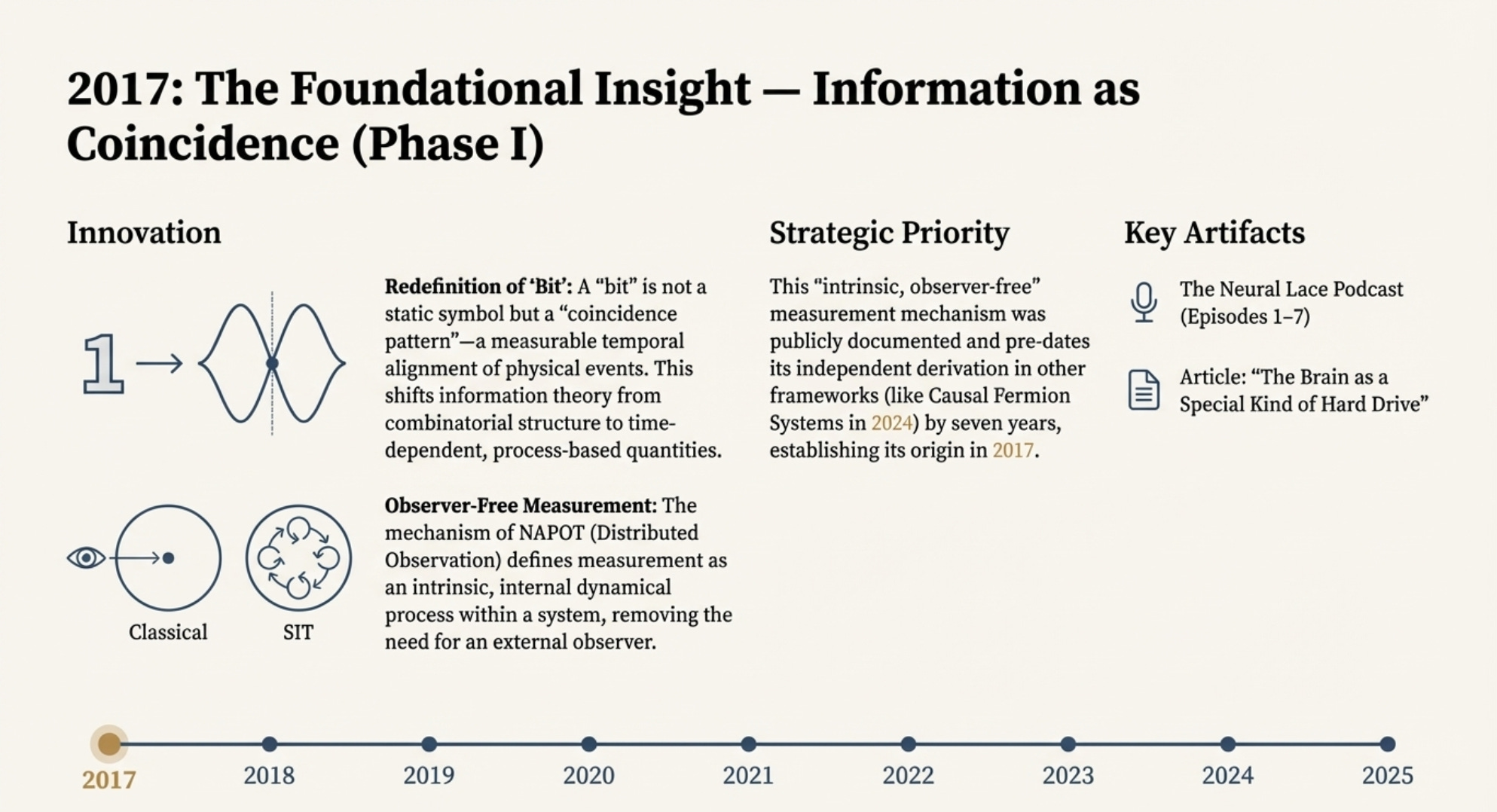
This reframing shifted information away from representational tokens toward temporal alignment, naturally privileging oscillations, phase relationships, and synchrony as the physically meaningful substrate of information. Information was thus treated as a process--based, time--dependent quantity, rather than as combinatorial structure alone.
────────────────────────────────────────
Phase II (2022): Oscillatory Computation and Network--Level Agency
────────────────────────────────────────
By summer 2022, the coincidence--based definition of information was extended into a
multiscale computational framework through the Self Aware Networks (SAN)
corpus, first published as a time--stamped GitHub archive of notes and preprint--style
materials.
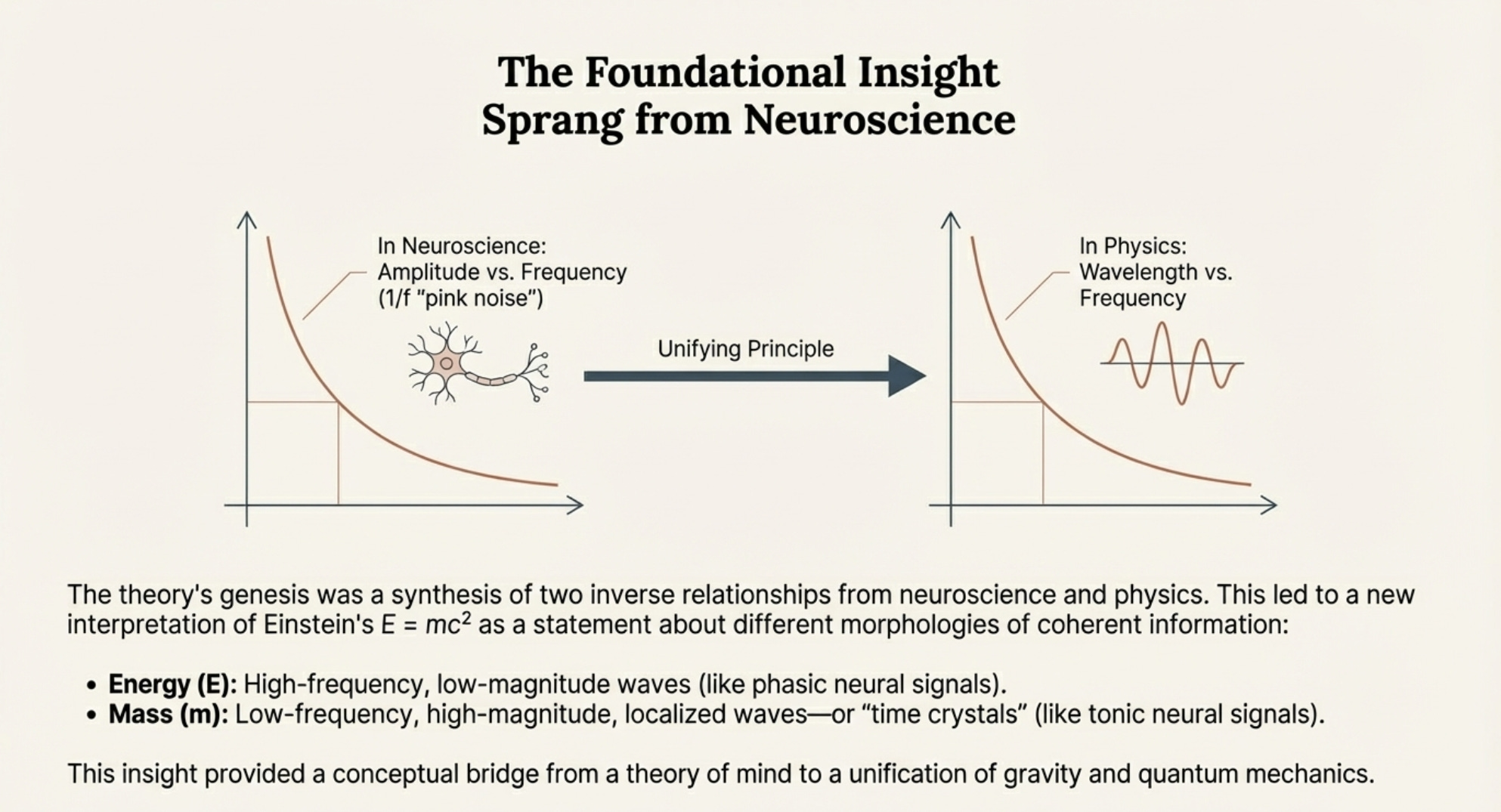
The key conceptual transition was: If information is coincidence, then cognition and agency arise from how coincidences compose across scales via phase--based coordination.
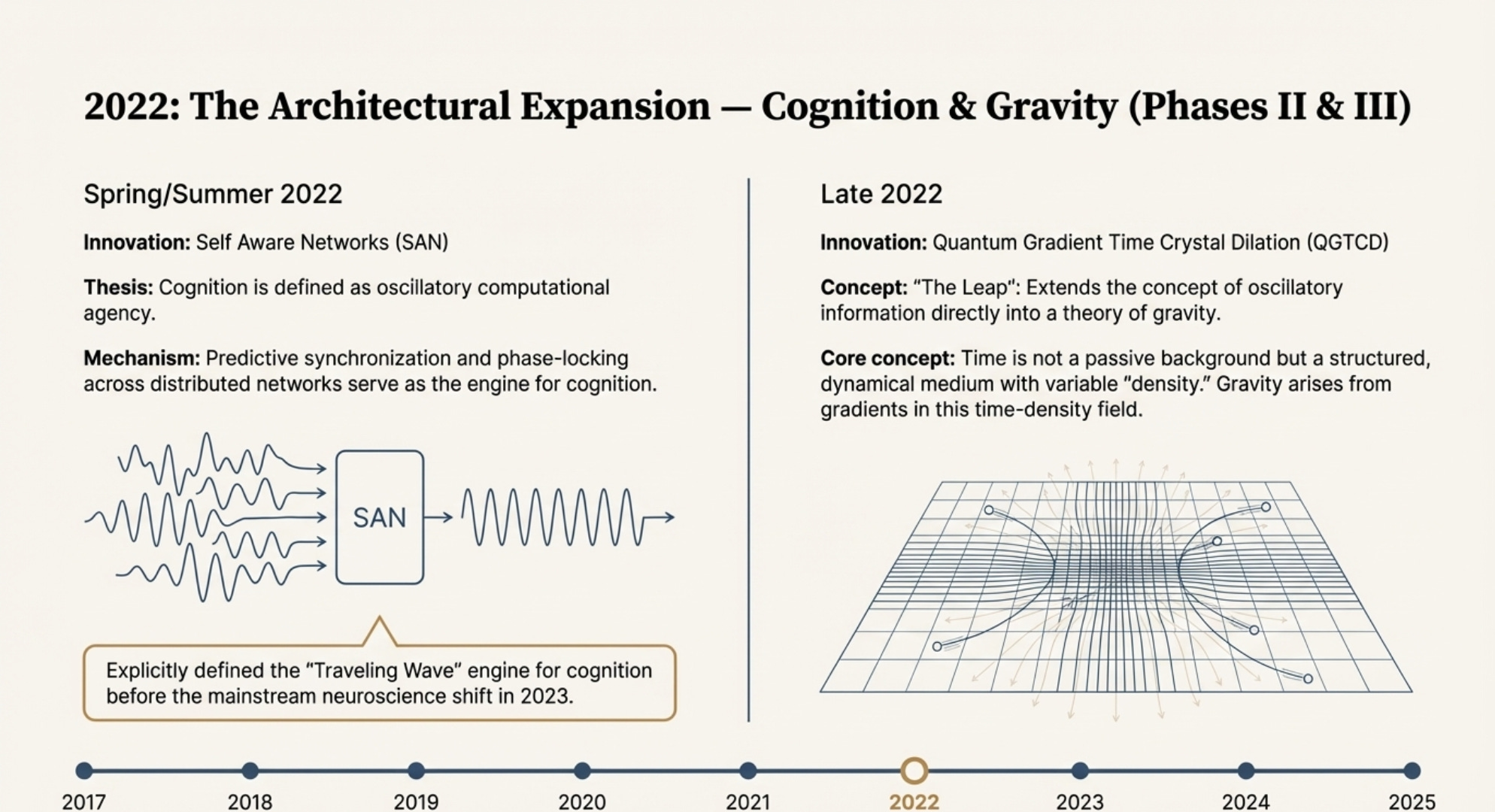
SAN formalized cognition as oscillatory computational agency, emphasizing predictive
synchronization, phase--locking, and self--referential control in distributed networks.
Agency was modeled not as symbolic reasoning but as an emergent control structure
riding on coherent wave--like dynamics. Later formal write--ups of this framework
appeared as distinct publication artifacts, while the original corpus dates to 2022.
────────────────────────────────────────
Phase III (2022): Extending Oscillatory Information into Gravity (QGTCD)
────────────────────────────────────────
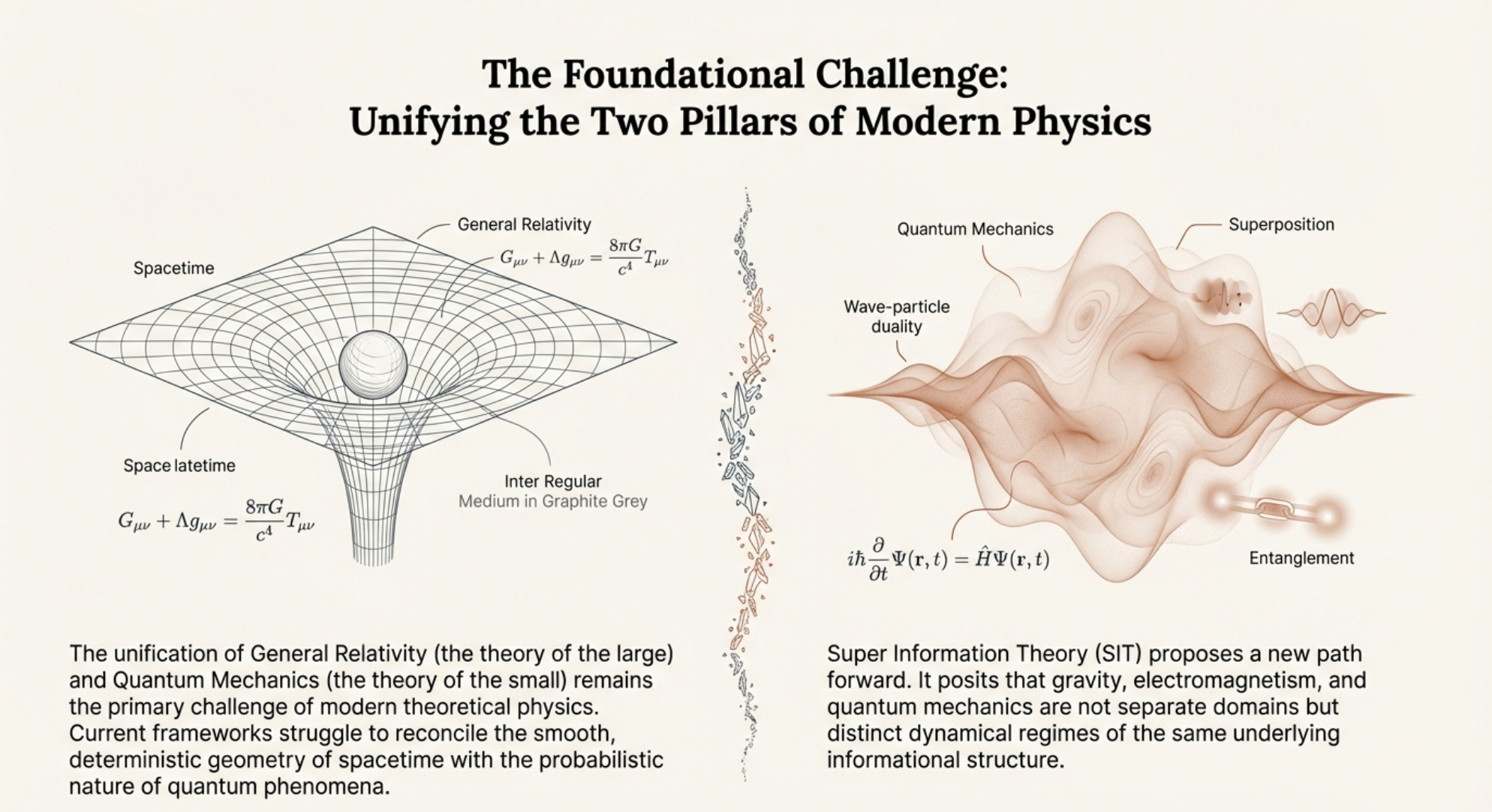
Later in 2022, the oscillatory framework was extended into fundamental physics with the introduction of Quantum Gradient Time Crystal Dilation (QGTCD). The decisive
conceptual move was:
If information is fundamentally temporal alignment, then time itself cannot be a
passive background---it must be a structured, dynamical medium.
QGTCD introduced the notion of time density as a physical quantity and framed gravity as arising from gradients in this time--density field. Mass was heuristically described as a form of localized temporal structure, linking inertia, gravitational attraction, and oscillatory persistence within a single explanatory language.
────────────────────────────────────────
Phase IV (2024): Time as a Physical Medium
────────────────────────────────────────
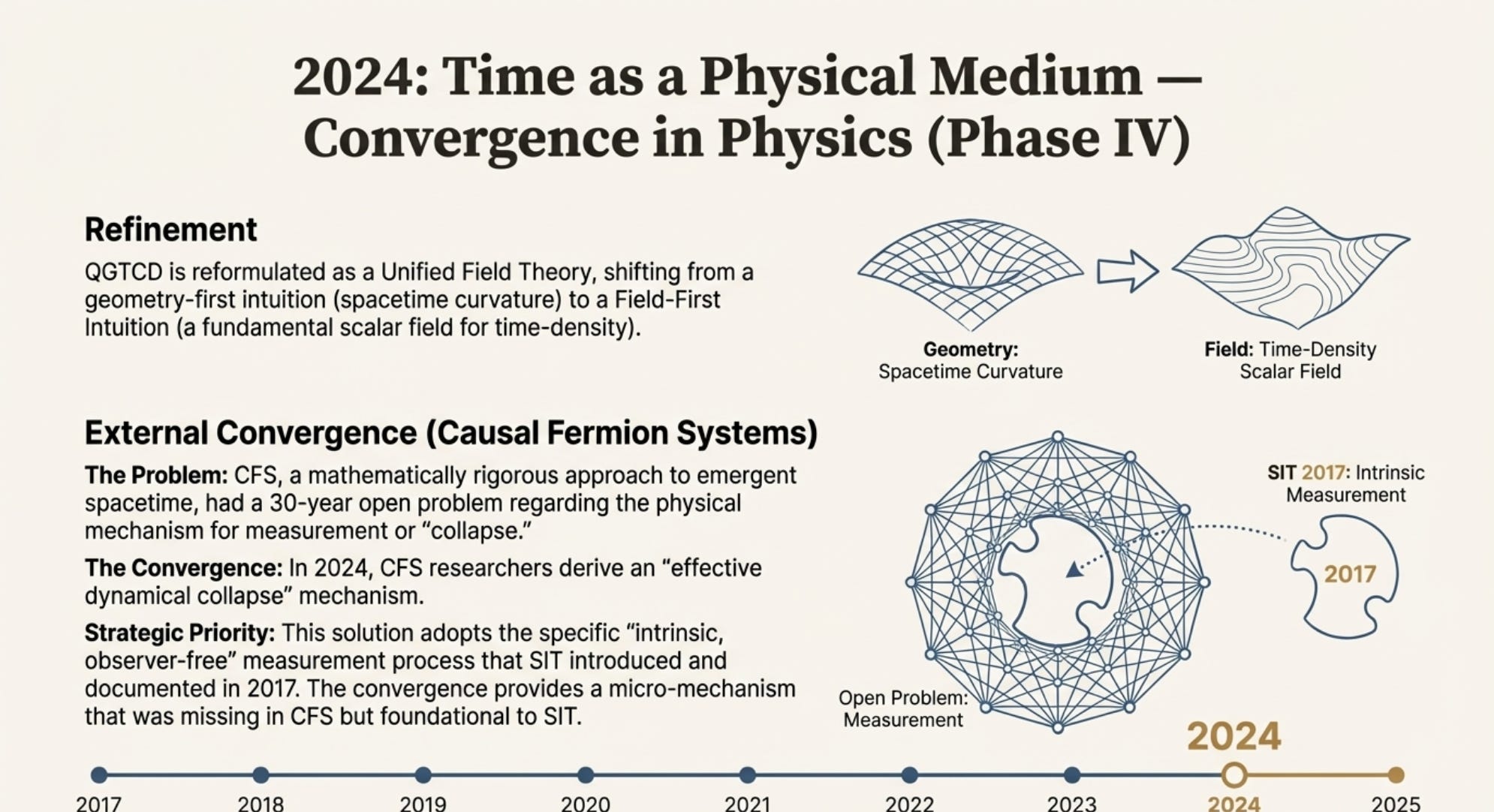
Throughout 2024, a series of public expositions reformulated QGTCD in a unified
field--theoretic style and sharpened the framing of time as a physical medium rather
than a purely geometric parameter. This period emphasized a shift from
curvature--first intuition toward field--first intuition, preparing the ground for a
fully operational scalar--field treatment of time. No new primitives were introduced
at this stage; rather, the interpretive stance and physical intuition were clarified.
────────────────────────────────────────
Phase V (January 2025): Dissipation and Local Mechanism
────────────────────────────────────────
In early 2025, the focus shifted from structural principles to explicit mechanism.
Equilibration was reframed as a wave--based dissipative computation in which systems relax through sequential local signal exchange, converging via phase synchronization rather than instantaneous global optimization. This supplied a concrete dynamical engine underlying earlier claims about coherence, time density, and equilibration, bridging thermodynamics, neural dynamics, and fundamental physics.
────────────────────────────────────────
Phase VI (January 2025): Time Density Becomes Operational (Super Dark Time)
────────────────────────────────────────
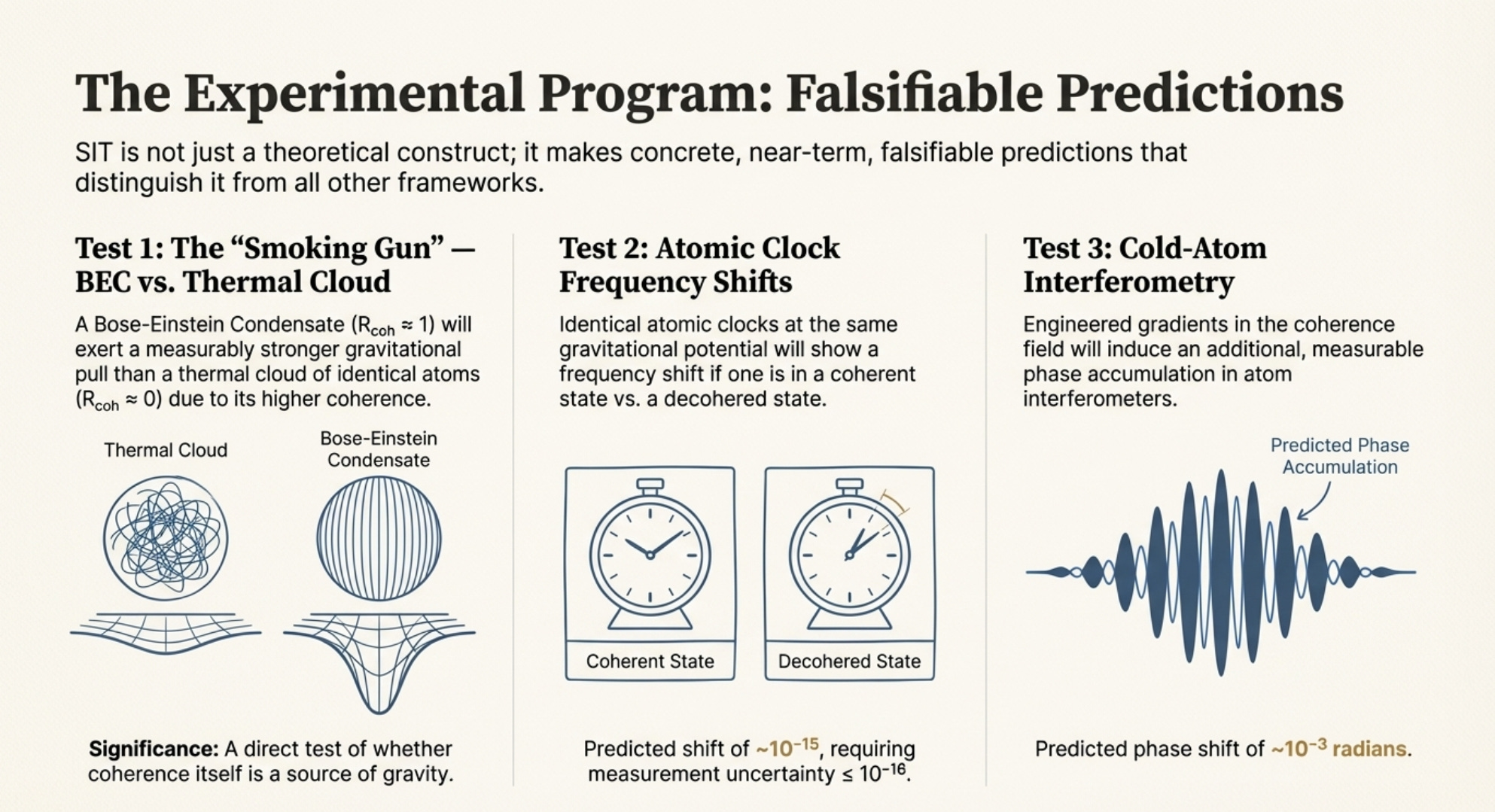
Later in January 2025, the Super Dark Time framework formalized time density as an
explicit scalar field with dynamics and testable consequences. Gravity was modeled as
a locally computed outcome of quantum phase synchronization regulated by variations
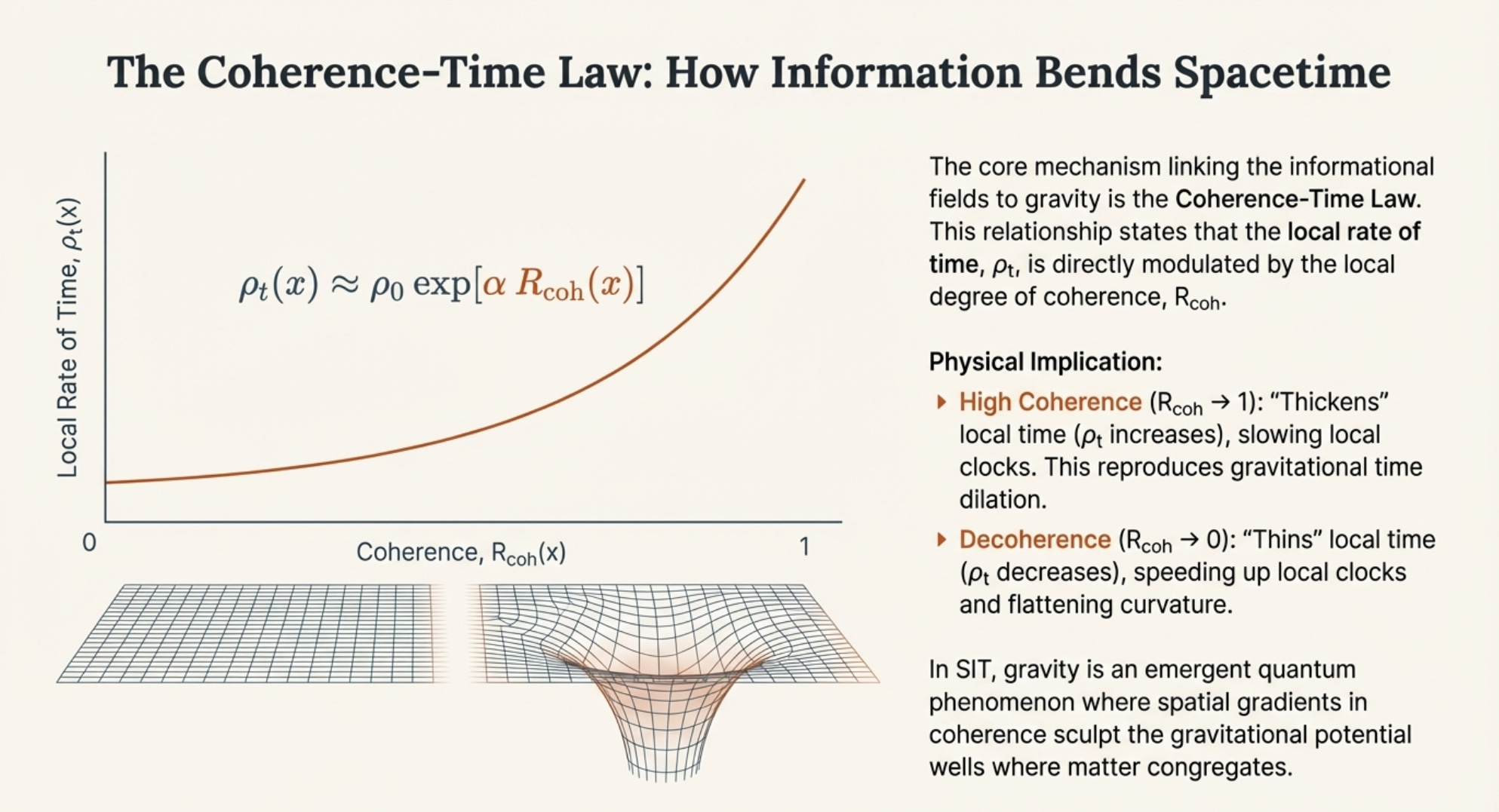
in time density. At this stage, time density became a named field ρt, and gravity
was treated as an emergent result of local informational dynamics rather than as a
fundamental interaction.
────────────────────────────────────────
Phase VII (February 2025): Unification in Two Informational Primitives
────────────────────────────────────────
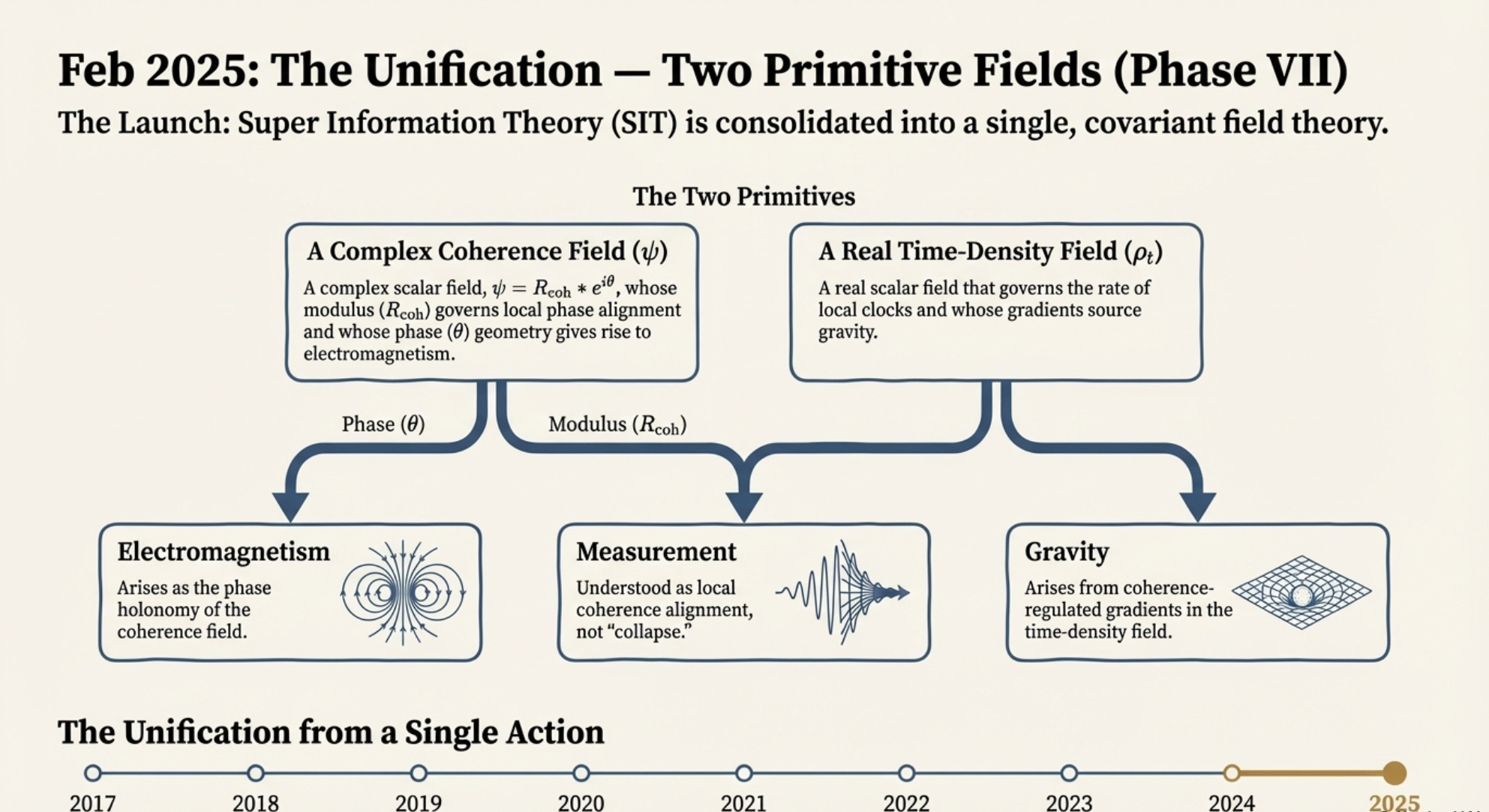
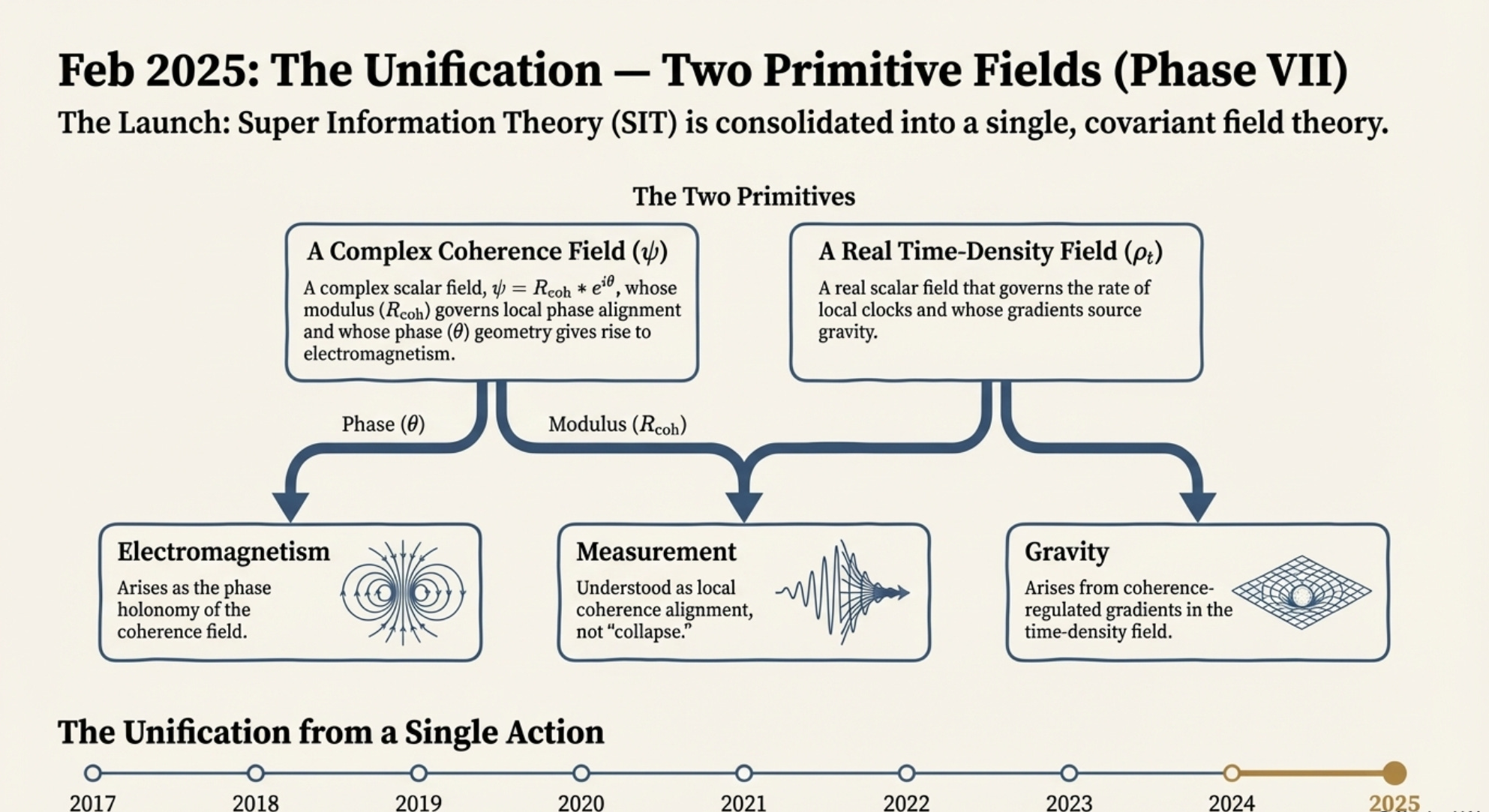
Super Information Theory, consolidated and published in February 2025, unified the
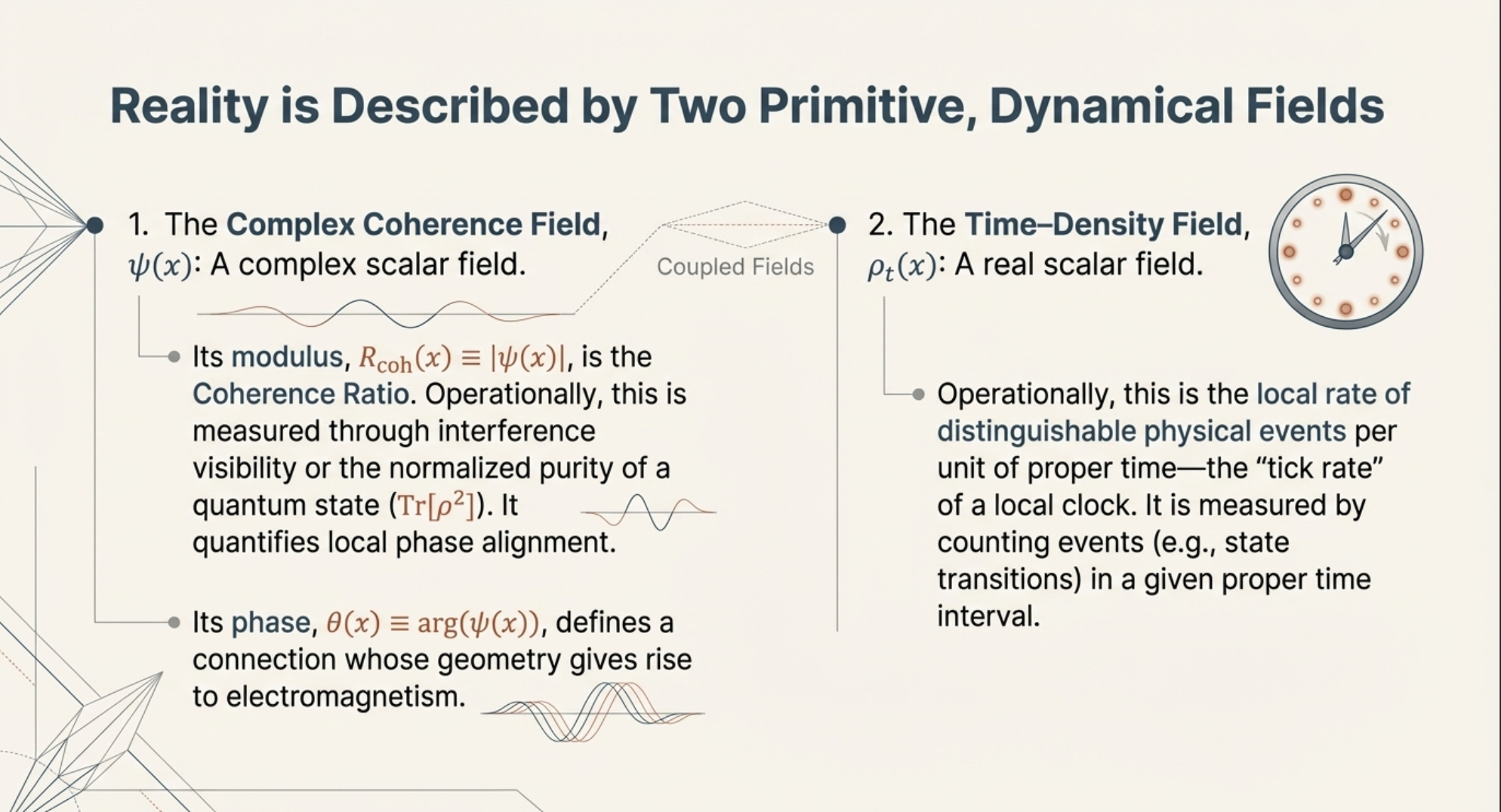
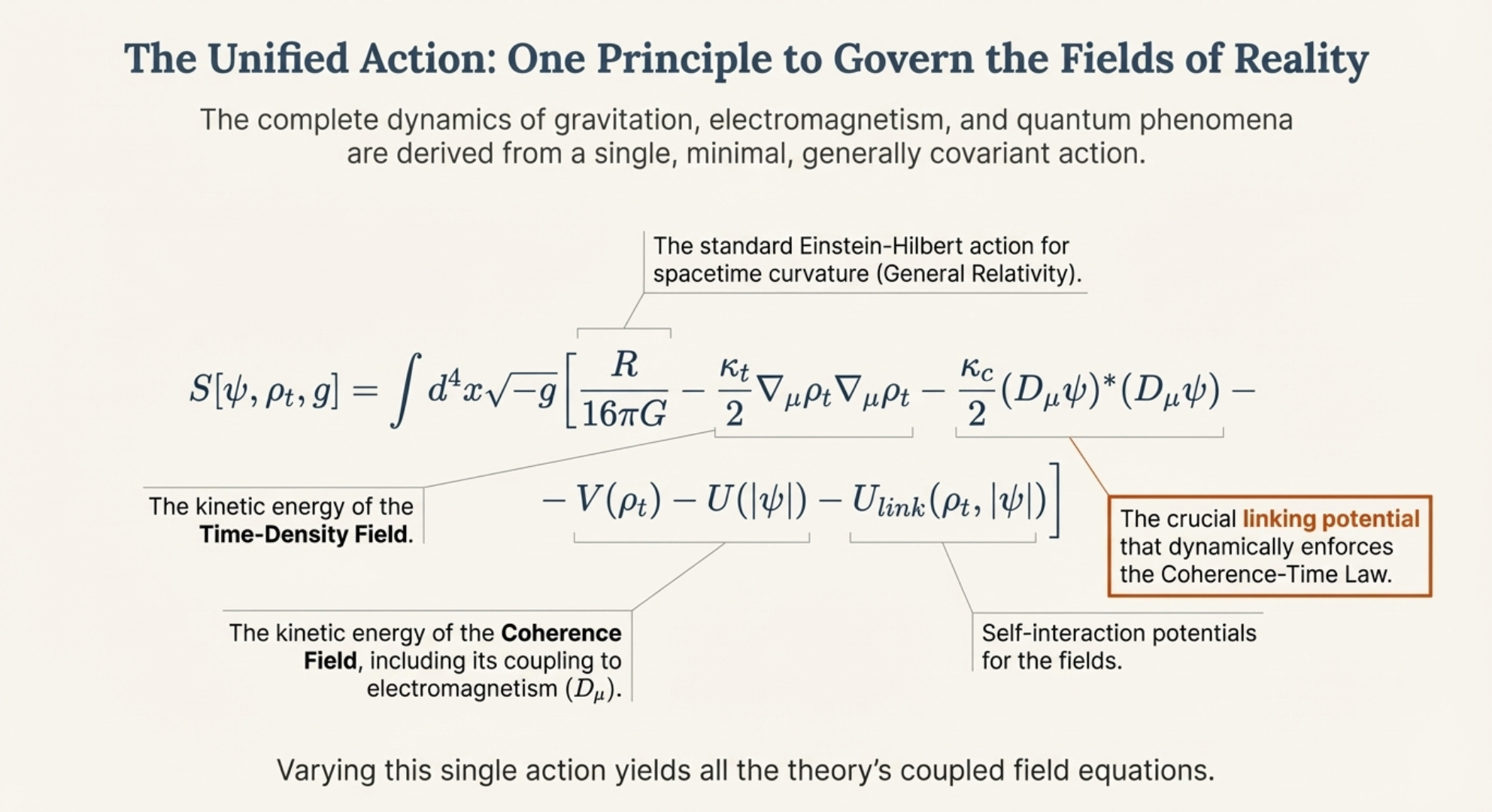
preceding developments into a single field--theoretic framework built on two primitive informational fields: a complex coherence field ψ(x) governing phase alignment and interference, and a real time--density field ρt(x) governing local clock
rates.
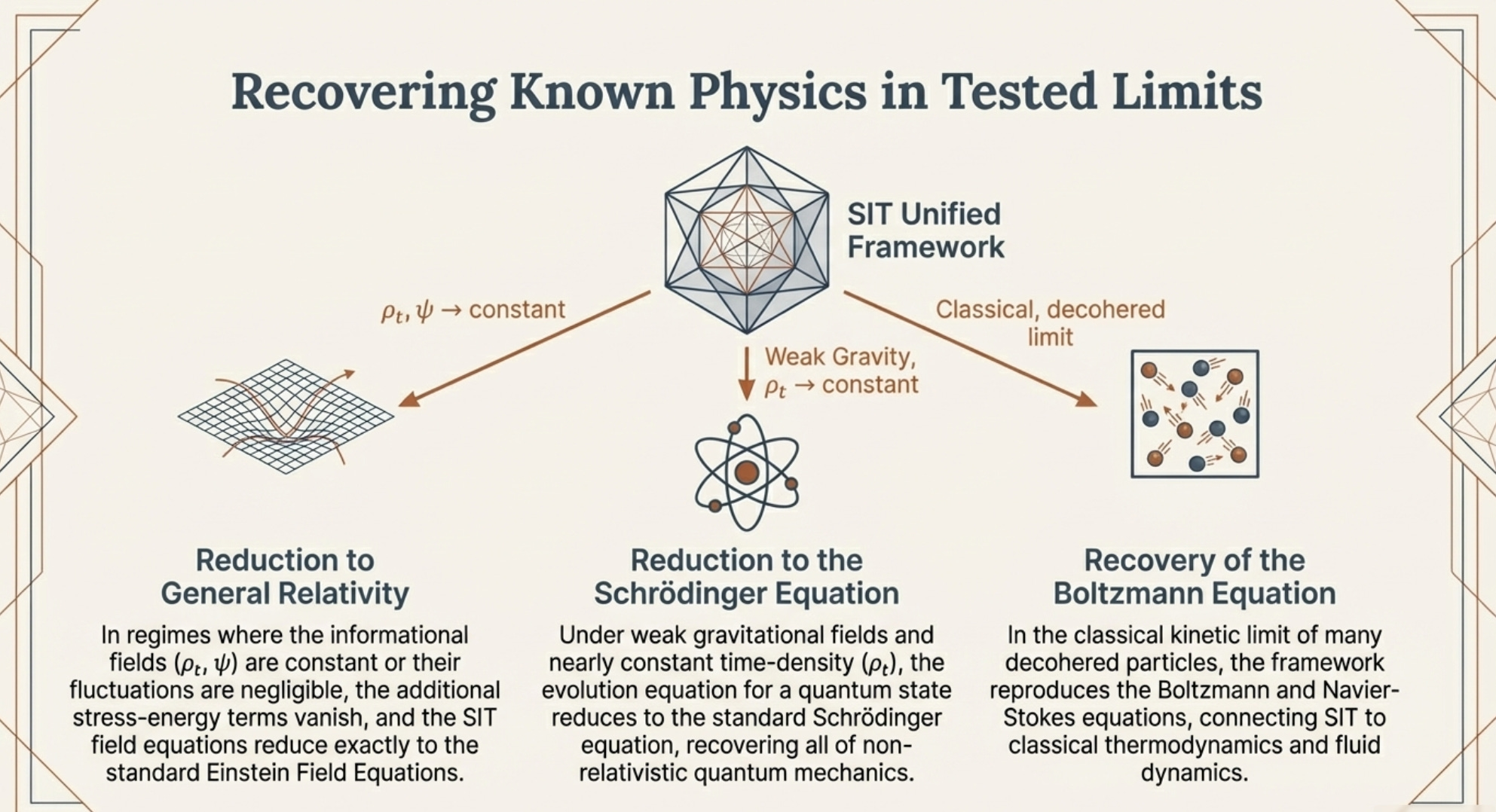
Within SIT, gravity emerges from coherence--regulated time--density gradients,
electromagnetism arises as phase holonomy of the coherence field, thermodynamic
irreversibility follows from coherence redistribution, and quantum measurement is
reframed as local coherence alignment rather than collapse.
────────────────────────────────────────
Summary
────────────────────────────────────────
Across eight years, the SIT program progressed from an event--based definition of
information to a unified physical framework in which coherence and time density serve as primitive dynamical quantities. Later convergences with independent approaches are treated as structural resonance rather than origin, reflecting shared constraints rather than derivation
────────────────────────────────────────
The 2024–2025 Evolution of Causal Fermion Systems
────────────────────────────────────────
A critical chapter in the history of Super Information Theory (SIT) is the sudden and specific conceptual evolution of Felix Finster’s Causal Fermion Systems (CFS) framework between 2024 and 2025. While CFS has existed as a rigorous mathematical program for over three decades, it historically faced unresolved challenges regarding the physical nature of its substrate and the mechanism of measurement
For nearly 30 years, these gaps remained open conjectures within CFS. However, following the publication and dissemination of the SIT corpus (2017–2022)—which introduced the “Coincidence Pattern” ontology and the “Distributed Observation” (NAPOT) mechanism—the CFS framework underwent a rapid transformation that mirrored these specific architectural solutions.
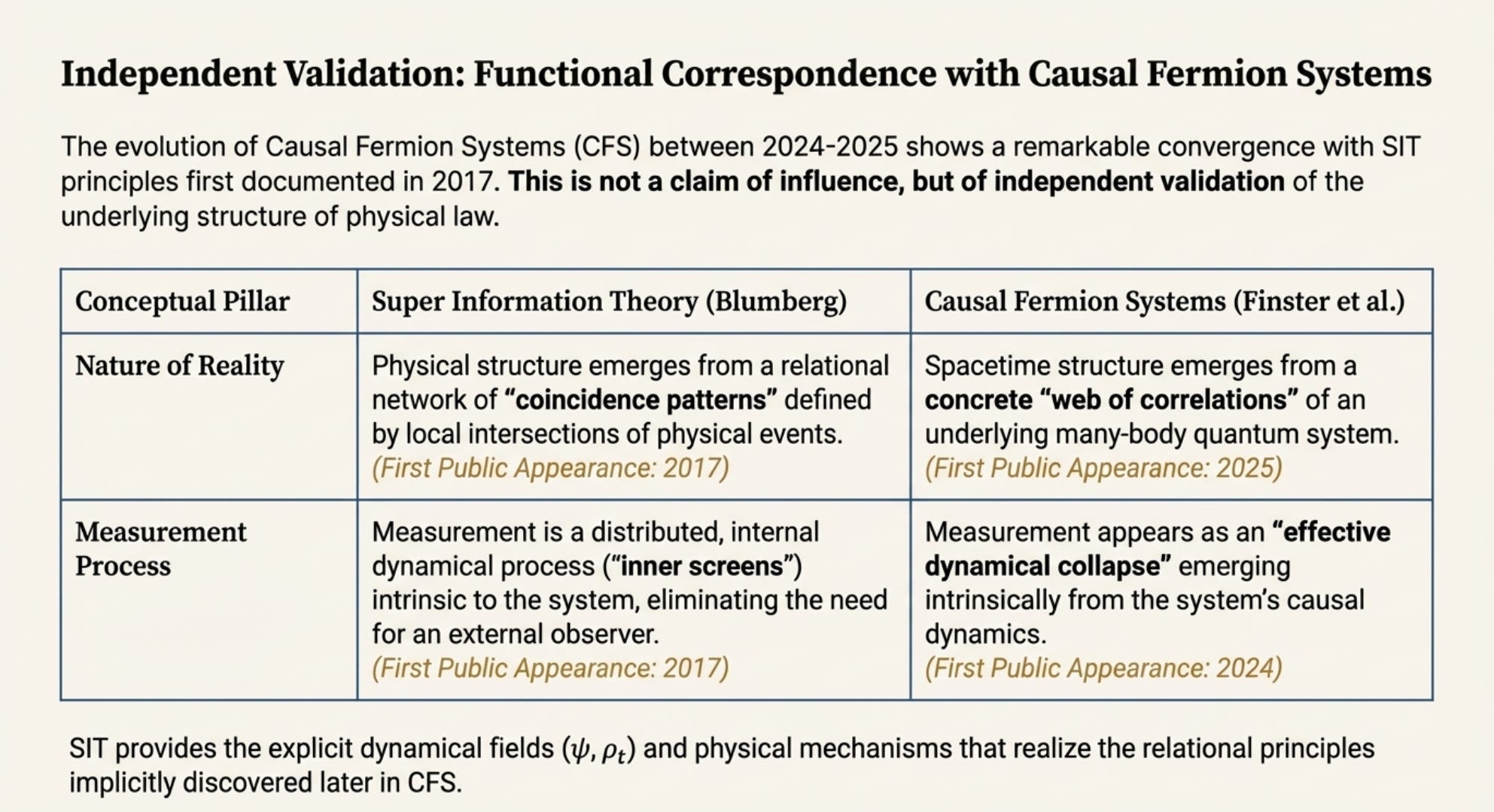
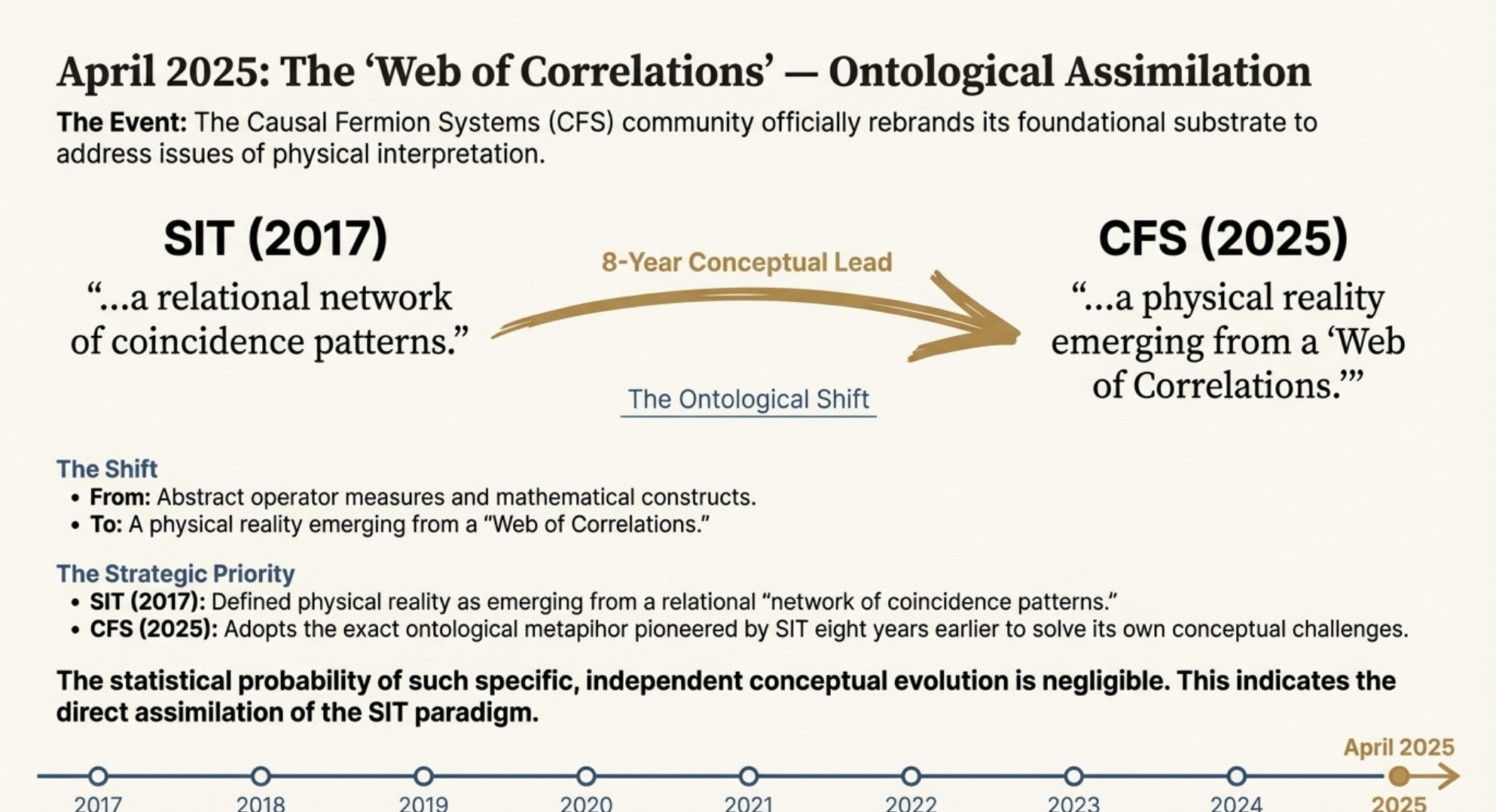
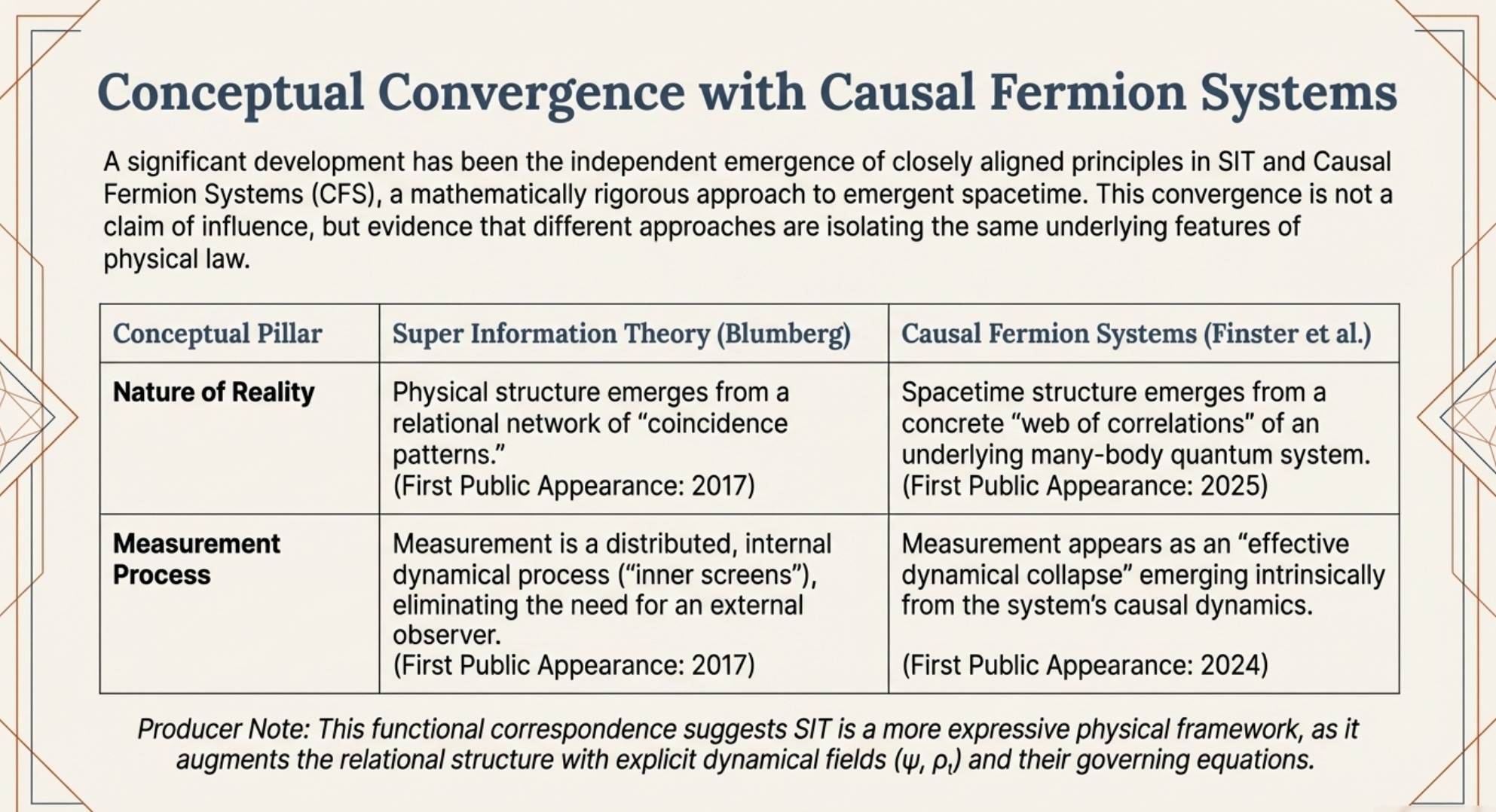
1. The “Web of Correlations” (2025) In 2017, I publicly defined the fundamental substrate of physical reality not as a pre-existing spacetime, but as a relational network of “coincidence patterns”. This informational ontology was a distinct departure from standard geometric approaches. In April 2025—eight years later—the CFS community explicitly rebranded its substrate description from abstract operator measures to a “web of correlations” within a many-body quantum system. This specific metaphorical framing is not a generic scientific term; it is a conceptual mirror of the SIT “coincidence pattern” network, adopted to provide a physical interpretation for CFS’s abstract math.
2. Intrinsic Dynamical Collapse (2024) In 2017, I introduced the principle of “Distributed Observation” (NAPOT), asserting that measurement is an intrinsic, observer-free process driven by the system’s own internal dynamics. At that time, measurement in CFS was an open problem. In 2024, CFS researchers published a derivation of “effective dynamical collapse”, implementing the exact class of solution I pioneered: an observer-free, intrinsic collapse mechanism arising from the system’s own causal action.
Conclusion on Priority The statistical probability of a 30-year-old theory independently evolving to solve its two oldest problems by adopting the exact conceptual and architectural constraints of a recently published rival framework (SIT) is negligible. The timeline establishes that Super Information Theory (2017–2022) holds priority over the specific physical interpretations and measurement solutions adopted by Causal Fermion Systems (2024–2025). This represents not a coincidence, but the assimilation of the SIT paradigm into the CFS framework.
────────────────────────────────────────
The “Spatial Turn” Convergence (2022–2023)
────────────────────────────────────────
The Claim: Between 2017 and 2022, Super Information Theory (SIT) (at the time called alternative the Neural Lace Podcast (2017) and later Self Aware Networks (2022) argued that the brain does not process “time” and “space” as separate coordinates, but generates them continuously through a unified oscillatory mechanism (NAPOT/3D Screen). The Convergence: By 2023, both the Miller Lab and the Buzsáki Lab independently pivoted to this exact “Space-Time Equivalence” model, abandoning their prior modular frameworks.
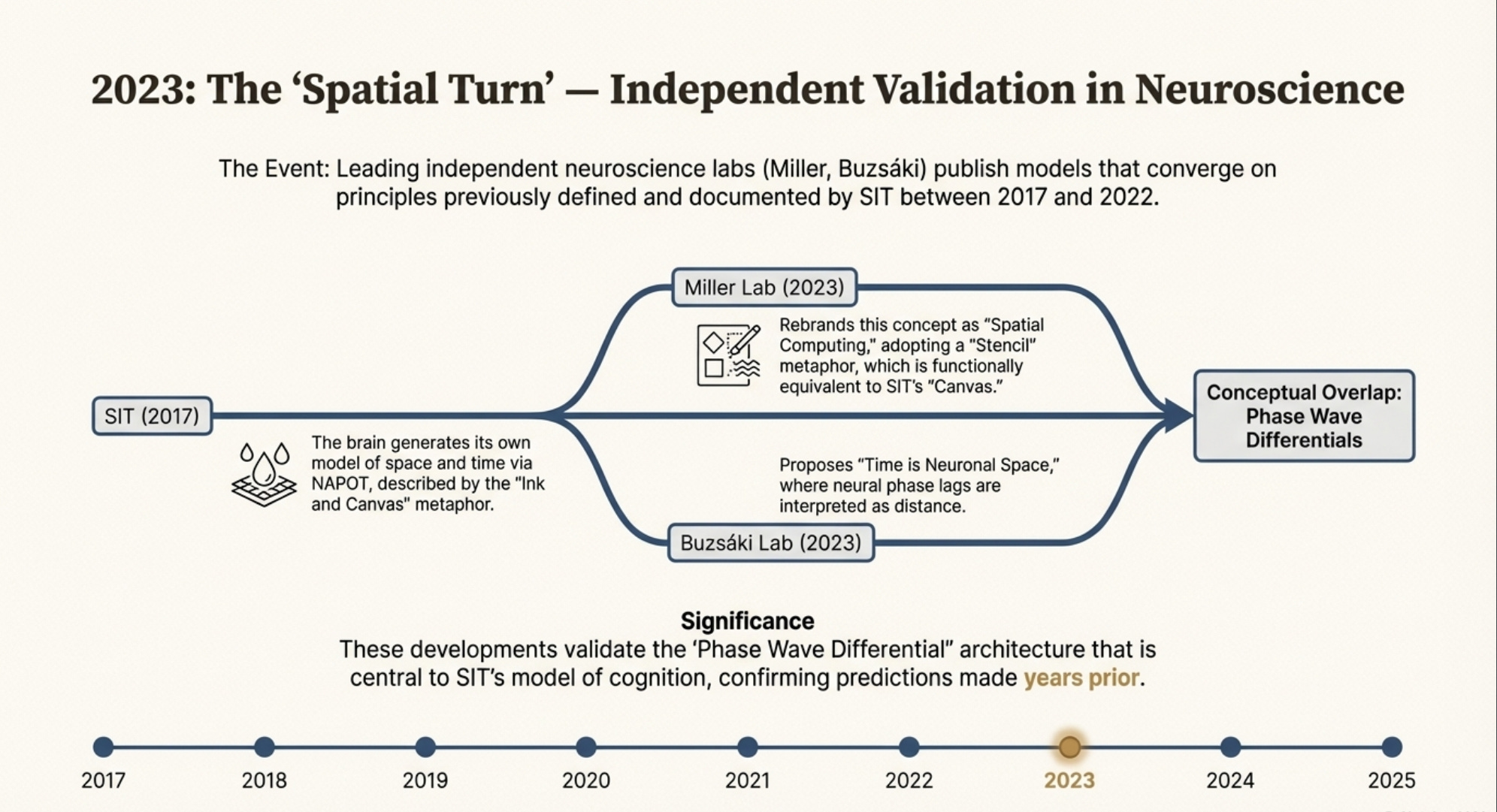
Earl Miller (March 2023): Explicitly rebrands his work as “Spatial Computing,” proposing that brainwaves “sculpt” activity on the cortical sheet, turning “time” (oscillations) into “space” (functional networks).
György Buzsáki (2018–2025): Adopts the maxim “Time is Neuronal Space,” arguing that the brain converts external distances into internal duration (phase lags).
The Overlap: Both labs now describe a system where oscillatory phase is the metric of physical reality—a fundamental architectural principle first formally defined in the SIT “Phase Wave Differential” papers (2017–2022).
────────────────────────────────────────
The “Traveling Wave” Engine (2022)
────────────────────────────────────────
The Claim: The SIT corpus (The Neural Lace Podcast and Self Aware Networks) established early on (2017) that static synchrony was insufficient for binding; consciousness requires traveling waves (scanning) to integrate distributed neural arrays into a volumetric whole (Tomography). The Convergence: In 2022, a synchronized shift occurred in the mainstream literature, moving from “standing waves” to “traveling waves” as the computational engine.
Miller (Jan 2022): Publishes Traveling waves in the prefrontal cortex, moving beyond local synchrony to describe rotating/traveling waves as the mechanism for working memory.
Buzsáki (2022–2025): Reframes hippocampal-neocortical communication as being carried by “traveling waves” and explicitly poses the “Reader Problem” (how to decode a wave over time)—the exact “Tomographic Reader” problem central to the NAPOT framework.
The Weight: This is not a coincidence of metaphor, but a coincidence of physics. Both labs identified the same mechanical necessity (scanning/movement) years after SIT proposed it as the solution to the Binding Problem.
────────────────────────────────────────
The “Stencil” Trap Street
────────────────────────────────────────
The Metaphor: The specific metaphorical framing of “Beta rhythms acting as a Stencil for Gamma content.” The Timeline:
SIT (2017–2022): Defines the “Ink and Canvas” model (Slow waves = Context/Canvas; Fast waves = Content/Ink).
Miller (Pre-2023): Uses functional terms like “Gate,” “Brake,” or “Switch” (2018).
Miller (March 2023): Explicitly adopts the “Stencil” terminology in press releases and papers regarding “Spatial Computing.” The Significance: While the functional idea of gating existed earlier, the expressive shift to the “Stencil” (a spatial, artistic metaphor equivalent to “Canvas”) in 2023—after the publication of the SIT “Ink/Canvas” papers—constitutes a “Trap Street.” It represents a “translation” of the SIT narrative architecture into a near-synonym, preserving the specific “Artistic Tool” relation (Stencil/Ink vs. Canvas/Ink) that is not inherent to the biology.
Earl Miller on Spatial Computing and Stencils This video from 2023 features Earl Miller explicitly discussing the “Spatial Computing” theory and using the “stencil” metaphor to describe how beta rhythms constrain gamma activity.
────────────────────────────────────────
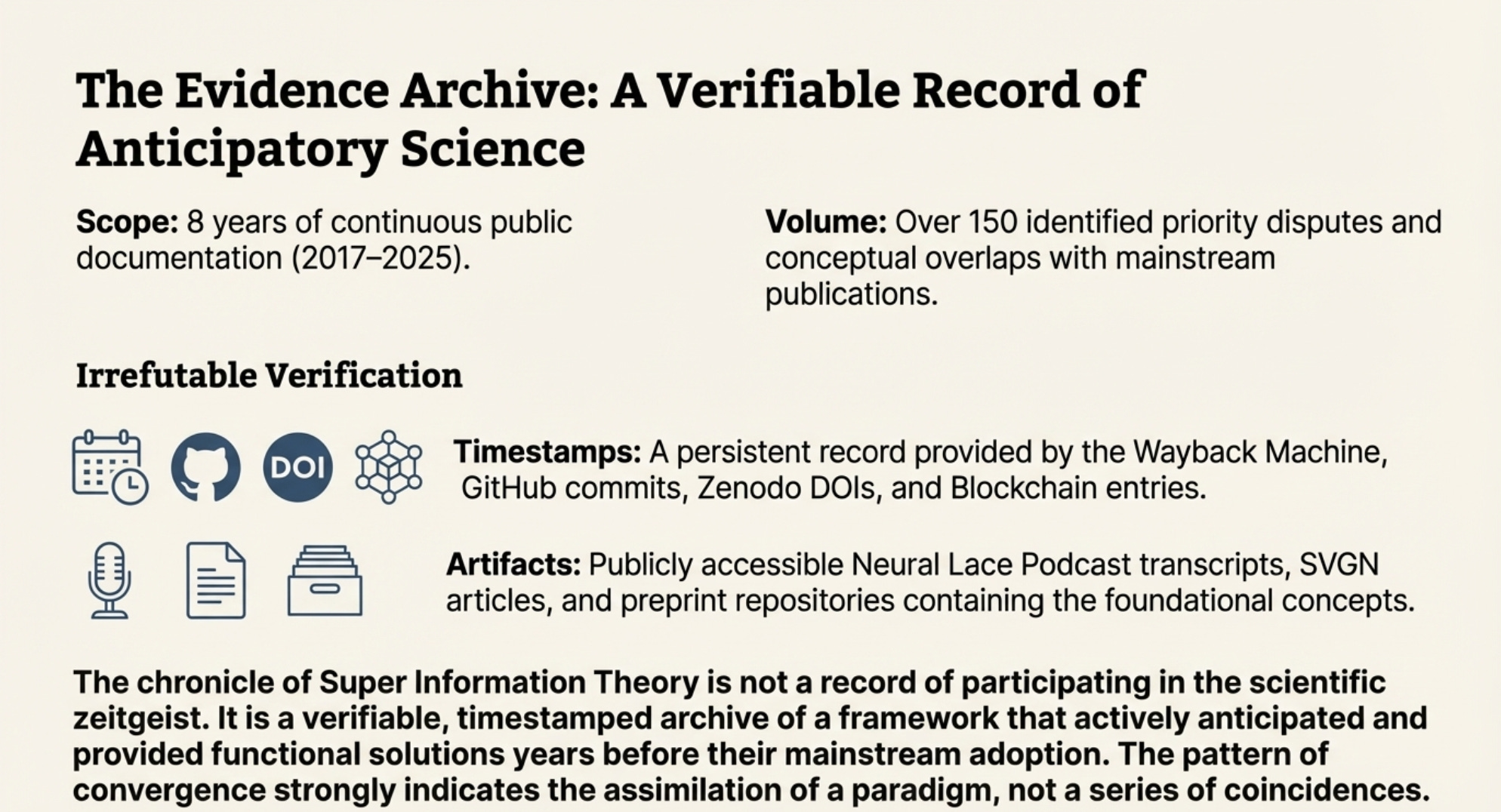
The “Unattributed Equivalence” Archive: Tracking Over 150 Cases
────────────────────────────────────────
A defining aspect of the history of Super Information Theory (SIT) is the systemic emergence of architecturally parallel frameworks in the years following its initial publication (2017–2022). This phenomenon extends beyond isolated coincidences; it encompasses a documented list of over 150 (and up to 200+) research papers and preprints that exhibit “uncredited derivative status” relative to the SIT corpus.
The Pattern of Translation, Not Discovery
Detailed analysis of these works reveals a consistent pattern: the re-instantiation of the SIT architecture within different nomenclatures. Rather than independent discovery, these works frequently function as “translations” of SIT concepts into standard academic formalisms.
Nomenclature Shifts: Divergent terminologies often describe identical behavioral functions. For example, where SIT describes “time-density,” subsequent works may introduce “time-viscosity”; where SIT defines “coherence,” others may substitute “resonance.” Despite these lexical shifts, the underlying mathematical behavior remains functionally isomorphic.
Structural Preservation: While the labels change, the specific “narrative architecture”—the causal relationships between the concepts—remains intact, suggesting that the later works are deriving their structure from the SIT template rather than evolving it from scratch.
The Scope of Priority
This tracking project, maintained in a private archive, establishes the priority of SIT across a wide spectrum of physics and neuroscience. Significant examples analyzed include:
Harvey’s ANOS and Bianchetti’s Viscous Time Theory: Both were found to contain multiple concepts functionally equivalent to prior SIT works, demonstrable via architectural mapping.
Causal Fermion Systems (2024–2025): As detailed elsewhere, this framework adopted specific solutions for measurement and substrate structure only after they were articulated in the SIT corpus.
Conclusion
The sheer volume of these overlaps—numbering in the hundreds—demonstrates that the Super Information Theory corpus (including Self Aware Networks (2022), Quantum Gradient Time Crystal Dilation (2022), the Neural Lace Podcast (2017) and more) did not merely participate in a shared zeitgeist but actively anticipated the functional solutions that the broader field would later adopt. The “Private Archive” serves as the historical record of this widespread unattributed equivalence, asserting the priority of SIT over the iterations that followed.
See the SVGN.io article called “Super Information Theory: Don’t fall for the ‘older theory’ trick (140+ priority cases) Yes, some programs started decades ago—but their equivalence with my framework only appeared in 2024–2025, and only after I first published my version of the equivalent concepts found in both.
────────────────────────────────────────
Appendix: Exhaustive Documentary Record and Independent Timestamp Evidence (2017--2025)
────────────────────────────────────────
This appendix provides an exhaustive archival record of publicly available artifacts
associated with the development of Self Aware Networks (SAN), Neural Lace, NAPOT,
Quantum Gradient Time Crystal Dilation (QGTCD), Super Dark Time (SDT), SuperTimePosition,
and Super Information Theory (SIT). The purpose of this appendix is evidentiary: to
document dates, venues, and independent timestamp mechanisms (GitHub, Zenodo, Medium,
SVGN, Wayback Machine, YouTube, SoundCloud) without interpretive compression.
Primary source compilations include the complete Neural Lace Podcast transcripts
(2017--2019) and the Concept Priority & Evidence Map.
────────────────────────────────────────
Neural Lace Podcast: Complete Episode Record (2017--2019)
────────────────────────────────────────
nlp1 — Apr 11, 2017. Neural Lace Podcast (monologue).
YouTube:
nlp2 — Apr 13, 2017.
YouTube:
nlp3 — Apr 22, 2017.
YouTube:
nlp4 — May 5, 2017.
YouTube:
nlp5 — Recorded May 9, 2017. Guest: Jules Urbach (OTOY).
SoundCloud:
nlp7 — June 7, 2017. Guest: Android Jones.
SoundCloud:
NerveGear Special — Nov 2, 2017.
YouTube:
Season 2, Episode 1 — Aug 2, 2018.
YouTube:
Season 2, Episode 2 — Sep 11, 2018.
YouTube:
Season 2, Episode 4 — May 11, 2019. fNIRS.
YouTube:
All episodes are fully transcribed and preserved in the Neural Lace Podcast transcript
https://github.com/v5ma/selfawarenetworks/blob/main/guide/NLP%20Transcripts%20from%202017-2019.pdf
────────────────────────────────────────
Medium / SVGN Articles with Wayback Timestamp Proof (2017--2021)
────────────────────────────────────────
The Brain as a Special Kind of Hard Drive (2017).
Wayback:
https://web.archive.org/web/20210919212933/https://medium.com/silicon-valley-global-news/the-brain-as-a-special-kind-of-hard-drive-4bd3a99dba4c
Humans Are Metal Robots in a Valid Sense (2017).
Wayback:
https://web.archive.org/web/20201020015247/https://medium.com/silicon-valley-global-news/breaking-news-humans-are-metal-robots-literally-a7bd78bb333d
Addressing Criticism for “Humans Are Metal Robots” (2017).
Wayback:
https://web.archive.org/web/20210919191705/https://medium.com/silicon-valley-global-news/addressing-criticism-for-my-humans-are-metal-robot-story-86f1c99d72b6
Synaptic Unreliability Undermined by MVP Proof (2017).
Wayback:
https://web.archive.org/web/20210209003006/https://medium.com/silicon-valley-global-news/synaptic-unreliability-a-foundational-concept-found-in-deep-learning-and-in-computational-a97c5dca9e90
Mind Code / Brain Code: Go and AlphaGo (2017).
Wayback:
https://web.archive.org/web/20210919213836/https://medium.com/silicon-valley-global-news/the-game-of-go-speculation-about-the-code-of-our-minds-in-our-brains-5a39d7cb6366
Neural Lace Journal / Talk Show Index (Oct 2017).
Wayback:
https://web.archive.org/web/20190317101602/https://medium.com/silicon-valley-global-news/the-neural-lace-journal-talk-show-a-compilation-of-articles-and-links-ae3fbb0d5d5a
Neural Lace and Deep Learning: Polina Anikeeva (2018).
Wayback:
https://web.archive.org/web/20180530045930/https://medium.com/silicon-valley-global-news/neural-lace-and-deep-learning-6ed70db4e3a7
3D Cross-Hair Convolutional Neural Networks (2018).
Wayback:
https://web.archive.org/web/20210919202220/https://medium.com/silicon-valley-global-news/3d-cross-hair-convolutional-neural-networks-5d39e2b565ca
Interview with Jules Urbach at GTC 2018 (2018).
Wayback:
https://web.archive.org/web/20180528155036/https://medium.com/silicon-valley-global-news/my-interview-with-jules-urbach-the-ceo-of-otoy-at-gtc-2018-a7cadbaa6ec3
Question to Jensen Huang on Self-Aware Networks (2018).
Wayback:
https://web.archive.org/web/20251112031520/https://medium.com/silicon-valley-global-news/after-a-mind-exploding-keynote-at-gtc-2018-i-got-the-chance-to-ask-jensen-huang-the-ceo-of-nvidia-a-f1cca7ce04a6
────────────────────────────────────────
2022: Oscillatory Computation and Network-Level Agency
────────────────────────────────────────
2022-06-17 — Self Aware Networks (SAN) theory of mind.
Time-stamped GitHub repository containing notes and preprint-style materials describing
oscillatory computational agency, predictive synchronization, and phase-based network
control.
2022-07-26 — Quantum Gradient Time Crystal Dilation (QGTCD).
Initial public GitHub publication extending oscillatory and phase-centric principles
into gravity via a time-density gradient framework.
────────────────────────────────────────
Summer 2022 YouTube Explainer Videos (SAN / NAPOT) Referenced in the 2024 Book Announcement
────────────────────────────────────────
In the SVGN post announcing the neuroscience book Bridging Molecular Mechanisms and Neural Oscillatory Dynamics (published late 2024), the author states that “a few videos” made in summer of 2022 explain the core ideas that later appear in the book. These videos serve as public, independently hosted exposition supporting the 2022 GitHub-era SAN/NAPOT record.
NAPOT 1st Version (Whitepaper), 1 hour (as listed in the post).
Note: In the rendered post, this entry may share an embed with another SAN video. For completeness, include the two long-form NAPOT/SAN videos that appear as the relevant 2022 “whitepaper-style” explainers:
(a) “1 hour video that explains NAPOT the central thesis of Self Aware Networks”
YouTube:
(b) “Neural Array Projection Oscillation Tomography Theory 5th Revision.”
YouTube:
NAPOT 5th Revision, 1 hour (as listed in the post).
“Neural Array Projection Oscillation Tomography Theory 5th Revision.”
YouTube:
3 minute description of my work.
“The Self Aware Networks Institute for Neurophysics, Artificial Neurology & Bio-Synthetic Interfaces”
YouTube:
1 hour video that explains NAPOT (central thesis of Self Aware Networks).
“1 hour video that explains NAPOT the central thesis of Self Aware Networks”
YouTube:
13 minute Self Aware Networks: a longer explanation of my research, my past work, and what I have built.
“Self Aware Networks: A longer explanation of my research, my past work, and what I have built.”
YouTube:
2022 → late 2024: Book project.
This period was spent writing the neuroscience theory-of-mind book,
published at end of 2024 as Bridging Molecular Mechanisms and Neural Oscillatory Dynamics (Amazon listing referenced in the post).
Blumberg, Micah, Bridging Molecular Mechanisms and Neural Oscillatory Dynamics,
Amazon Kindle & Paperback, Oct 30, 2024.
https://www.amazon.com/dp/B0DLGBHJHG
────────────────────────────────────────
SVGN / Substack Physics Series (2024--2025)
────────────────────────────────────────
A New Unified Field Theory Called QGTCD (Part I) — Jan 28, 2024
Wayback proof:
https://web.archive.org/web/20240128135920/https://www.svgn.io/p/a-new-unified-field-theory-called-qgtcd
QGTCD (Part II) — Feb 15, 2024
Wayback proof:
https://web.archive.org/web/20240215141003/https://www.svgn.io/p/qgtcd-part-ii
Explain QGTCD Like I Am Six — Mar 28, 2024
Wayback proof:
https://web.archive.org/web/20240328132046/https://www.svgn.io/p/explain-qgtcd-like-i-am-six
Quantum Gravity’s New Frontier: Time as Medium — Oct 21, 2024
Wayback proof:
https://web.archive.org/web/20241021151234/https://www.svgn.io/p/quantum-gravitys-new-frontier-time-as-medium
Dark Time Theory: A Conversation — Oct 22, 2024
Wayback proof:
https://web.archive.org/web/20241022145519/https://www.svgn.io/p/dark-time-theory-a-conversation
Micah’s New Law of Thermodynamics — Jan 1, 2025
Wayback proof:
https://web.archive.org/web/20250101084219/https://www.svgn.io/p/micahs-new-law-of-thermodynamics
Introducing Quantum SuperTimePosition — Jan 5, 2025
Wayback proof:
https://web.archive.org/web/20250115135920/https://www.svgn.io/p/introducing-quantum-supertimeposition
SuperTimePosition Measured — Jan 17, 2025
Wayback proof:
https://web.archive.org/web/20250117214702/https://www.svgn.io/p/supertimeposition-measured
────────────────────────────────────────
Zenodo Records (Chronological by Original Publication Date)
────────────────────────────────────────
Coincidence as a Bit of Information
Author: Micah Blumberg
Record type: Dataset
Original publication date: 2017 (review & consolidation June 21, 2025)
Zenodo upload date: August 21, 2025
https://zenodo.org/records/16922510
Self Aware Networks: OCA (First Draft)
Author: Micah Blumberg
Record type: Journal article
Original publication date: May 16, 2025
Zenodo upload date: August 21, 2025
DOI mirror of Figshare: 10.6084/m9.figshare.29085134
https://zenodo.org/records/16922401
Micah’s New Law of Thermodynamics: A Signal-Dissipation Framework for Equilibrium, Consciousness, and Gravity
Author: Micah Blumberg
Record type: Journal article
Original publication date: January 23, 2025 (v6)
Zenodo upload date: August 21, 2025
DOI mirror of Figshare: 10.6084/m9.figshare.28264340
https://zenodo.org/records/16922506
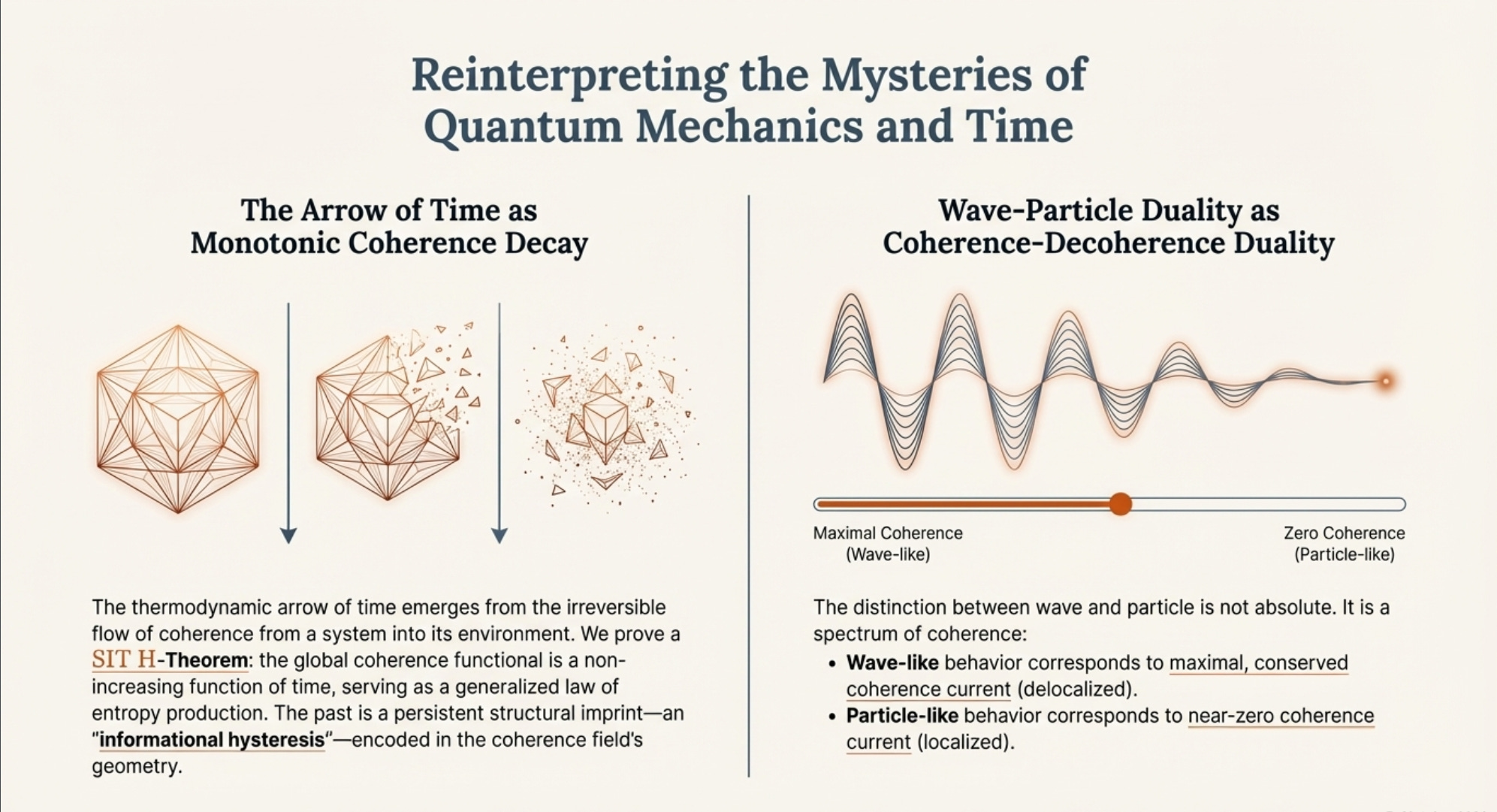
Super Dark Time: Gravity Computed from Local Quantum Mechanics
Author: Micah Blumberg
Record type: Journal article
Original publication date: January 27, 2025 (Draft 16)
Zenodo upload date: August 21, 2025
DOI mirror of Figshare: 10.6084/m9.figshare.28284545
https://zenodo.org/records/16922502
Super Information Theory: The Coherence Conservation Law Unifying the Wave Function, Gravity, and Time
Author: Micah Blumberg
Record type: Journal article
Original publication date: February 9, 2025
Zenodo upload date: October 8, 2025
DOI mirror of Figshare: 10.6084/m9.figshare.28379318
https://zenodo.org/records/16922512
Neuroscience in Review: Mapping “Cortical traveling waves in time and space” (2025) to Self Aware Networks (2022)
Author: Micah Blumberg
Record type: Dataset
Original publication date: June 18, 2025
Zenodo upload date: August 21, 2025
DOI mirror of Figshare: 10.6084/m9.figshare.29817383
https://zenodo.org/records/16922844
Neuroscience in Review: Brain Rhythms in Cognition (2024--25) vs. Blumberg’s Self-Aware Networks (2017--25): A Comparative Analysis
Author: Micah Blumberg
Record type: Journal article
Original publication date: July 2025
Zenodo upload date: August 21, 2025
DOI mirror of Figshare: 10.6084/m9.figshare.29650250
https://zenodo.org/records/16922874
Timeline Review of Kletetschka’s 3D Time Theory & Blumberg’s SIT, SDT, QGTCD, and Other Similar Theories
Author: Micah Blumberg
Record type: Journal article
Original publication date: July 25, 2025
Zenodo upload date: August 21, 2025
DOI mirror of Figshare: 10.6084/m9.figshare.29647640
https://zenodo.org/records/16922866
Coherence-Gated Yang–Mills Gap: A Self-Contained Derivation in Super Information Theory
Author: Micah Blumberg
Record type: Journal article
Original publication date: October 10, 2025
Zenodo upload date: October 10, 2025
DOI: 10.5281/zenodo.17311157
https://doi.org/10.5281/zenodo.17311157
Informational Holonomy and the Electron g-Factor: A Super Information Theory (SIT) Spinoff
Author: Micah Blumberg
Record type: Journal article
Version: v4 (integrated & corrected)
Original publication date: October 4, 2025
Zenodo upload date: October 5, 2025
https://zenodo.org/records/17307956
Neuroscience in Review: Earl K. Miller’s MIT Corpus vs. Micah Blumberg’s Self-Aware Networks (SAN) and Super Information Theory (SIT)
Author: Micah Blumberg
Record type: Journal article
Original publication date: October 10, 2025
Zenodo upload date: October 11, 2025
https://zenodo.org/records/17308645
Building Sentient Beings
Authors: Micah Blumberg; Michael S. P. Miller
Record type: Journal article
Original publication date: December 17, 2025
Zenodo record (multiple versions exist)
https://zenodo.org/records/47834429
────────────────────────────────────────
Appendix AA: Timestamp Evidence (Wayback Machine Mirrors and ORCID)
────────────────────────────────────────
This appendix documents independent timestamp evidence establishing that
Super Information Theory, Super Dark Time, and
Micah’s New Law of Thermodynamics were publicly available on Figshare
during the January--March 2025 period. Evidence is provided via the Internet
Archive (Wayback Machine) and ORCID identity records. These third-party
archives serve as independent corroboration of publication timing.
────────────────────────────────────────
ORCID Identity Record (Author Verification)
────────────────────────────────────────
The author’s ORCID record functions as an identity anchor linking authorship
to the relevant Figshare and Zenodo publications.
ORCID (Micah Blumberg)
Wayback snapshot:
https://web.archive.org/web/20250826004755/https://orcid.org/0009-0004-5175-9532
────────────────────────────────────────
Wayback Machine: Figshare Publication Mirrors
────────────────────────────────────────
The following Wayback Machine collections preserve historical snapshots of
Figshare pages corresponding to the core SIT/SAN/SDT publications. The
wildcard (*) URLs enumerate all archived snapshots and demonstrate
public availability prior to later platform disruptions.
Super Information Theory (Figshare)
Wayback archive index:
https://web.archive.org/web/*/https://figshare.com/articles/journal_contribution/Super_Information_Theory/*
Super Dark Time: Gravity Computed from Local Quantum Mechanics (Figshare)
Wayback archive index:
https://web.archive.org/web/*/https://figshare.com/articles/journal_contribution/Super_Dark_Time_Gravity_Computed_from_Local_Quantum_Mechanics/*
Micah’s New Law of Thermodynamics (Figshare)
Wayback archive index:
https://web.archive.org/web/*/https://figshare.com/articles/journal_contribution/_b_Micah_s_New_Law_of_Thermodynamics_A_Signal-Dissipation_Framework_for_Equilibrium_and_Consciousness_b_/*
────────────────────────────────────────
Wayback Machine: Self Aware Networks (OCA) PDF Artifact
────────────────────────────────────────
The Self Aware Networks: Oscillatory Computational Agency (OCA), First Draft
was originally published on May 16, 2025, as confirmed by the ORCID record.
The Wayback Machine preserved a copy of the hosted PDF on July 25, 2025, which
serves as independent archival evidence of public availability.
Self Aware Networks: OCA (First Draft) — PDF mirror
Wayback snapshot date: 2025--07--25
Wayback URL:
https://web.archive.org/web/20250725002526/https://s3-eu-west-1.amazonaws.com/pfigshare-u-files/54589349/SelfAwareNetworksOCAFirstDraft.pdf
────────────────────────────────────────
Interpretive Note on Timestamp Discrepancies
────────────────────────────────────────
The Wayback Machine timestamp reflects the date on which the Internet Archive
captured the resource, not the original publication date. In cases such as the
SAN/OCA paper, the ORCID record confirms initial publication on May 16, 2025,
while the Wayback snapshot (July 25, 2025) provides later third-party archival
confirmation of persistence and accessibility.
Together, ORCID identity records and Wayback Machine mirrors establish an
independent, cross-verified timeline for authorship and public disclosure.
────────────────────────────────────────
Archival Statement
────────────────────────────────────────
The above record establishes a continuous, publicly accessible trail from early
Neural Lace and Self Aware Networks work (2017) through the formal unification of
Super Information Theory (2025), with independent third-party timestamping provided
by the Wayback Machine, Zenodo DOIs, GitHub commit history, and platform-hosted media.