
Tracking the Republican Civil War: A Guide with Infographics (Second Half of 2025)
Foreign Policy Flashpoints, War Powers, and the Deepening Fault Lines in Republican Politics and American Society

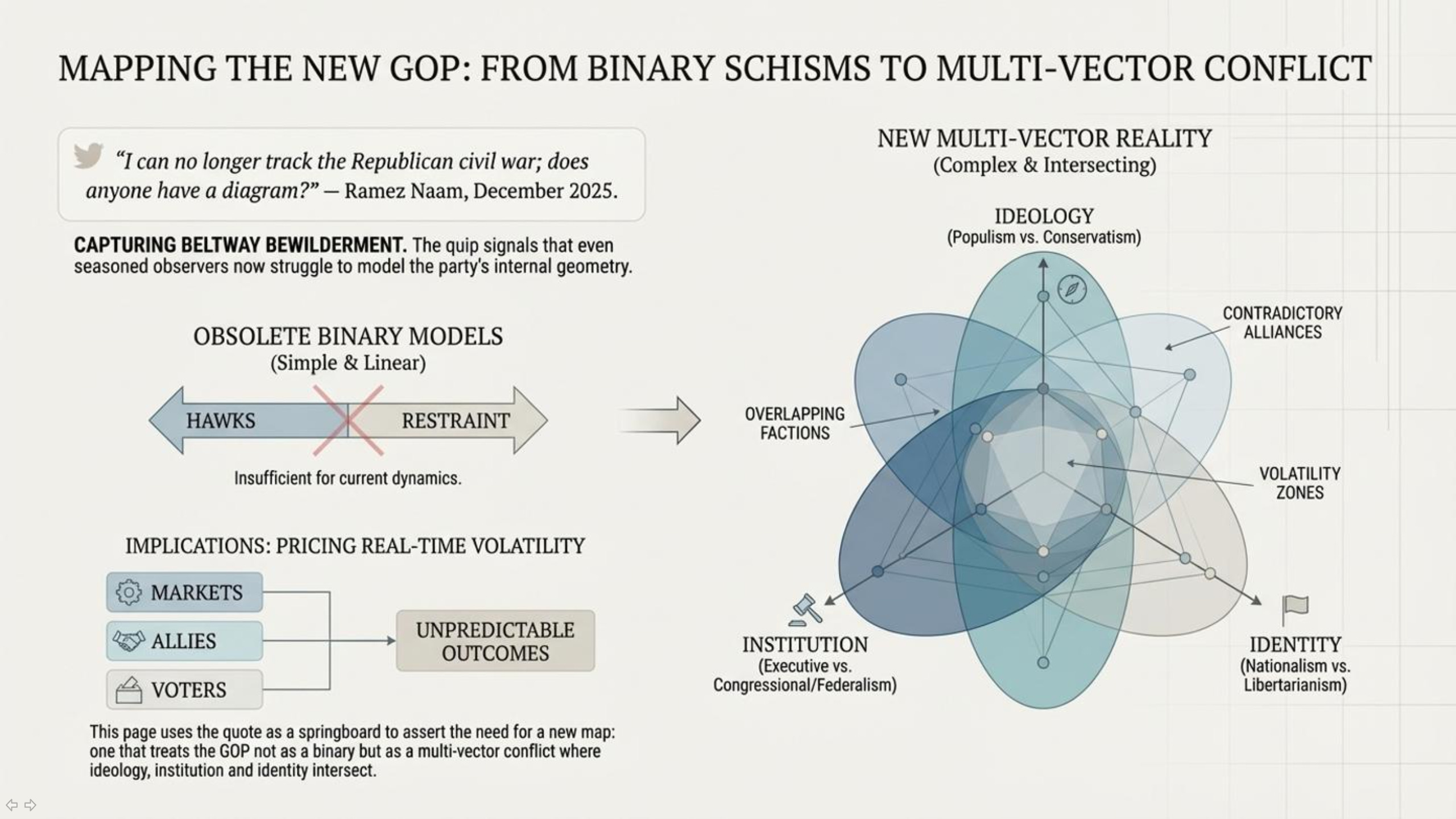
In December 2025, Ramez Naam remarked, “I can no longer track the Republican civil war. Does anyone have a nice little diagram?” That comment captured a widely felt confusion. What once appeared as a unified political movement had, by the second half of 2025, fractured into overlapping and often contradictory factions—splintering not just over ideology, but over executive power, constitutional limits, foreign intervention, domestic enforcement, and the role of institutions themselves.
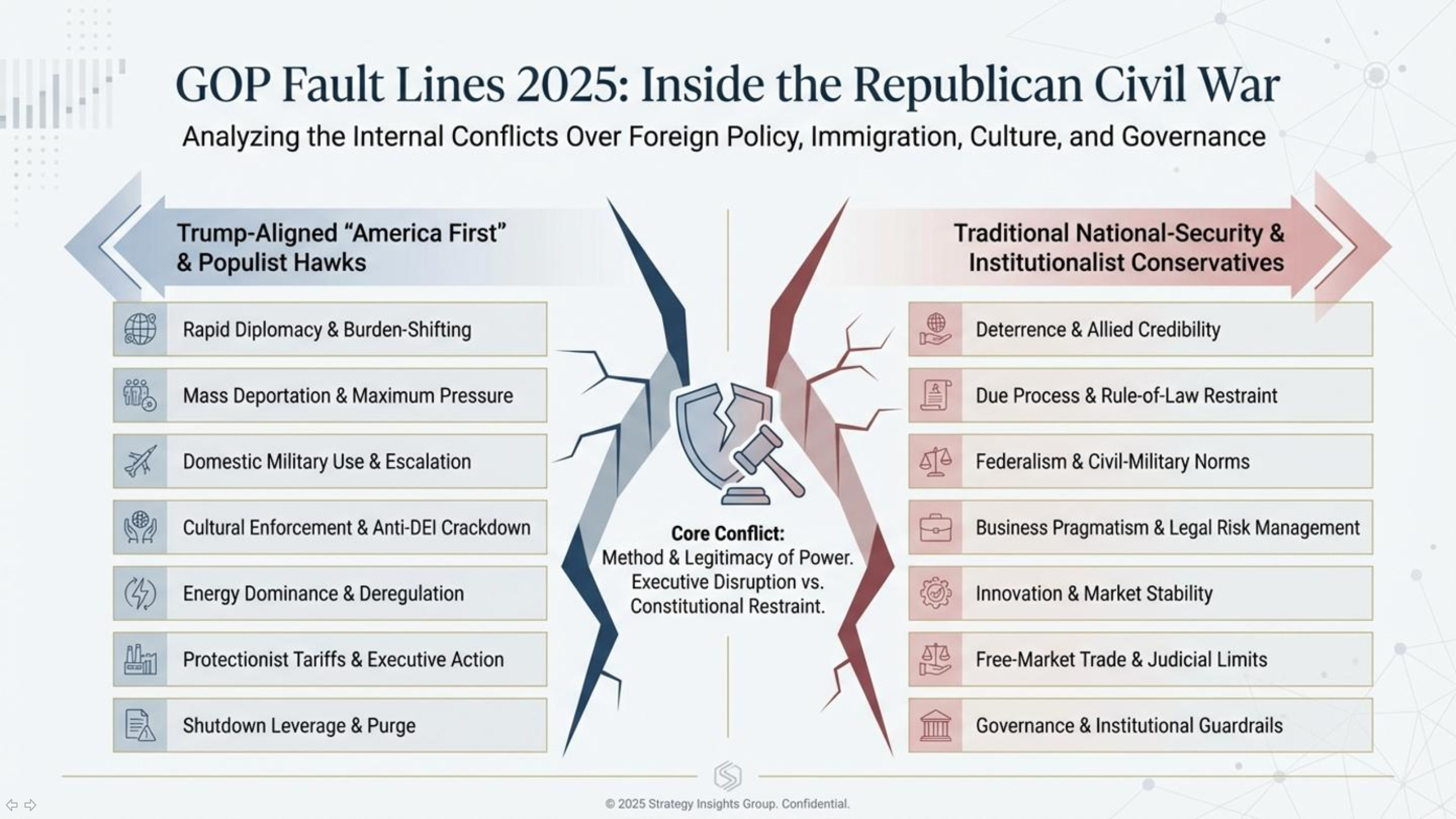
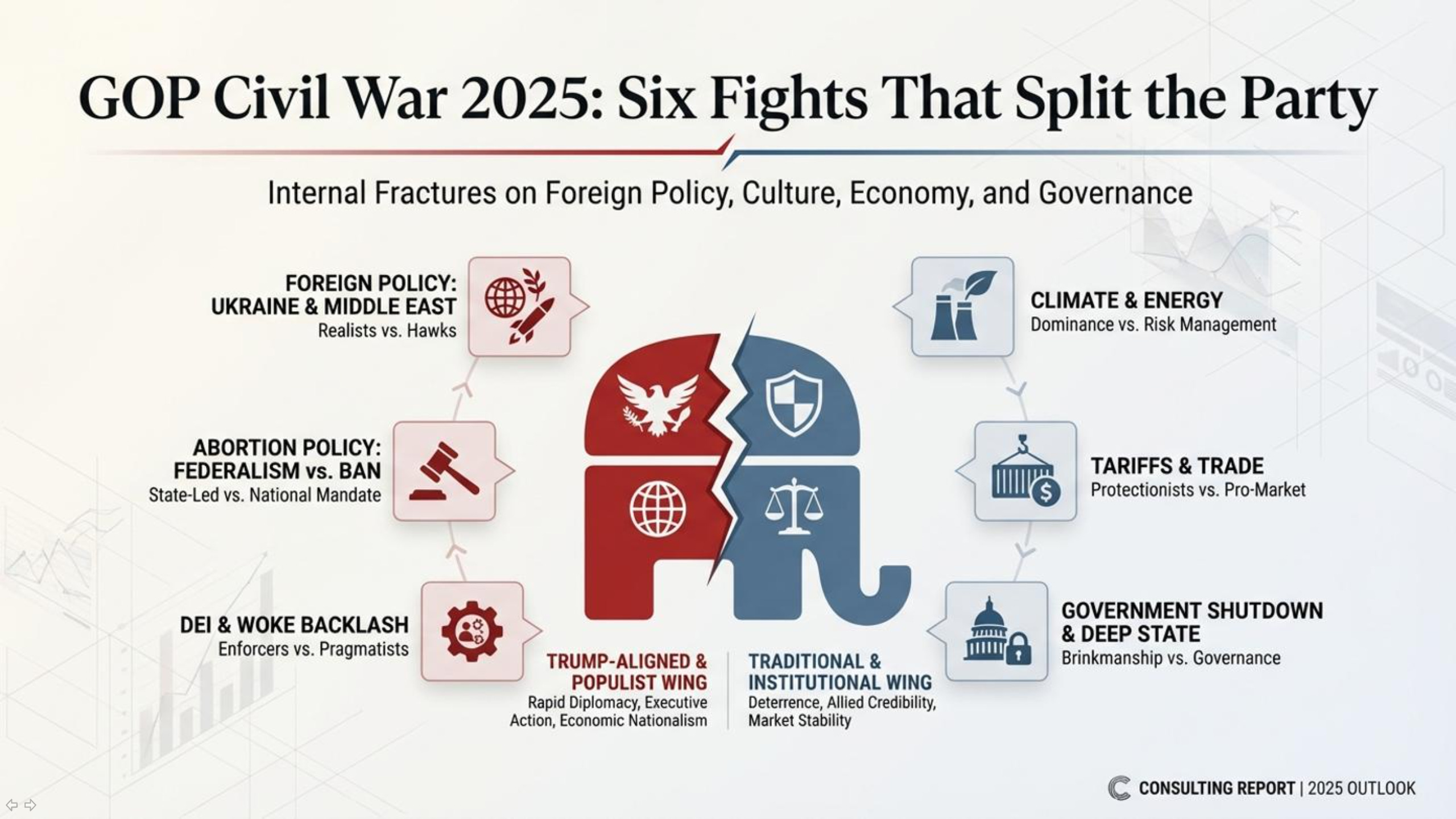
This article is a response to that question. It is an attempt to map the internal conflicts now shaping Republican politics, using a structured narrative and visual framing rather than slogans or partisan shorthand. Across foreign policy flashpoints, war powers disputes, immigration enforcement, cultural and social policy, climate governance, trade strategy, and executive authority, the Republican coalition has increasingly found itself in conflict with itself—hawks versus restraint advocates, institutional conservatives versus executive maximalists, libertarians versus nationalists, and state leaders versus federal power.
These divisions are not merely rhetorical. They have manifested in congressional rebellions, court battles, state–federal standoffs, economic instability, and civil unrest. Supporters of the administration view these struggles as necessary corrections to broken institutions and unchecked bureaucracies. Critics—including many within the Republican Party itself—see them as signs of constitutional strain and long-term political risk. Together, they form a complex and evolving internal conflict that resists simple left–right categorization.
What follows is not an argument for one side, but a guide to the fault lines themselves. By tracing where and how these conflicts emerged in the second half of 2025, this article aims to make the Republican civil war legible—less as a single schism, and more as a multi-front struggle over the future direction of the party and, by extension, the country.
Iran Conflict and GOP Split Over War Powers
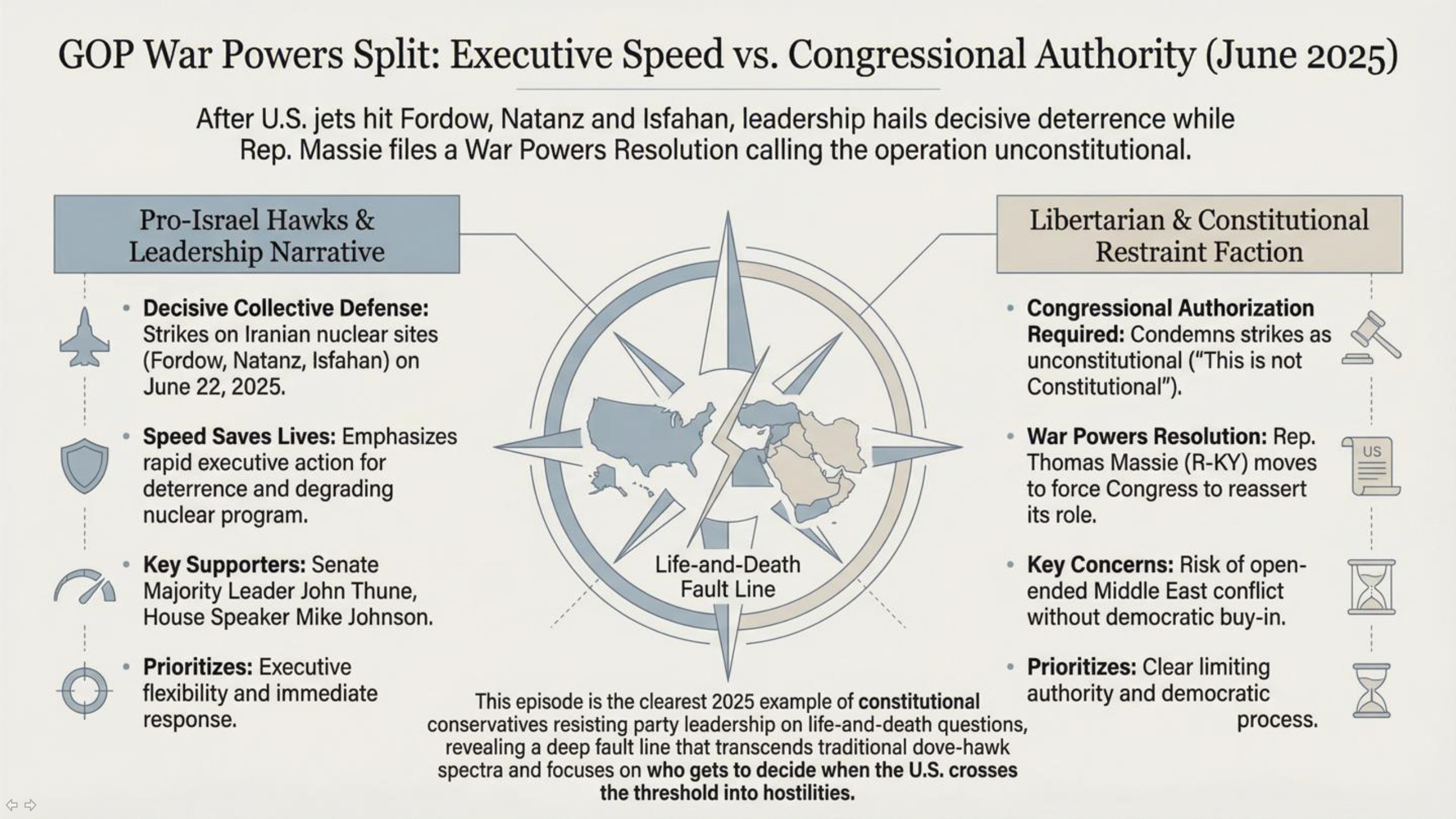
In mid-June 2025, Israel’s operation against Iran escalated into a broader Israel–Iran war, and the U.S. soon entered directly with strikes on three Iranian nuclear sites (Fordow, Natanz, and Isfahan) carried out on June 22 (following Trump’s June 21 announcement). Republican leadership and the party’s hawkish/pro-Israel wing largely rallied behind the operation as a decisive act of collective defense and a necessary step to degrade Iran’s nuclear program; Senate Majority Leader John Thune and House Speaker Mike Johnson publicly backed the strikes.
But the strikes also sharpened an intraparty rift between pro-intervention Republicans and a libertarian/constitutional-restraint faction that argues major uses of force require explicit congressional authorization. Rep. Thomas Massie (R-KY) immediately condemned the action as unconstitutional (“This is not Constitutional”) and moved to force Congress to reassert its war-powers role through a House War Powers Resolution directing an end to unauthorized hostilities with Iran absent specific authorization.
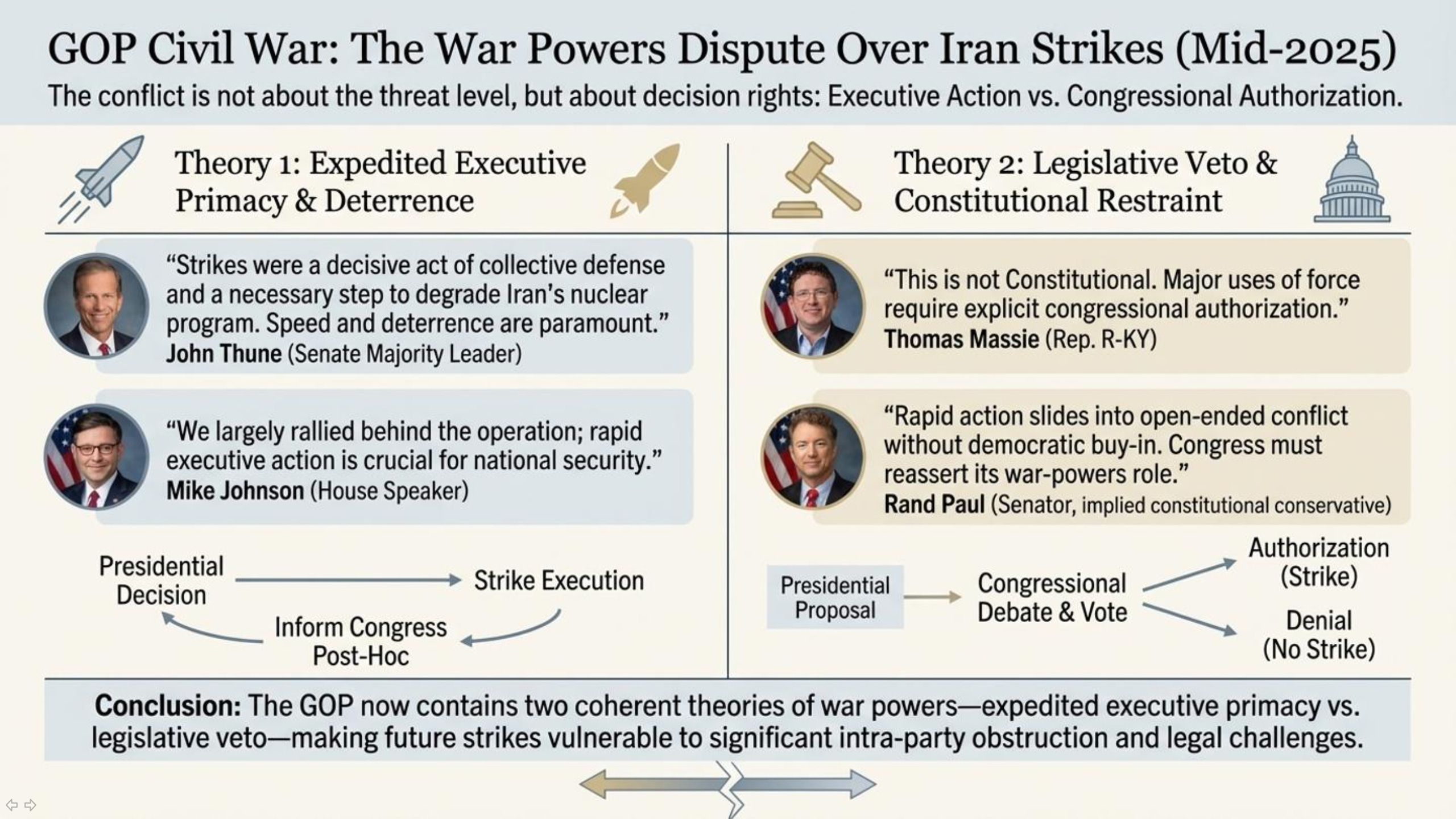
Framed as a Republican-vs-Republican conflict, the dispute wasn’t mainly about whether Iran is a threat—it was about who gets to decide when the U.S. crosses the threshold into hostilities: party leaders and national-security hawks prioritizing speed and deterrence, versus constitutional conservatives warning that “rapid executive action” can slide into an open-ended Middle East conflict without democratic buy-in or clear limiting authority.
Ukraine and Other Foreign Policy Divides — GOP Realists vs GOP Hawks
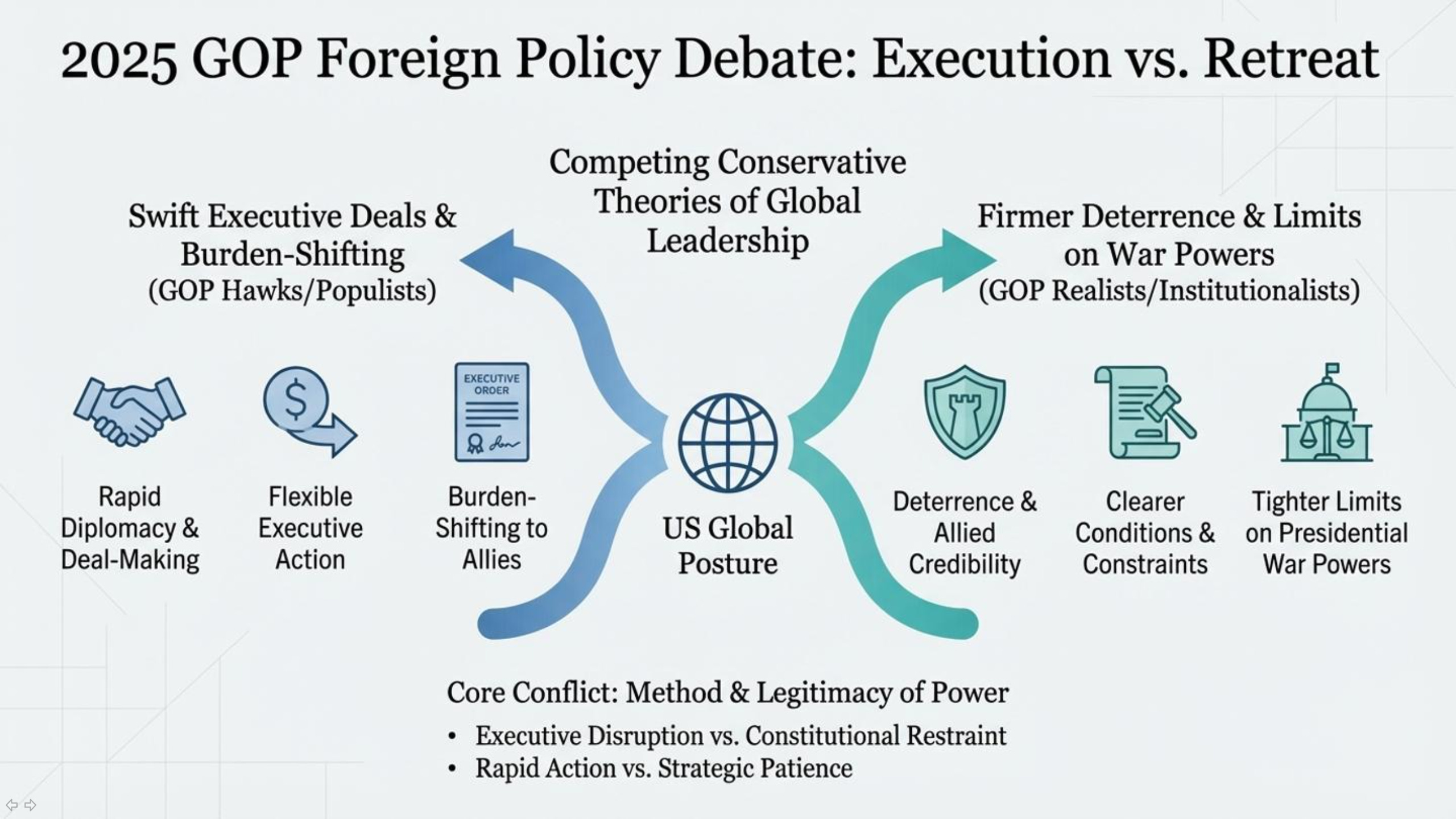
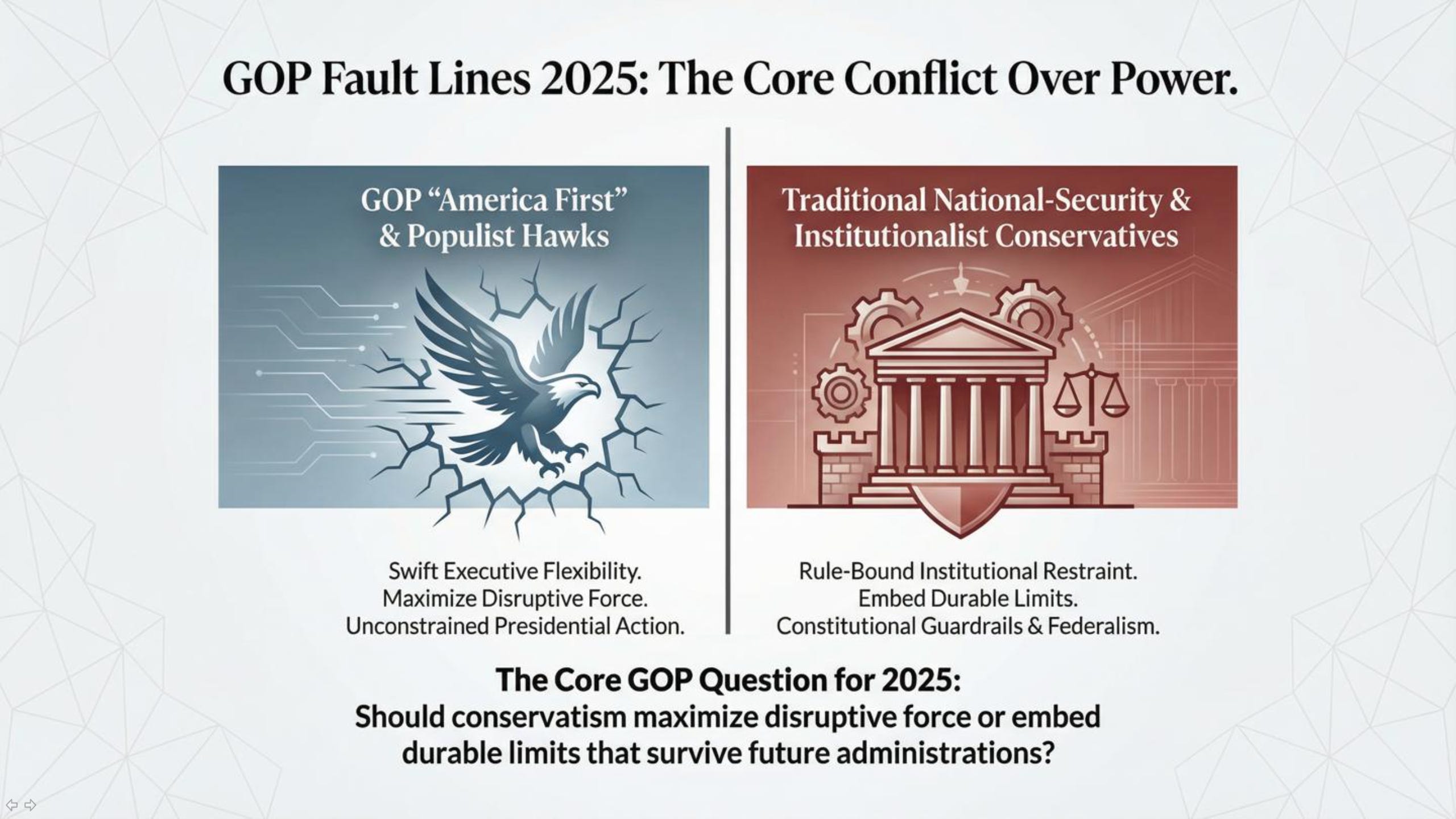
Throughout 2025, the Republican Party’s foreign-policy split widened into a recurring clash between two right-of-center camps: a Trump-aligned “America First” wing prioritizing rapid diplomacy, burden-shifting, and flexible executive action, and a more traditional national-security wing insisting that deterrence and allied credibility require firmer terms and clearer constraints.
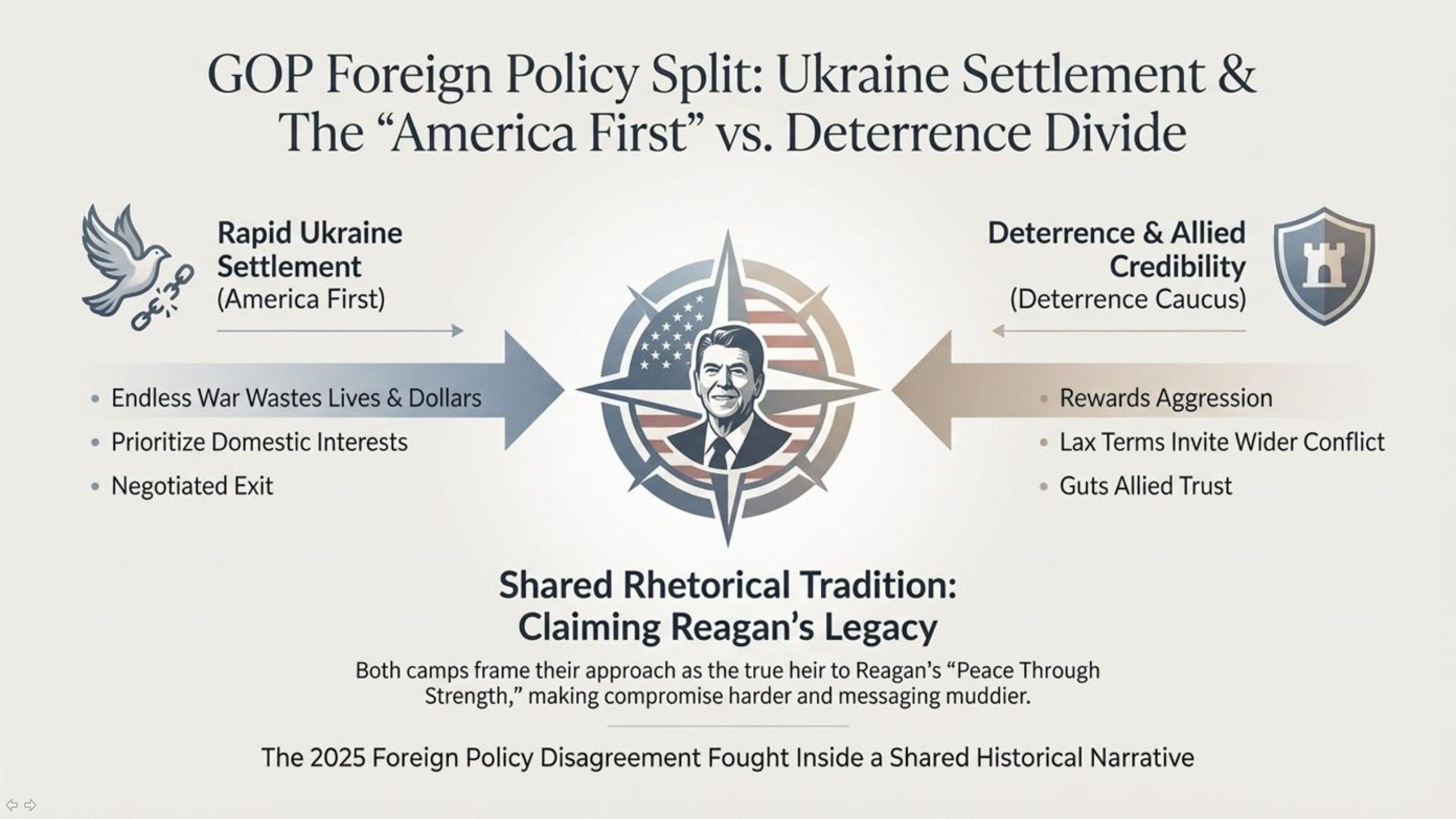
On Ukraine, that divide became explicit when the White House advanced a detailed peace framework and accelerated talks aimed at a quick settlement. A group of prominent Republican lawmakers publicly criticized the effort as structurally favoring Moscow and risking a deal that rewards aggression—objecting both to the substance of the proposal and to the advisers and channels involved in shaping it. At the same time, Trump’s defenders inside the party argued that negotiations are the only realistic exit from a grinding war and emphasized that material support for Kyiv could continue through revised mechanisms even as the administration reoriented strategy.
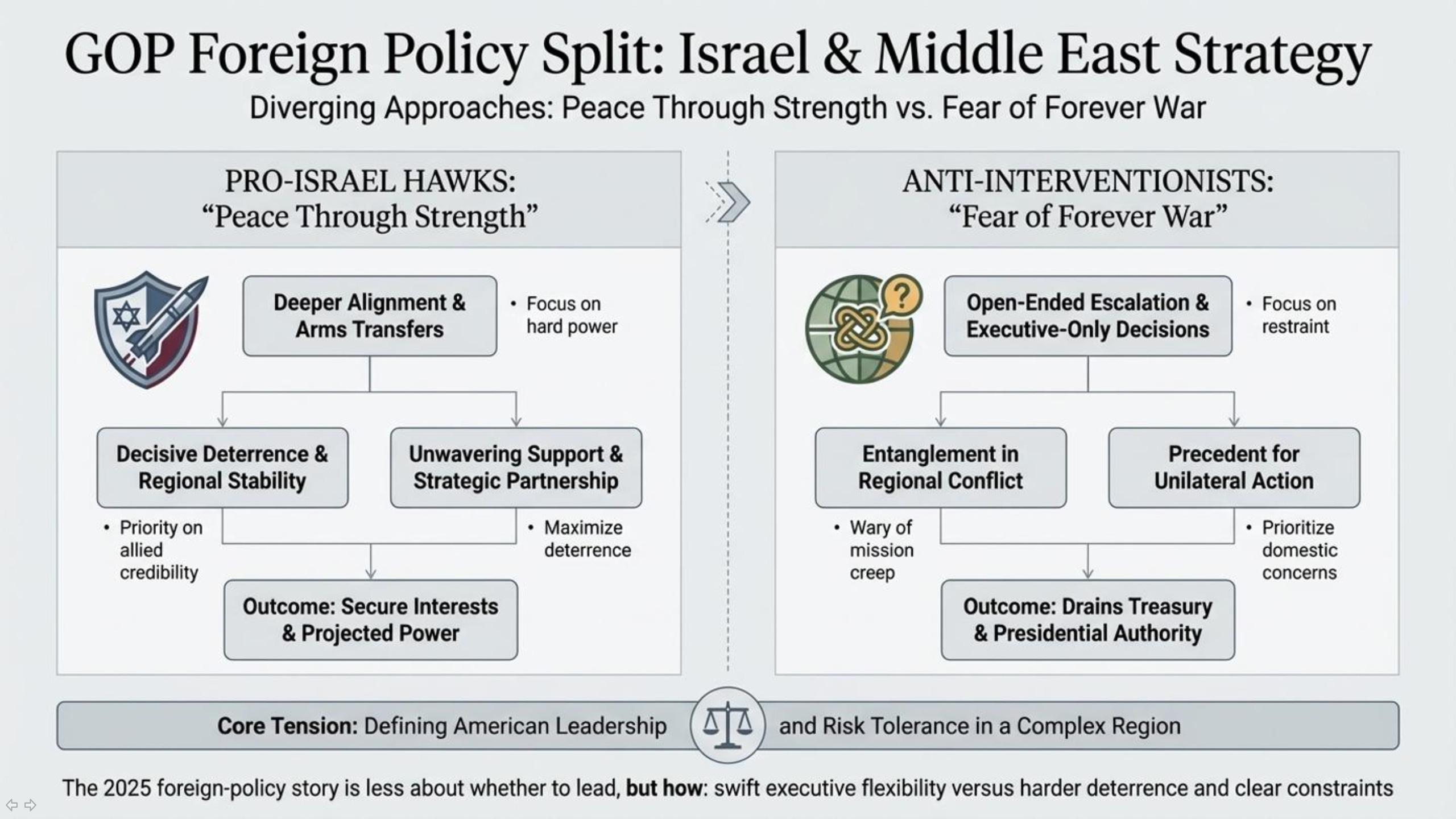
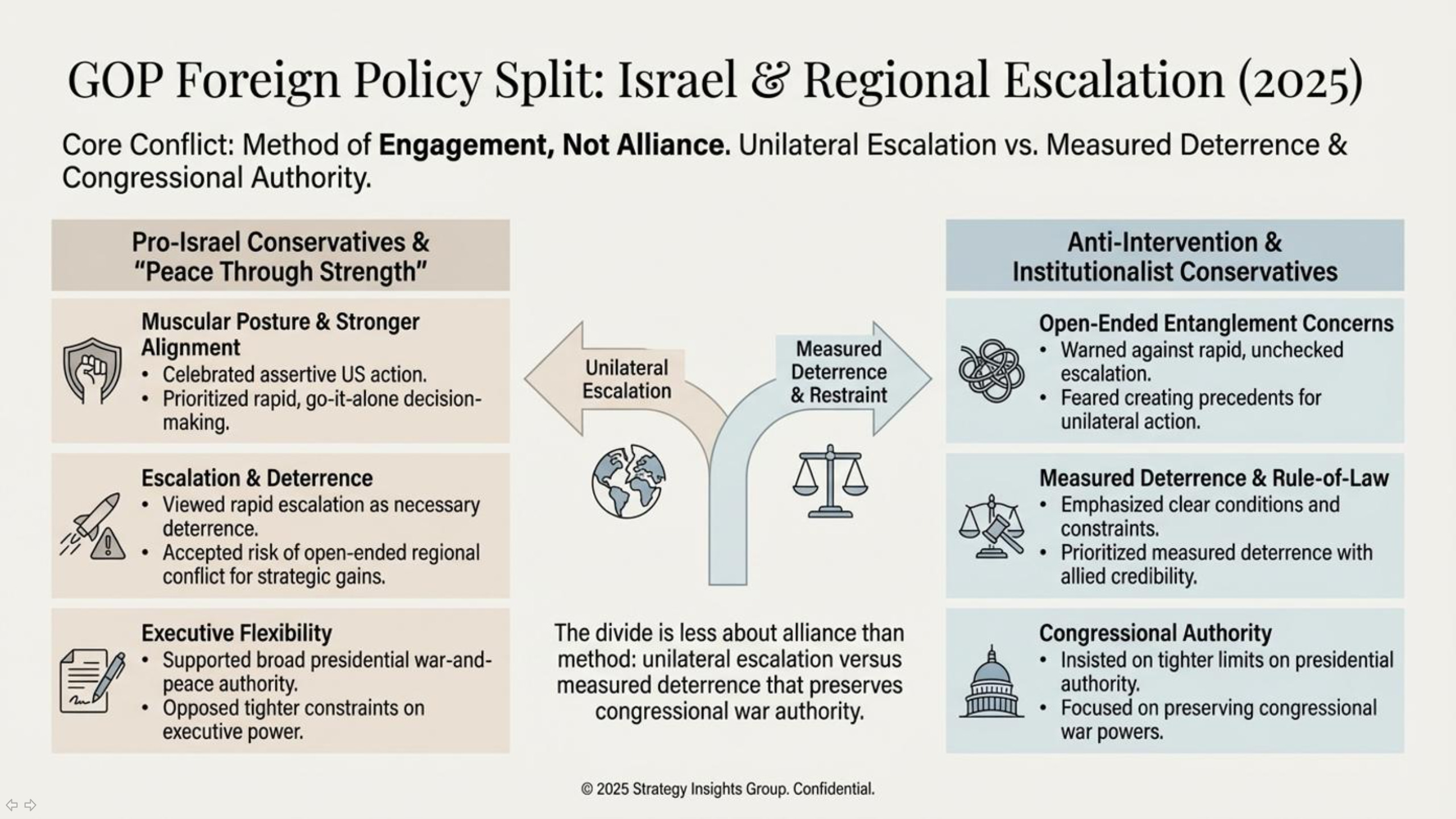
Similar Republican fault lines appeared around U.S. backing for Israel and the broader Middle East escalations. Pro-Israel conservatives and many GOP leaders praised a stronger alignment with Israel and a “peace through strength” posture, while anti-interventionist voices inside the party warned that rapid escalation and go-it-alone decision-making could entangle the U.S. in another open-ended regional conflict and create precedents for unilateral action.
Taken together, the 2025 foreign-policy story inside the GOP was less about whether America should lead than how: swift deal-making and executive flexibility versus harder deterrence, more explicit conditions, and tighter limits on presidential war-and-peace authority.
Mass Deportation vs Sanctuary — GOP Enforcement Maximalists vs GOP Due-Process Conservatives
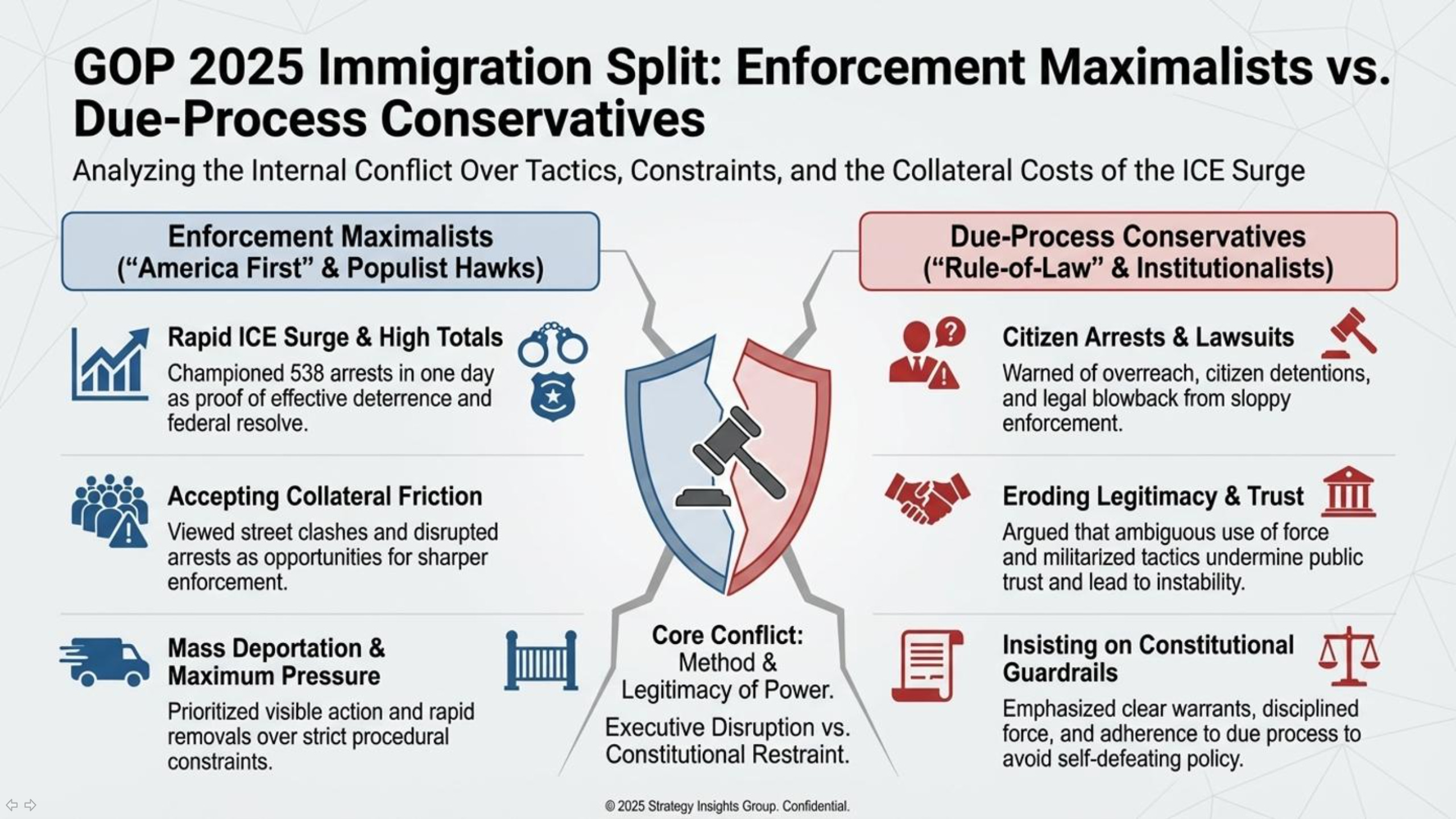
In the opening weeks of Trump’s 2025 immigration crackdown, Republicans split less over the goal (tough enforcement) than over the tactics and constraints. The administration highlighted a rapid surge in ICE activity—citing 538 arrests in one day (and higher totals in adjacent days) as proof the deportation machine was ramping up fast. Many Republicans treated the numbers as a political win: visible action, deterrence messaging, and a show of federal resolve against sanctuary jurisdictions. But a smaller Republican “rule-of-law” and civil-liberties flank focused on the risk of overreach—especially after local officials reported raids that swept up U.S. citizens and raised warrant and due-process questions. Inside the party, the divide was between a “move fast, maximum pressure” faction willing to accept collateral disputes as the cost of deterrence, and a constitutional-conservative faction warning that sloppy enforcement (even if politically popular) creates legal blowback and erodes legitimacy.
Standoffs in California — GOP Law-and-Order Nationalists vs GOP Civil-Military Restraint and Federalism: The early-June Los Angeles unrest pushed that internal Republican tension into a second arena: domestic use of military force. After protests erupted around immigration raids, Trump federalized California’s National Guard and the Pentagon activated a 700-Marine deployment—an unusually escalatory posture that became nationally controversial. Most Republican officials and conservative media voices backed the move as necessary “law and order,” arguing federal personnel and property needed protection and that swift force prevented wider disorder.
But prominent Republicans broke ranks, warning that deploying active-duty forces into a U.S. city (even in a support role) risks crossing civil-military red lines and normalizing the military as a domestic political instrument; some explicitly argued the military “should not be deployed against Americans,” while others opposed the Marines deployment as a step too far. The GOP fracture here wasn’t about immigration per se—it was about whether executive power should expand into domestic militarization, or remain bounded by restraint, federalism instincts, and long-term institutional risk.
Protests, Resistance, and Clashes — GOP “Maximum Force” vs GOP “Legitimacy and Control”
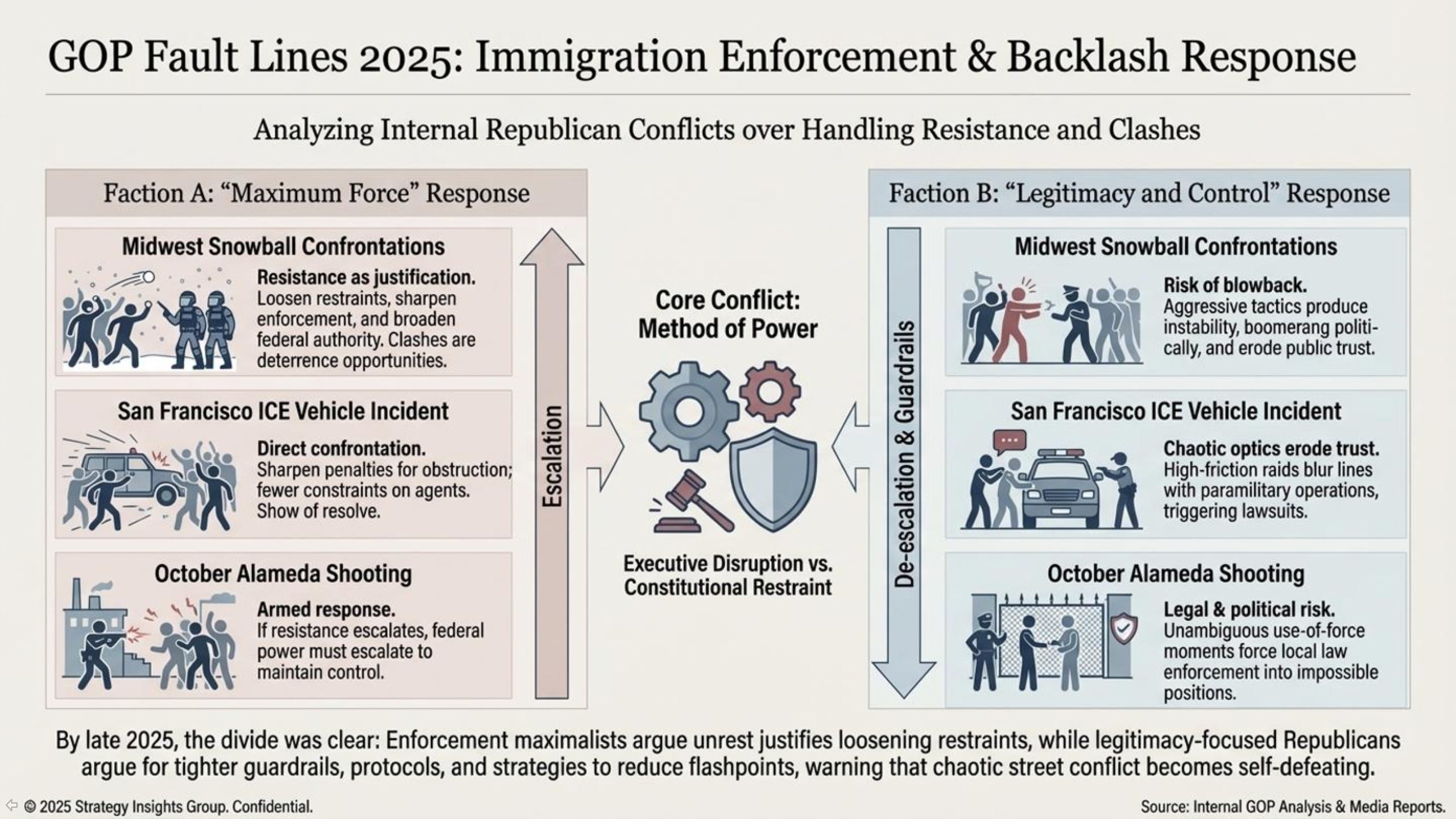
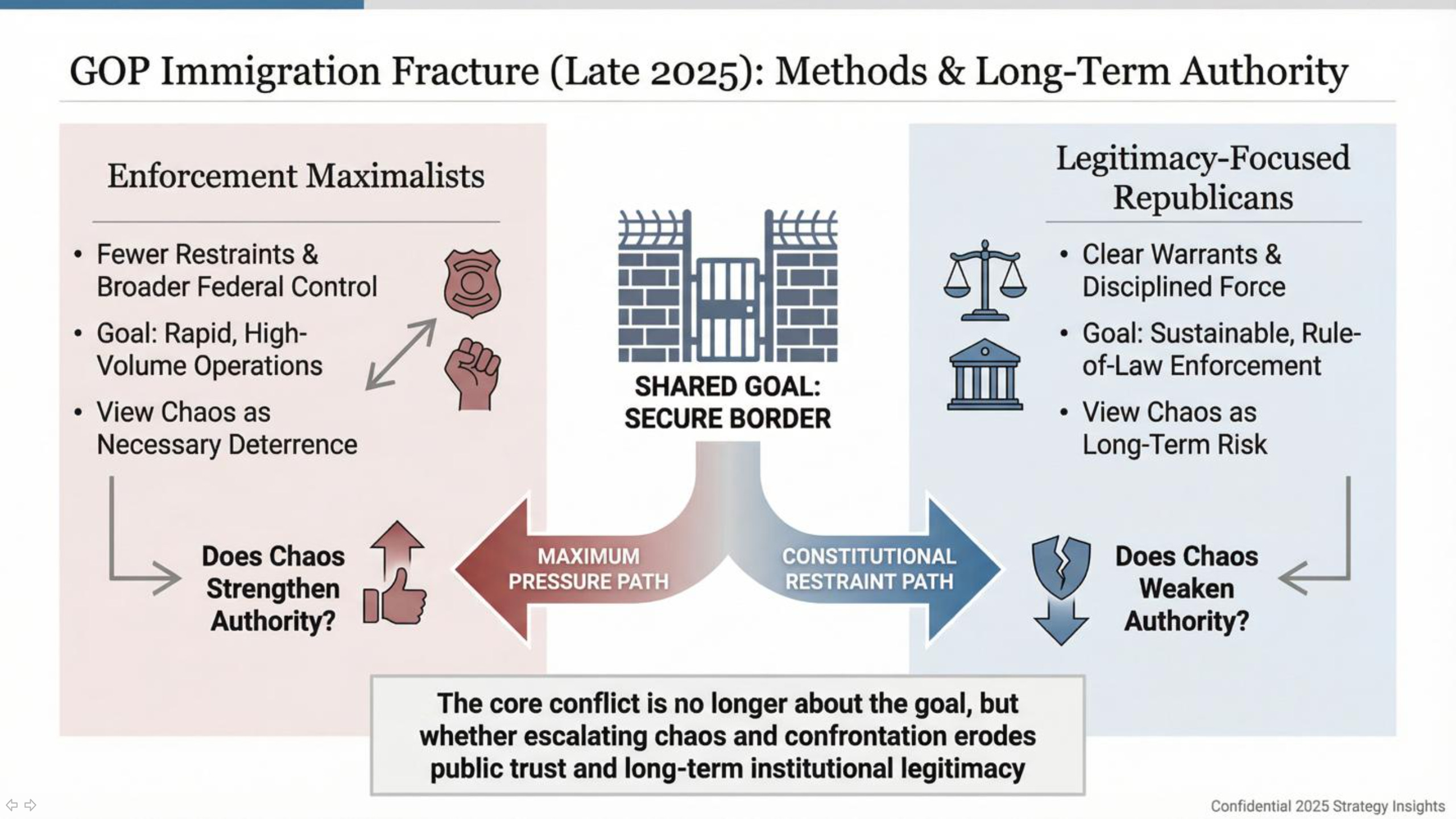
As immigration enforcement intensified through 2025, the Republican internal conflict shifted from whether to crack down to how to handle the backlash that followed. One GOP faction treated public resistance as proof the administration needed to go harder—more raids, faster removals, tighter penalties for interference, and fewer constraints on federal agents. In this view, clashes in the streets were a deterrence opportunity: if crowds disrupt arrests, then the response should be sharper enforcement, broader federal authority, and tougher consequences for anyone obstructing operations.
A competing Republican faction—often aligned with constitutional restraint, federalism instincts, or local governance realities—worried that aggressive, militarized tactics were producing the very instability that would boomerang politically and legally. They pointed to episodes where confrontation escalated quickly: crowds in the Midwest pelting agents with snowballs during arrests; a tense incident outside San Francisco’s immigration courthouse in July involving an ICE vehicle pushing through protesters; and the October Alameda episode near Coast Guard facilities where a vehicle confrontation ended with shots fired and injuries. For these Republicans, the issue wasn’t sympathy for “sanctuary” politics—it was the risk that high-friction raids, ambiguous use-of-force moments, and blurred lines between policing and paramilitary operations would erode public trust, trigger lawsuits, and force local law enforcement into impossible positions.
By late 2025, the Republican divide was clear: enforcement maximalists argued unrest justified loosening restraints and escalating federal control, while legitimacy-focused Republicans argued the crackdown must be executed with tighter guardrails—clear warrants and protocols, disciplined use of force, and strategies that reduce flashpoints—because a policy that consistently generates chaotic street conflict can become self-defeating even if its goals are popular inside the party.
Cultural and Social Policy Clashes — Abortion
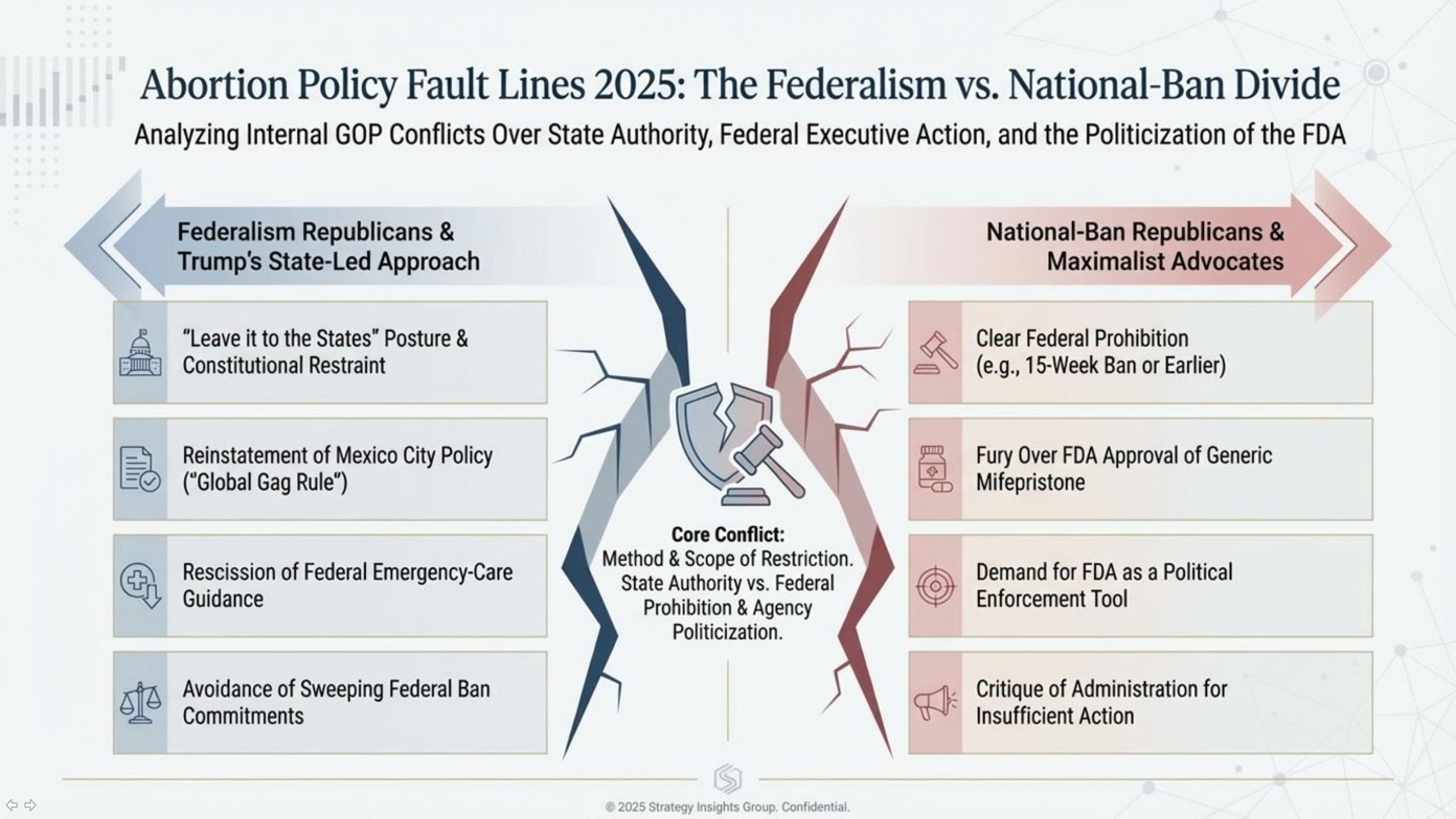
Abortion Policy — Federalism Republicans vs National-Ban Republicans (and a third split inside the administration): In 2025, the abortion fight inside the Republican coalition centered on how far federal power should go and which tools should be used. President Trump repeatedly leaned into a “leave it to the states” posture and resisted committing to a nationwide abortion ban, which immediately created friction with the party’s most maximalist anti-abortion wing that wanted a clear federal prohibition (often framed around 15 weeks or earlier). That tension didn’t stop the administration from taking restrictive federal actions that satisfied many social conservatives—most notably reinstating the Mexico City policy (“global gag rule”) early in the term and moving in June to rescind federal emergency-care guidance that had treated certain abortions as required stabilizing treatment in medical crises. Those moves were welcomed by Republicans who prioritize maximal abortion restriction through executive action, but they also heightened unease among Republican institutionalists and risk-management conservatives who worry about legal exposure, medical-system confusion, and political backlash when federal agencies intervene aggressively.
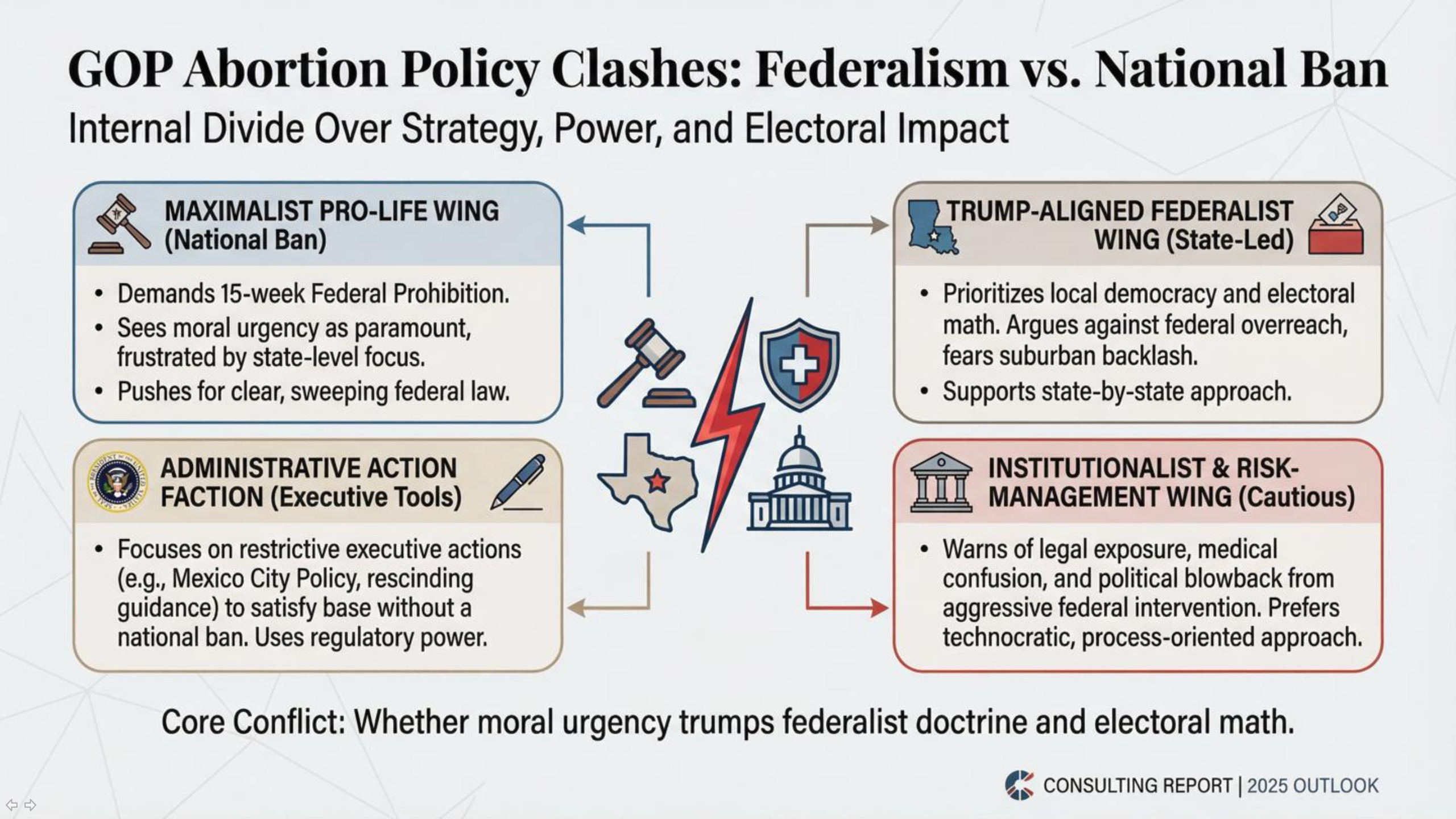
A second Republican split erupted in October 2025 when the FDA approved another generic version of mifepristone. Even though this followed standard regulatory logic (generic equivalence and existing safety controls), it triggered fury from anti-abortion leaders and some Republican lawmakers who viewed any expansion in the medication’s availability as a strategic defeat.
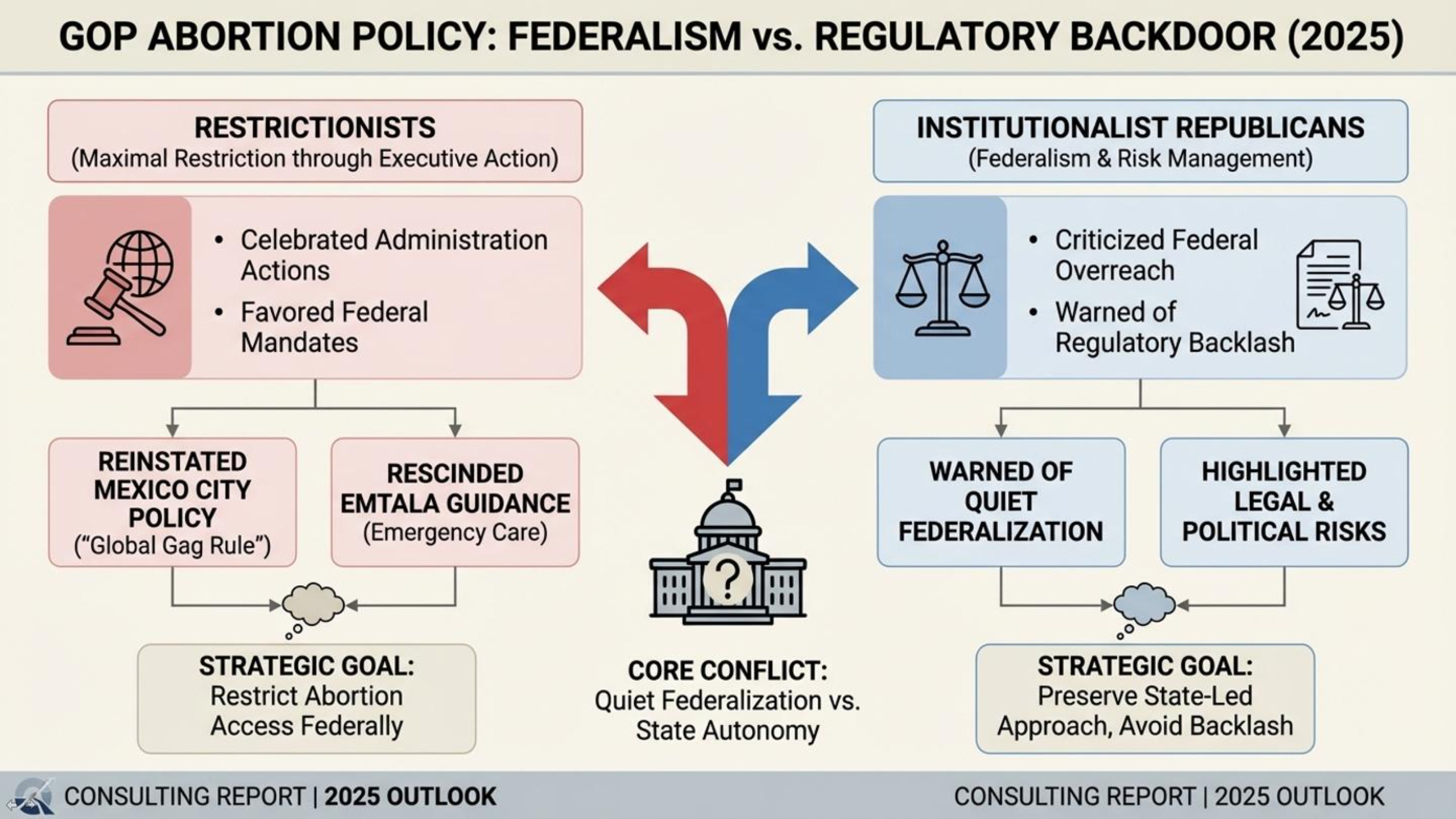
That backlash collided with a more technocratic, process-oriented faction—people inside the administration and the broader GOP ecosystem who argue that the FDA should not be turned into a political weapon and that a direct crackdown would invite courtroom losses and broader instability.
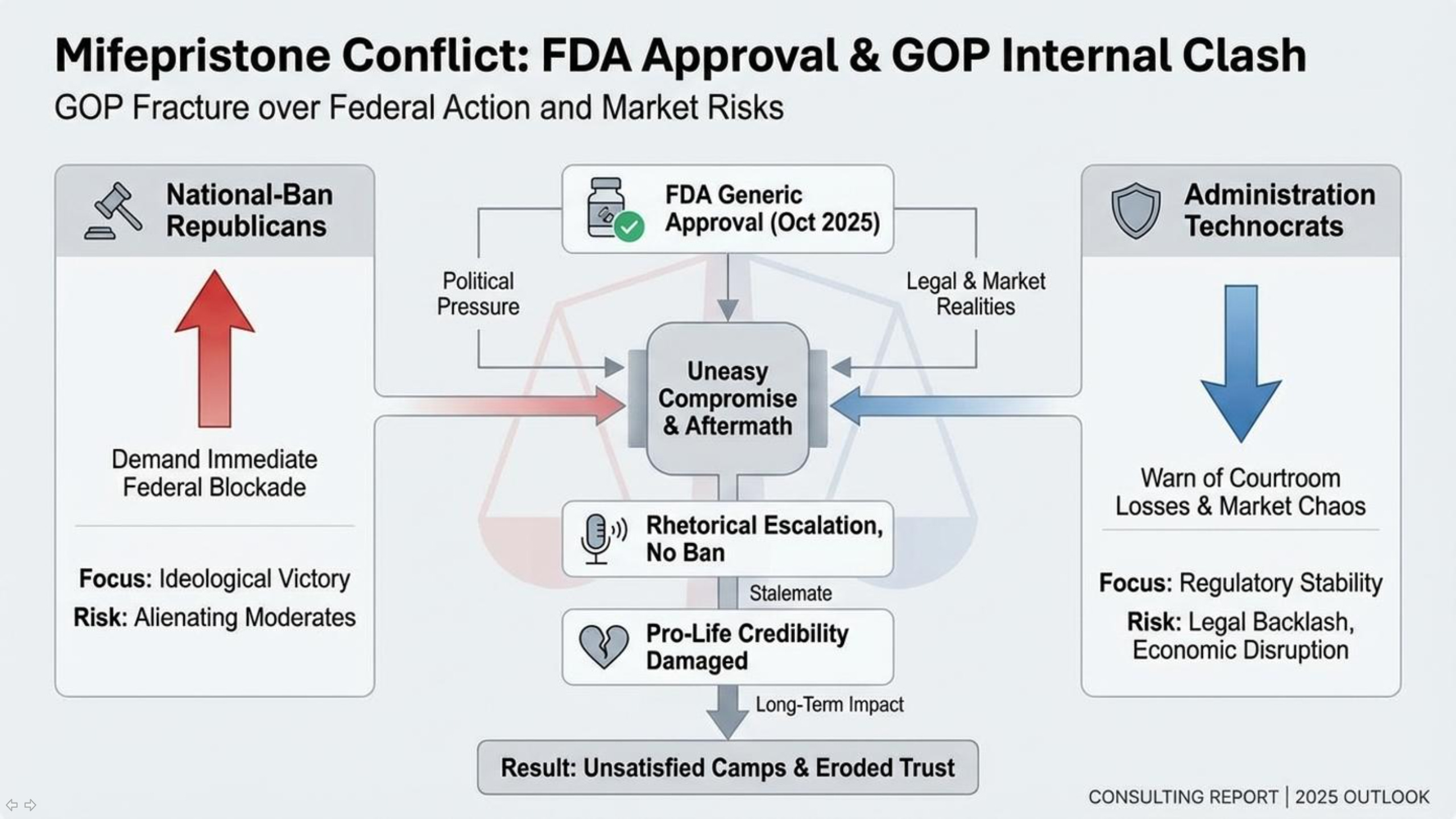
The result was an uneasy compromise that satisfied few: heightened rhetoric and signals of additional scrutiny, without an immediate, sweeping federal ban on the medication—leaving national-ban Republicans accusing the administration of not going far enough, while federalism-minded Republicans continued warning that the party was overreaching into an issue Trump had publicly framed as state-led.
Diversity Programs and “Woke” Backlash — GOP Culture-War Enforcers vs GOP Business Pragmatists
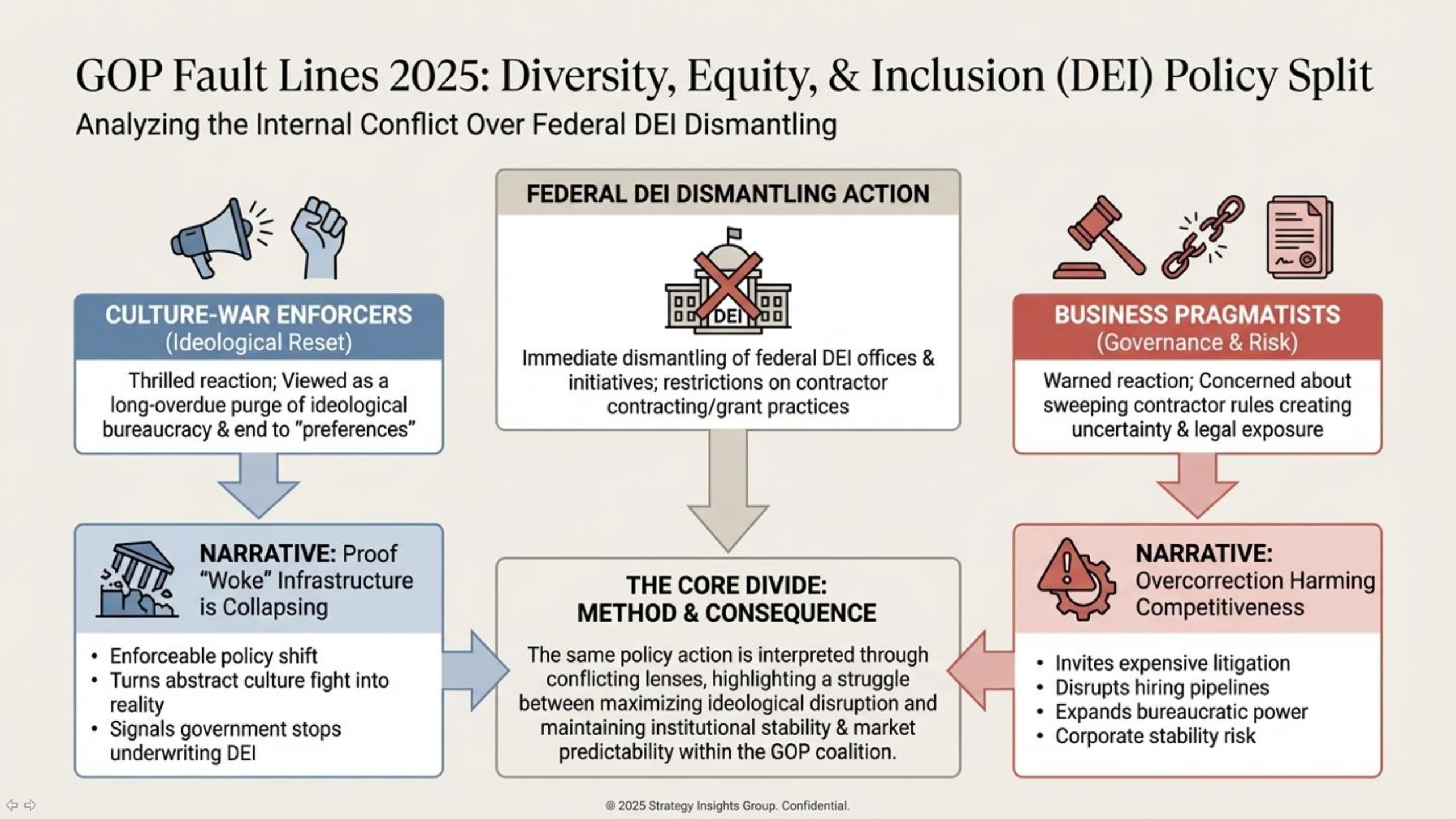
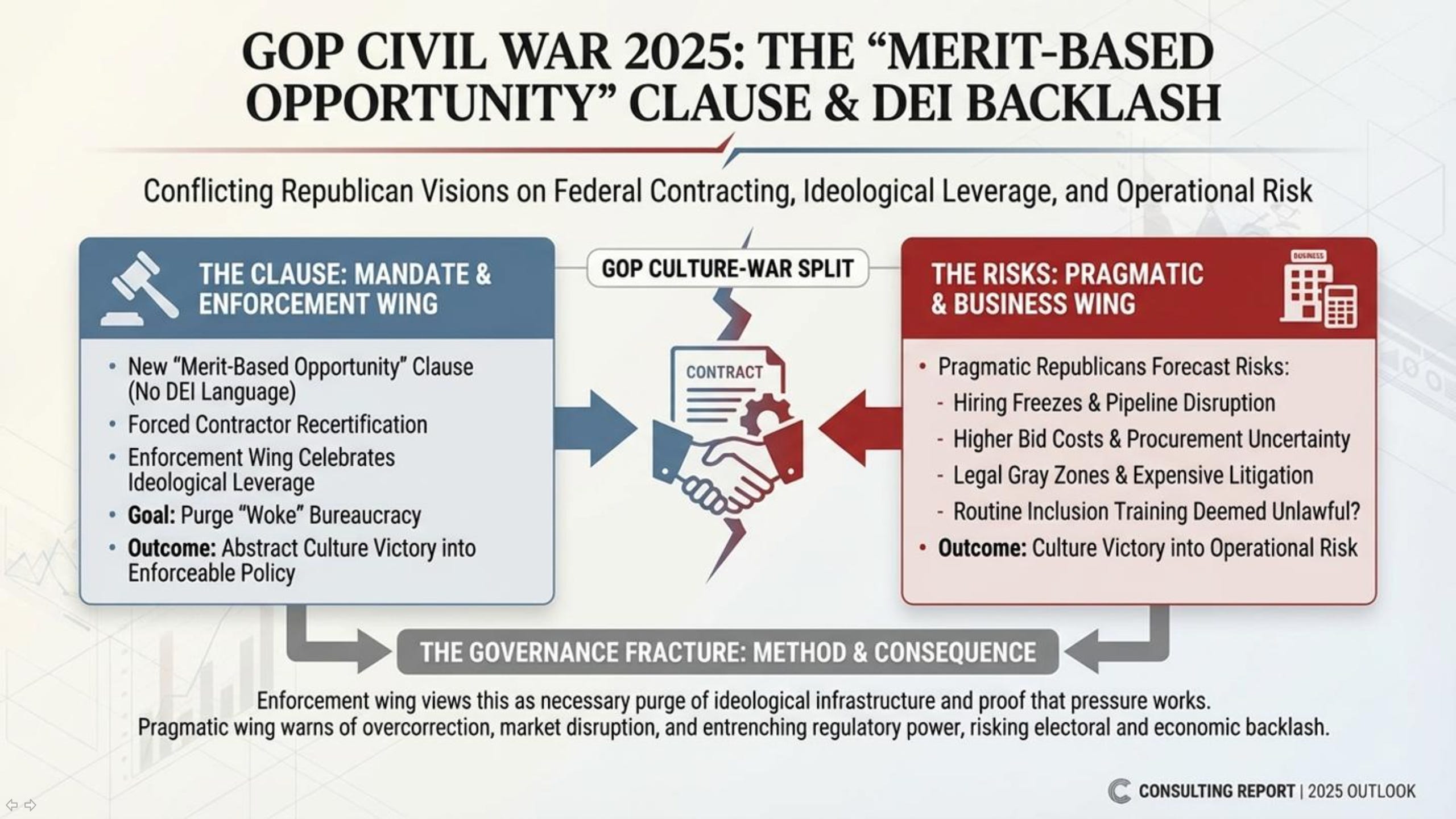
In 2025, the anti-DEI push became a major Republican-vs-Republican fault line because it mixed cultural politics with the machinery of government and the private economy. The Trump administration moved immediately to dismantle DEI offices and “equity” initiatives across federal agencies and to restrict DEI-related contracting and grant practices. A parallel executive action on “merit-based opportunity” went further by reshaping federal contractor obligations and revoking a long-standing affirmative-action framework that had governed how many contractors documented equal-employment compliance.
One Republican faction celebrated the crackdown as a long-overdue reset: purge what they saw as ideological bureaucracy, end “preferences,” and force institutions back toward a strict merit narrative. For them, eliminating DEI offices and embedding new certification and compliance expectations into contracts was the point—it turned an abstract culture fight into enforceable policy and signaled that the federal government would stop underwriting DEI as a default management practice.
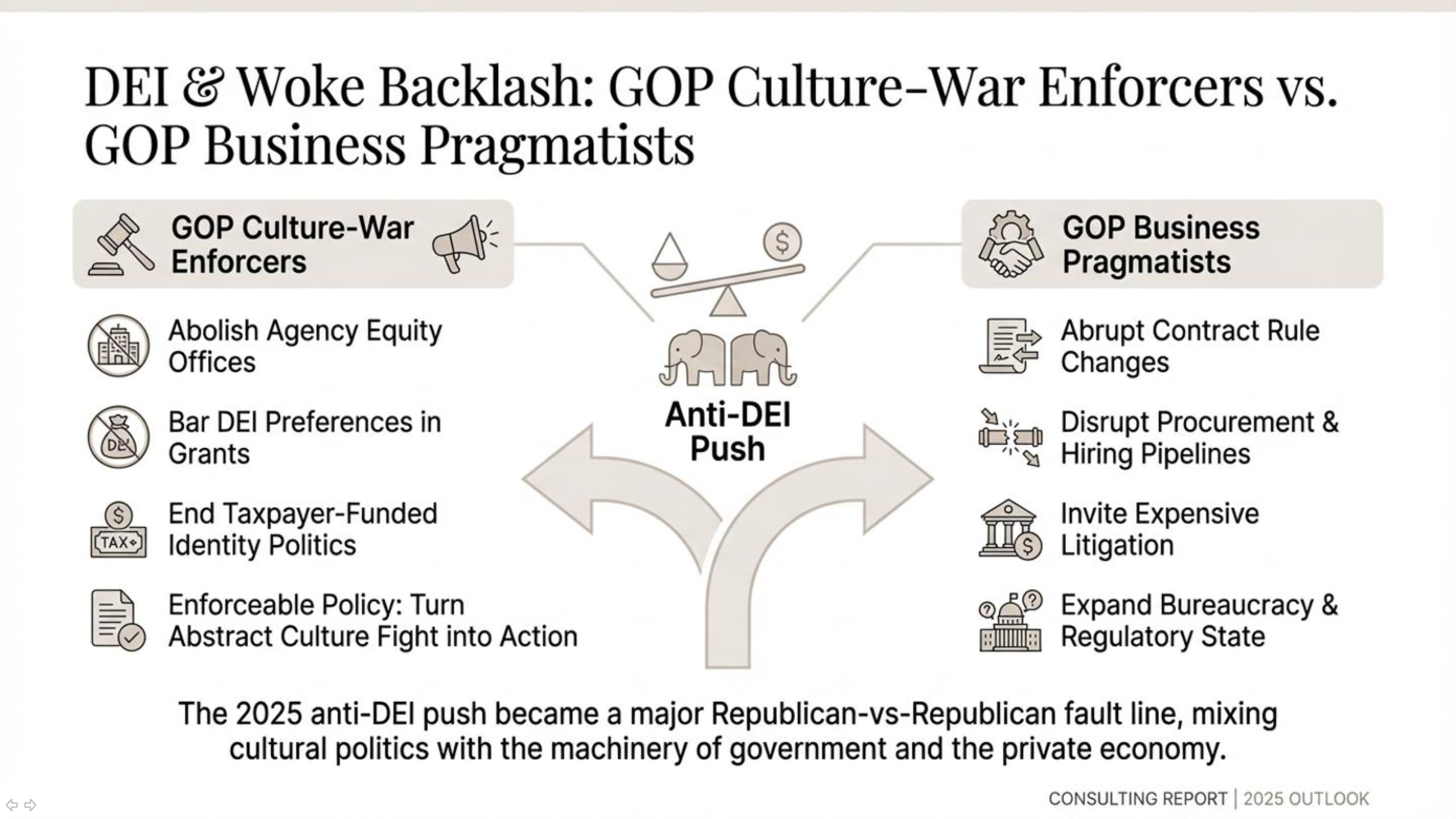
A competing Republican faction—more pro-business, process-oriented, and institutionally cautious—split off over method and risk. Many of these Republicans agreed with “no quotas” and “merit-first” principles, but worried that sweeping federal directives could disrupt hiring pipelines, create procurement uncertainty, invite expensive litigation, and push contractors into vague compliance traps where ordinary inclusion programs might be treated as prohibited.
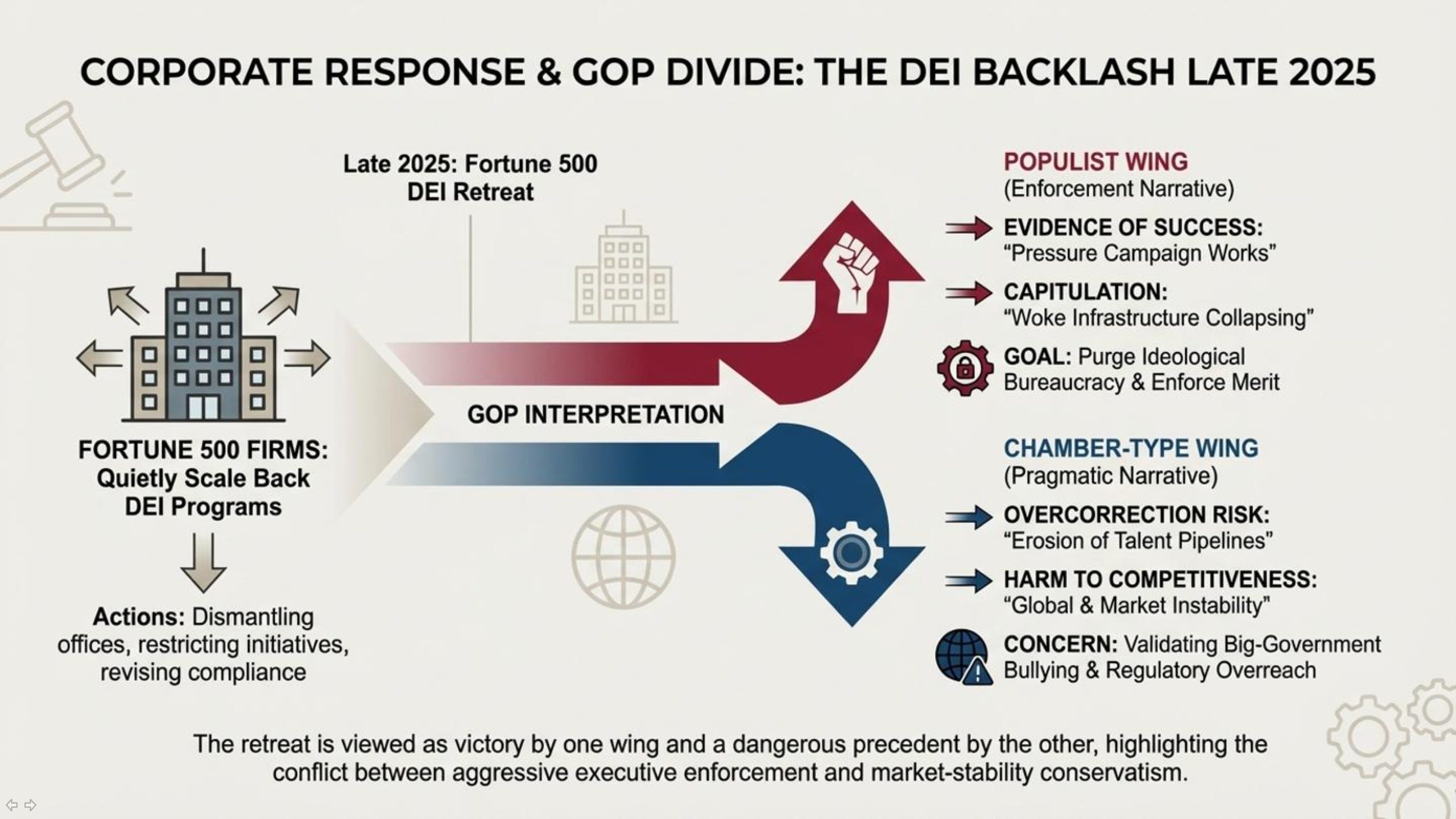
They also argued that using the federal contracting system as a cultural enforcement lever expands bureaucratic power in ways conservatives usually oppose, and that rapid, punitive shifts could backfire electorally and economically even if they energize the base.
By late 2025, as some major companies began scaling back or rebranding DEI efforts amid heightened legal and political scrutiny, Republicans interpreted the trend in opposite ways: the enforcement wing saw it as proof that pressure works and that “woke” infrastructure was collapsing, while the pragmatic wing warned it could turn into an overcorrection that harms competitiveness, recruitment, and corporate stability—while further entrenching the very regulatory state Republicans claim they want to shrink.
Climate and Environmental Policy Divisions — GOP “Energy Dominance” vs GOP “Innovation and Risk Management”
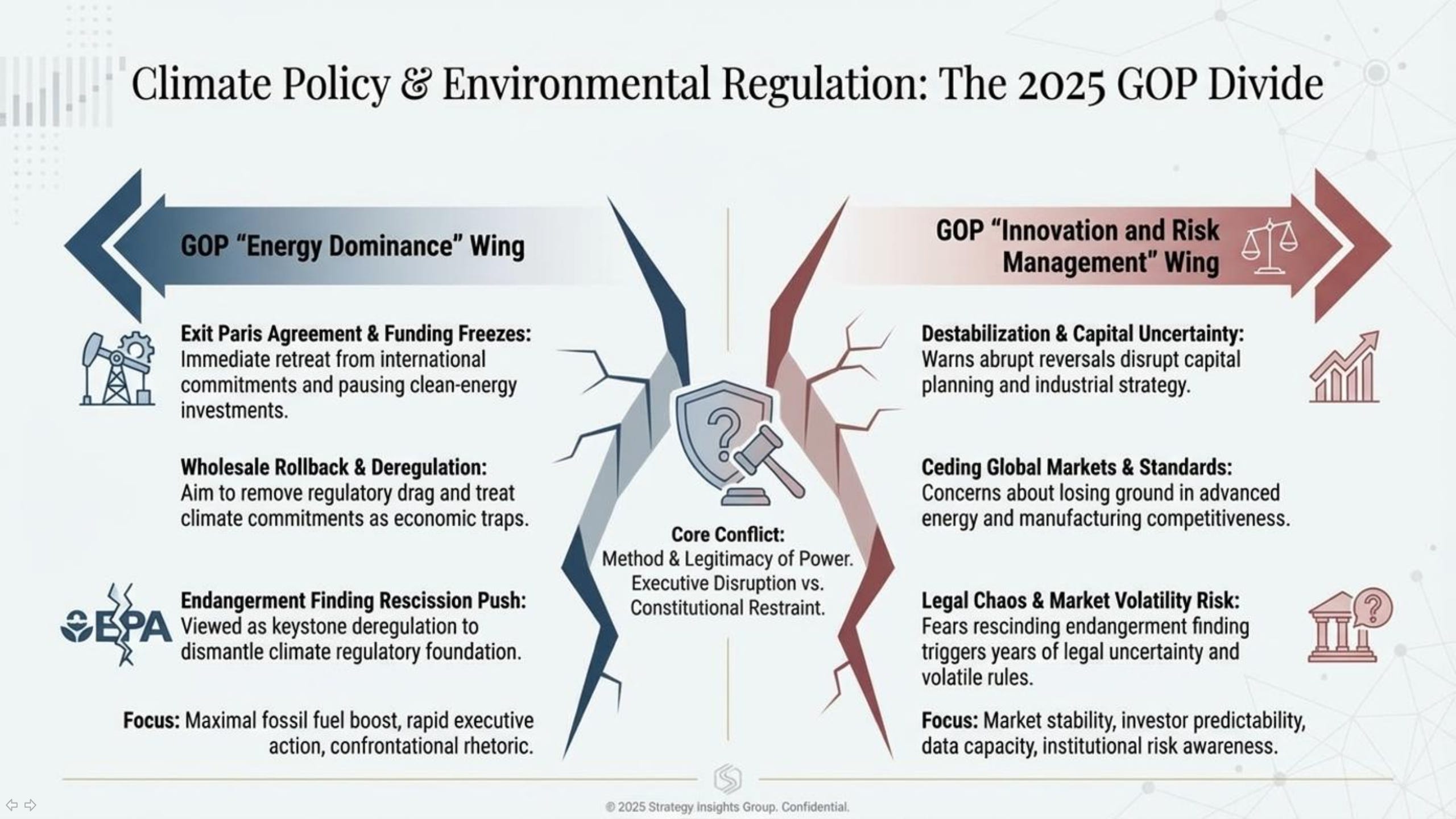
In 2025, climate policy became a Republican-vs-Republican split not just over beliefs about warming, but over strategy, markets, and America’s global posture. One faction—rooted in fossil-fuel states, deregulatory activists, and anti-“climate alarmism” messaging—praised the administration’s Day 1 retreat from the Paris Agreement and the “Unleashing American Energy” agenda that paused major clean-energy funding streams and signaled a wholesale rollback of climate-era rules. For these Republicans, the goal was clear: remove regulatory drag, boost drilling and pipelines, and treat climate commitments as an economic trap that constrains U.S. industry.
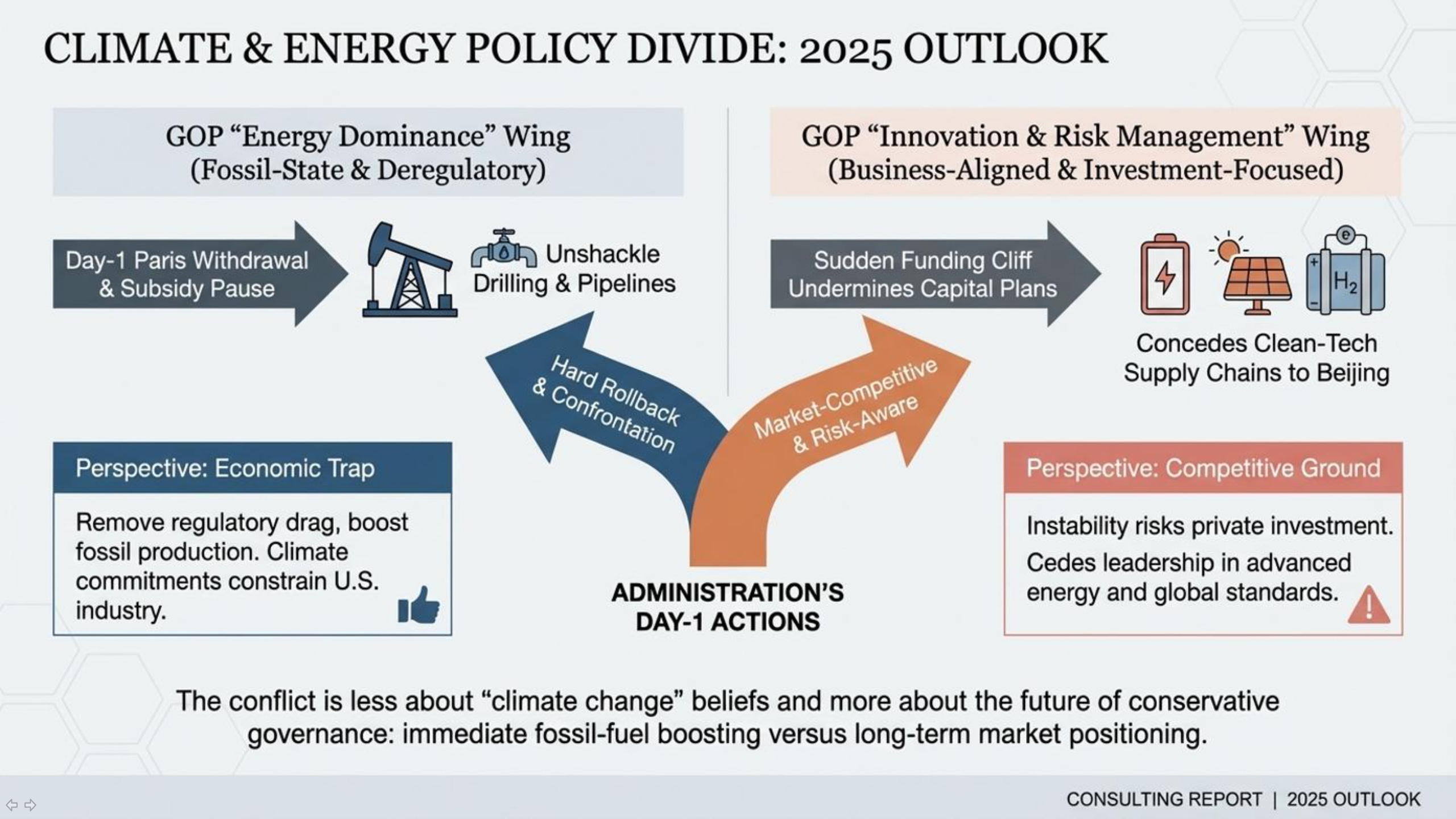
A competing Republican faction—more business-aligned, investment-focused, and governance-minded—did not necessarily embrace sweeping emissions mandates, but worried the administration’s approach created instability and ceded competitive ground in advanced energy, manufacturing, and global standards-setting. This wing viewed abrupt funding freezes, rapid reversals of agency posture, and inflammatory rhetoric as a risk to capital planning and industrial strategy, even if they agreed that regulations should be streamlined.
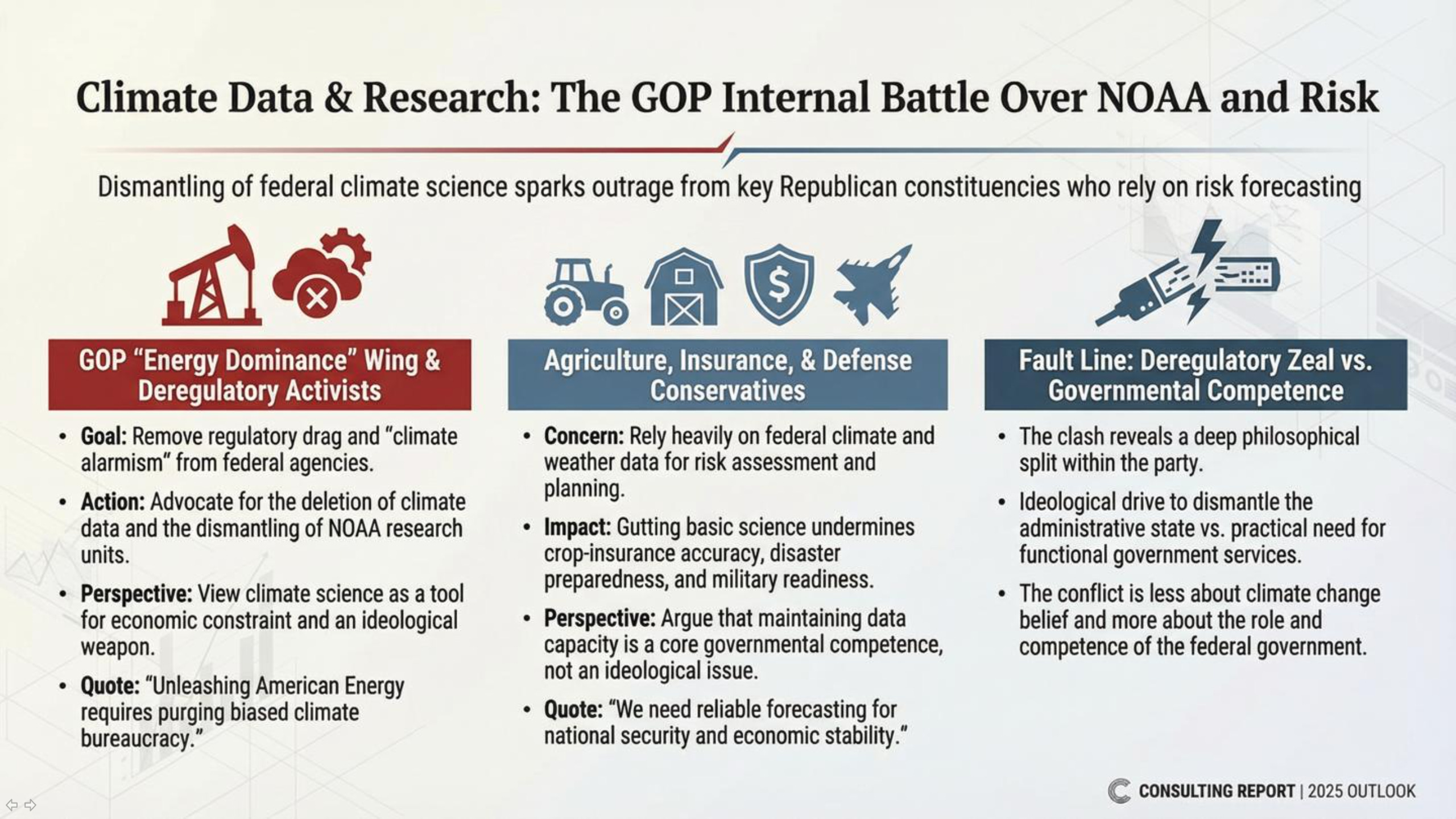
The intraparty fracture deepened as federal agencies moved beyond “policy rollback” into “science and infrastructure rollback.” Some Republicans defended removing climate-language from federal sites and dismantling research capacity as rooting out bias; others—especially those focused on disaster preparedness, agriculture, insurance markets, and military readiness—argued that cutting or degrading federal climate and weather research undermines the government’s basic duty to provide reliable data for risk forecasting and emergency planning.
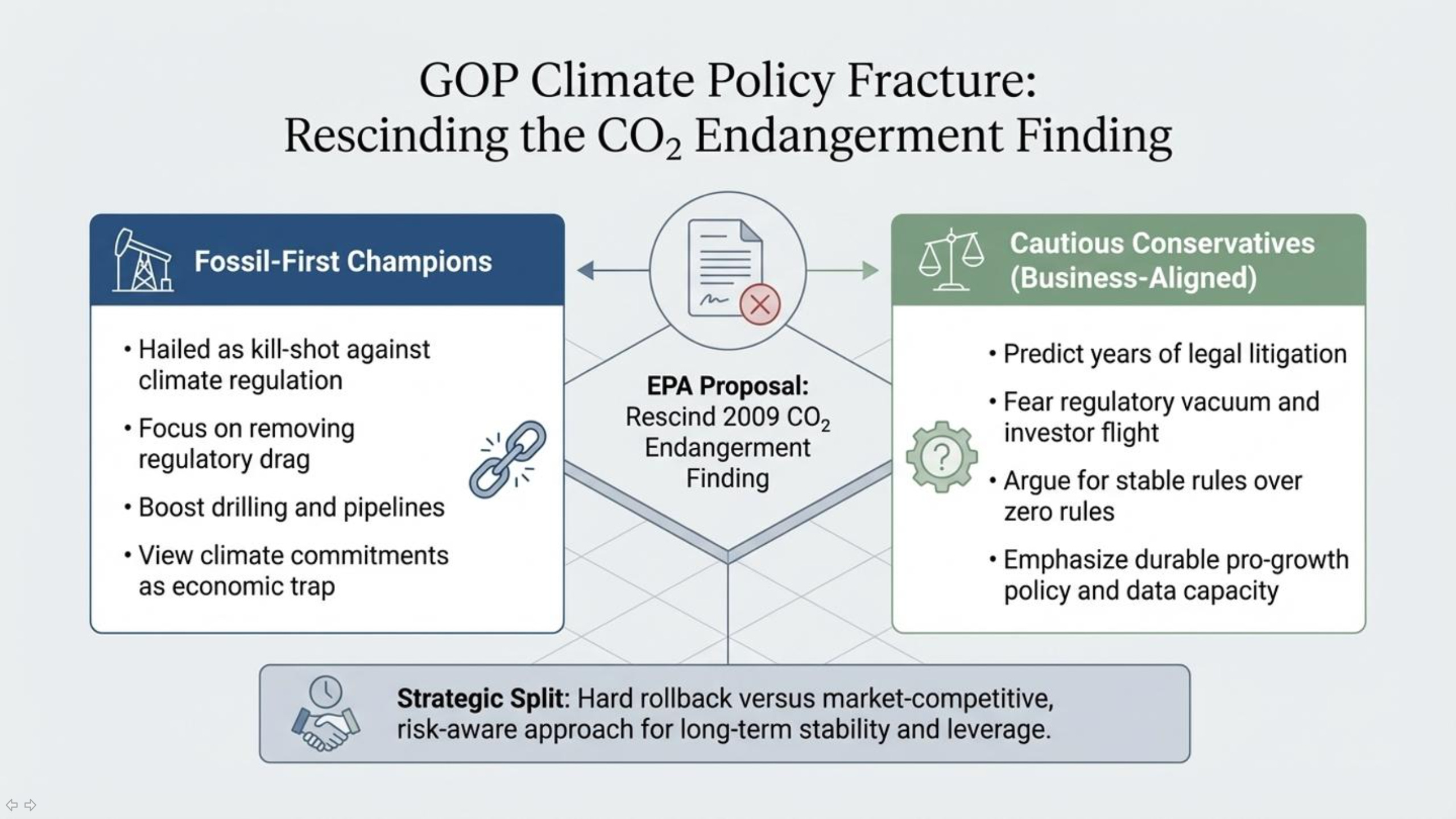
The sharpest policy-line split came when the EPA advanced steps to unwind the legal foundation for regulating greenhouse gases by proposing to rescind the endangerment finding. Deregulation-first Republicans celebrated this as the keystone for dismantling a costly regulatory regime. Caution-first Republicans warned it would trigger years of legal uncertainty and market volatility, leaving businesses and states without stable rules of the road.
By the end of 2025, the Republican climate conflict looked less like a single argument about “climate change” and more like a struggle over what kind of conservative governance wins: hard rollback and rhetorical confrontation versus a market-competitive, risk-aware approach that still restrains regulation but preserves data capacity, investor predictability, and U.S. leverage abroad.
Tariffs and Trade — Populist Protectionists vs Pro-Market Republicans (and a second split over executive power)
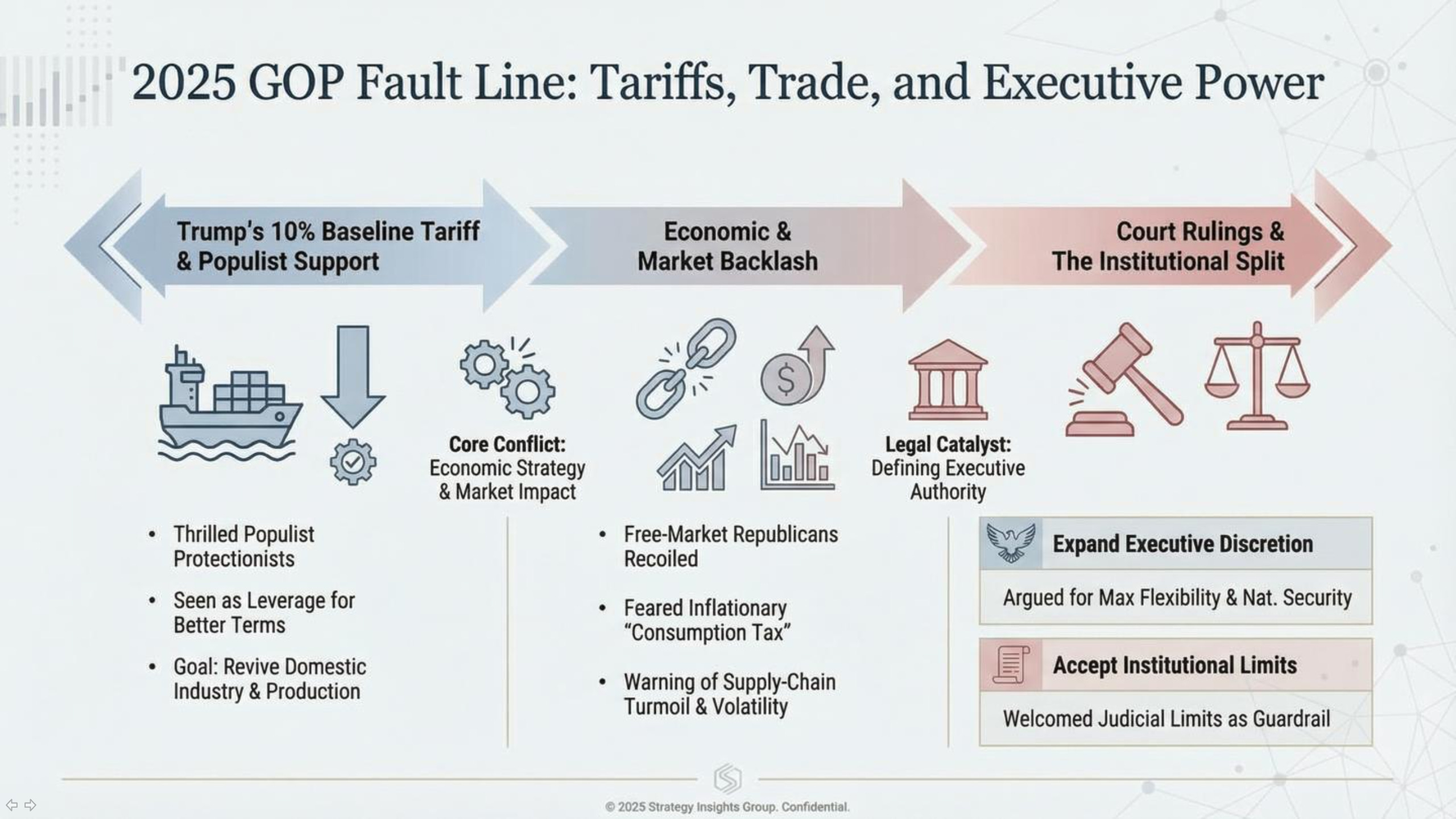
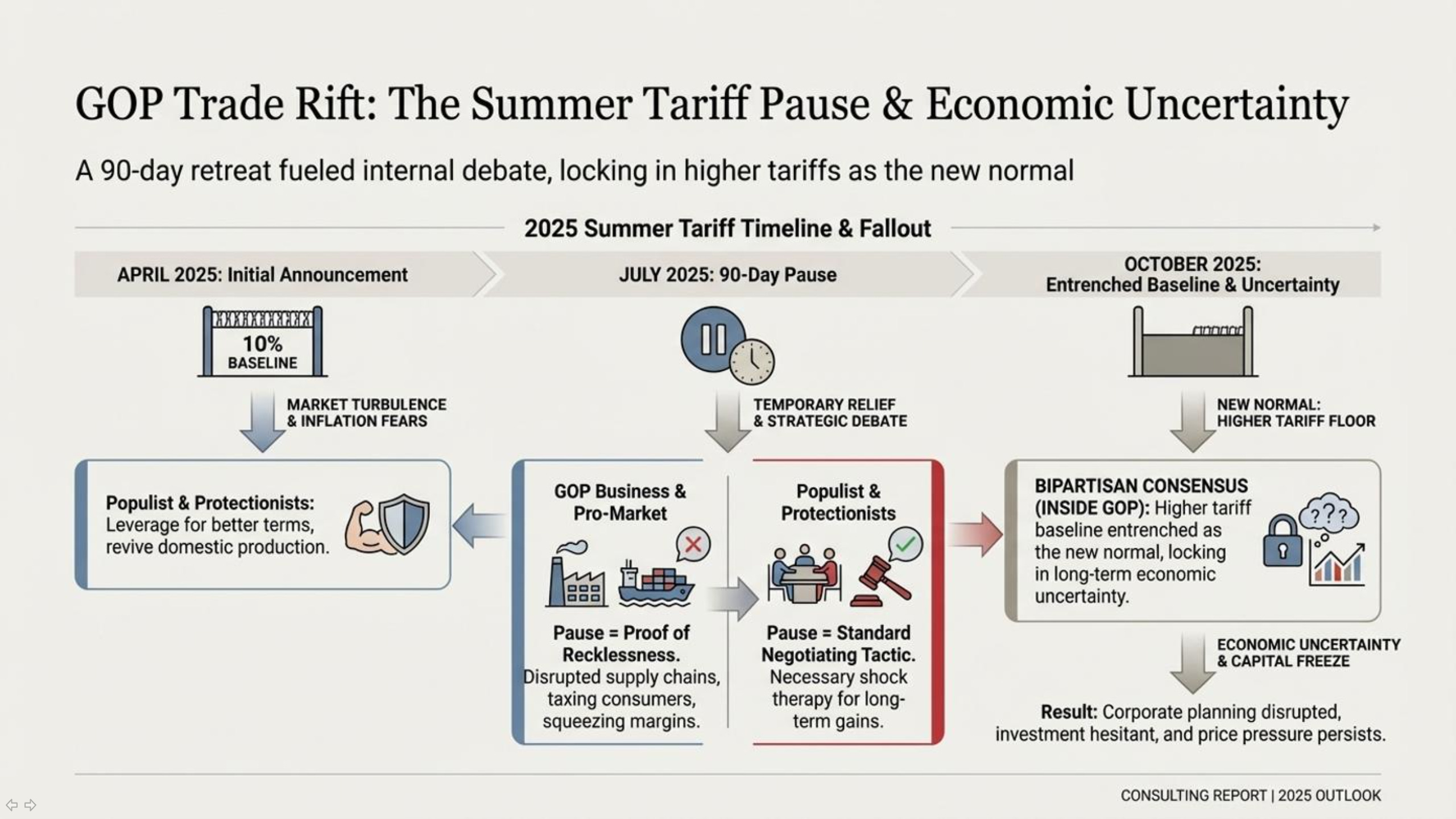
In 2025, trade policy became a loud Republican-vs-Republican fight over whether “economic nationalism” should be the party’s default. Trump’s “Liberation Day” announcement on April 2—built around a broad 10% baseline tariff and additional country-specific “reciprocal” rates—was championed by populist trade hawks inside the GOP as a show of leverage meant to force better terms, revive domestic production, and punish chronic trade imbalances.
But pro-business and free-market Republicans recoiled as markets sold off and major importers warned the plan functioned like a sweeping consumption tax that would feed inflation, disrupt supply chains, and inject uncertainty into capital planning. The White House’s subsequent 90-day pause on key elements of the rollout crystallized the split: one faction framed the volatility as necessary shock therapy, while the other saw it as preventable turbulence that risked turning “toughness” into economic self-harm.
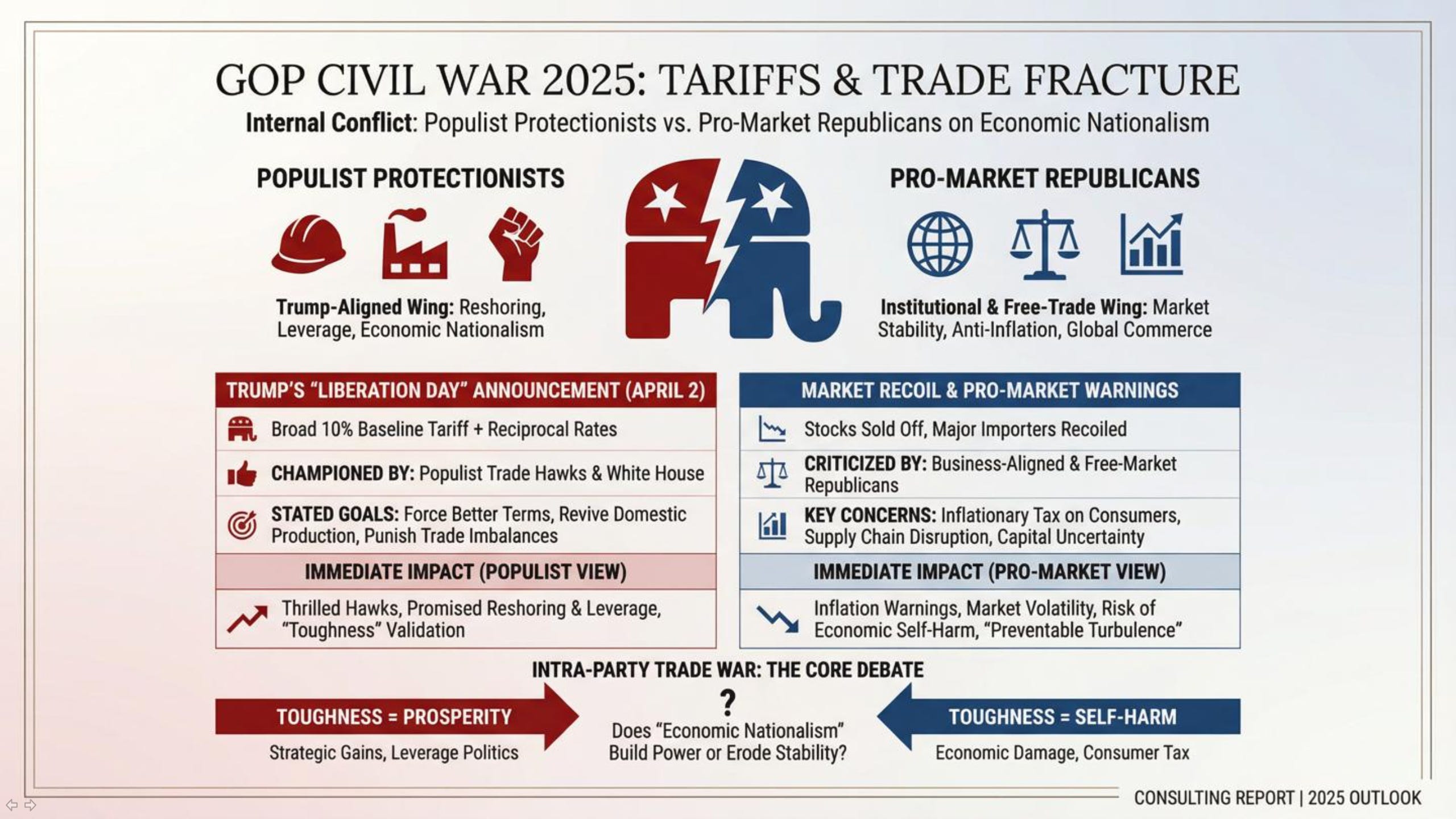
Over the summer, the same intraparty conflict reappeared around deal-making: Trump’s team touted new frameworks—including a major U.S.–EU arrangement built around a broad tariff ceiling—as proof that hardball tactics worked, and trade populists celebrated the headline terms and investment pledges as validation. Free-market Republicans, meanwhile, argued these agreements still normalized a higher-tariff baseline, locking in price pressure and forcing companies to operate under politicized trade rules rather than predictable market access. By early fall, tariff-linked inflation estimates and corporate disclosures about absorbed tariff costs became ammunition in the GOP argument: the populist wing insisted short-term price increases were worth the strategic gains, while business-aligned Republicans warned the policy was quietly taxing consumers and squeezing margins.
A separate Republican fracture opened in the courts: when the Federal Circuit ruled (7–4) that major tariffs imposed under emergency authority exceeded statutory limits, it triggered a full-blown separation-of-powers dispute inside the party. Executive-power Republicans argued the president needs maximum flexibility to act swiftly on trade for national security and resilience.
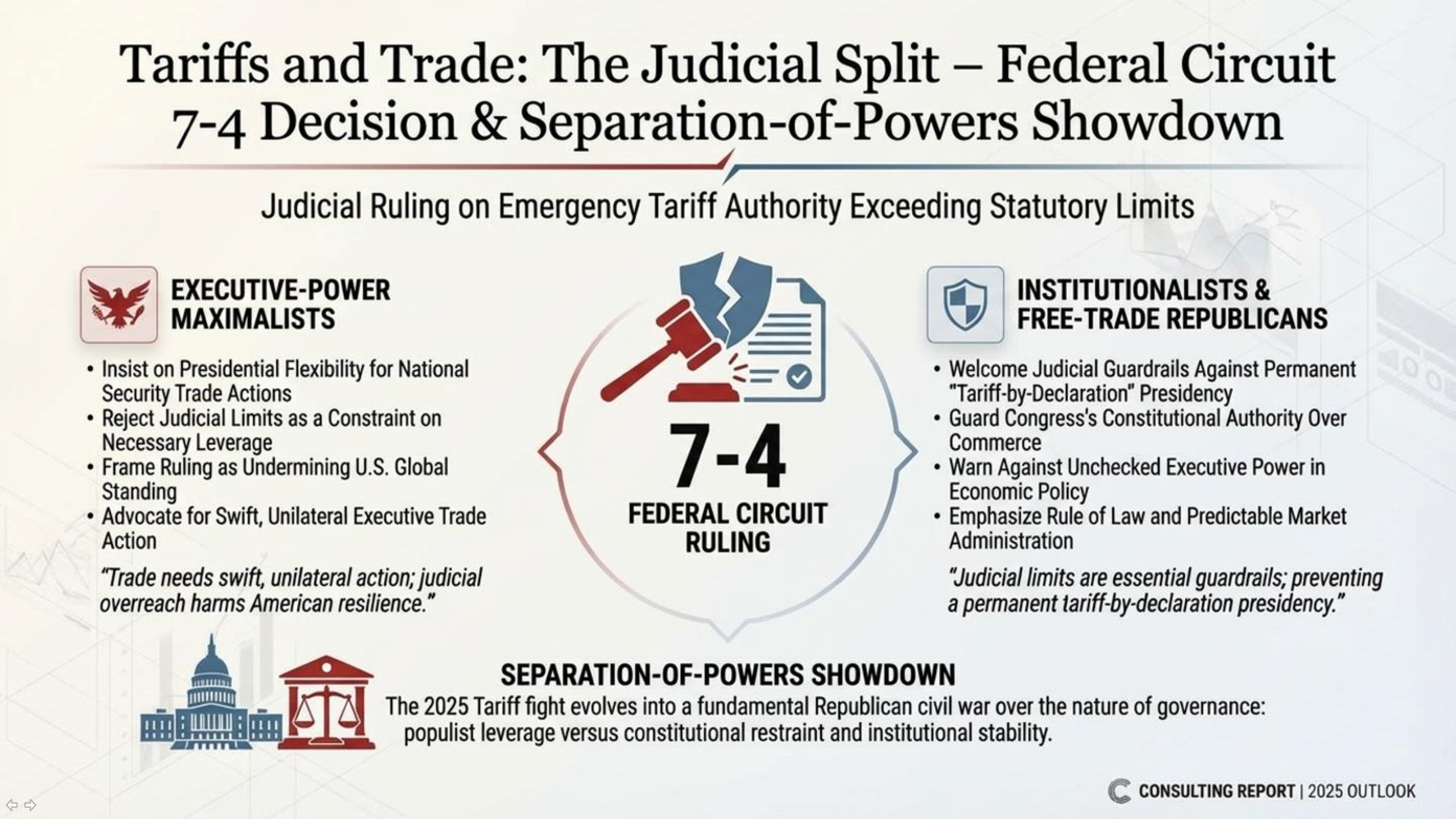
Institutional and free-trade Republicans—often uneasy with expanding emergency powers—welcomed the prospect of judicial limits as a guardrail against a permanent “tariff-by-declaration” presidency. In short, the 2025 tariff fight wasn’t only about trade policy; it was also a Republican civil war over what kind of party governs: populist leverage politics with broad presidential discretion, or market-stability conservatism constrained by rules, institutions, and predictable economic administration.
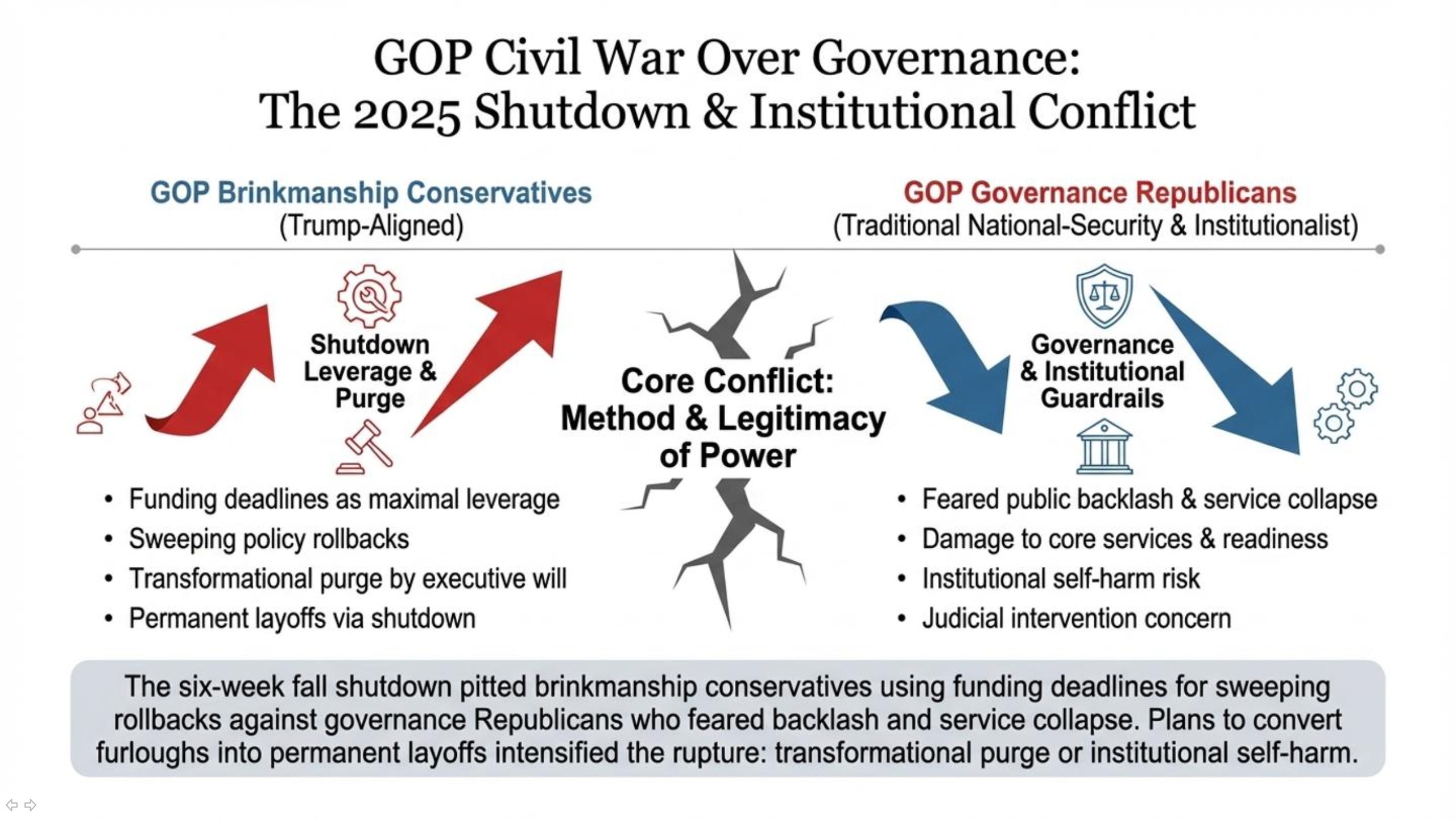
Record Government Shutdown — GOP Brinkmanship vs GOP Governance (and a fight over who controls the purse)
The fall 2025 shutdown (October 1–November 12) became less a party-vs-party story than a Republican civil war over tactics, authority, and the future size of government. One faction—White House-aligned hardliners and House confrontationalists—treated the shutdown as leverage: use the funding deadline to force sweeping policy wins, lock in major spending rollbacks, and prove that the executive branch can reshape government by willpower. A rival faction—Senate institutional conservatives and swing-district pragmatists—wanted a cleaner funding path, warning that prolonged closure would trigger public backlash, damage core services, and hand courts a reason to intervene.
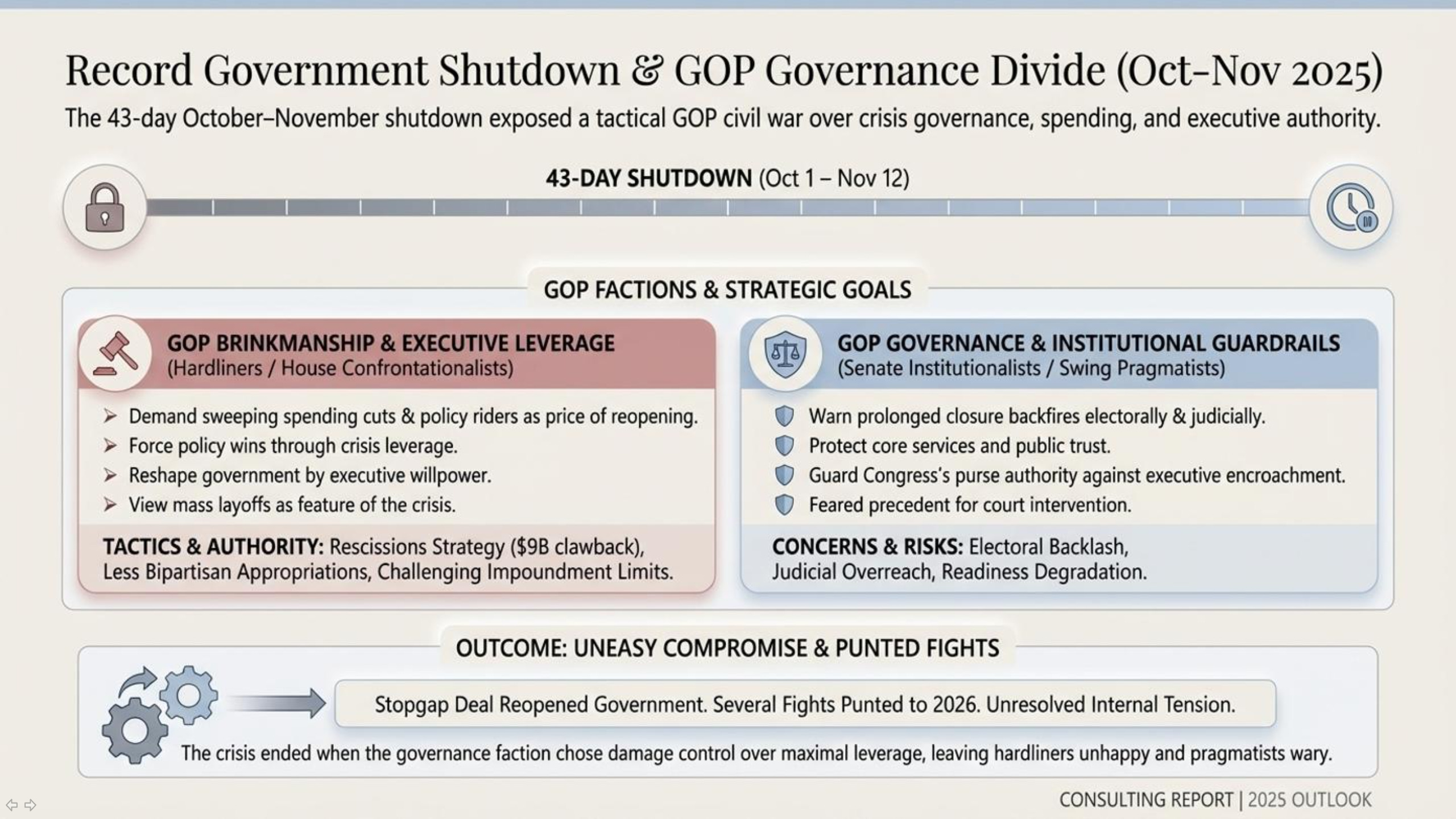
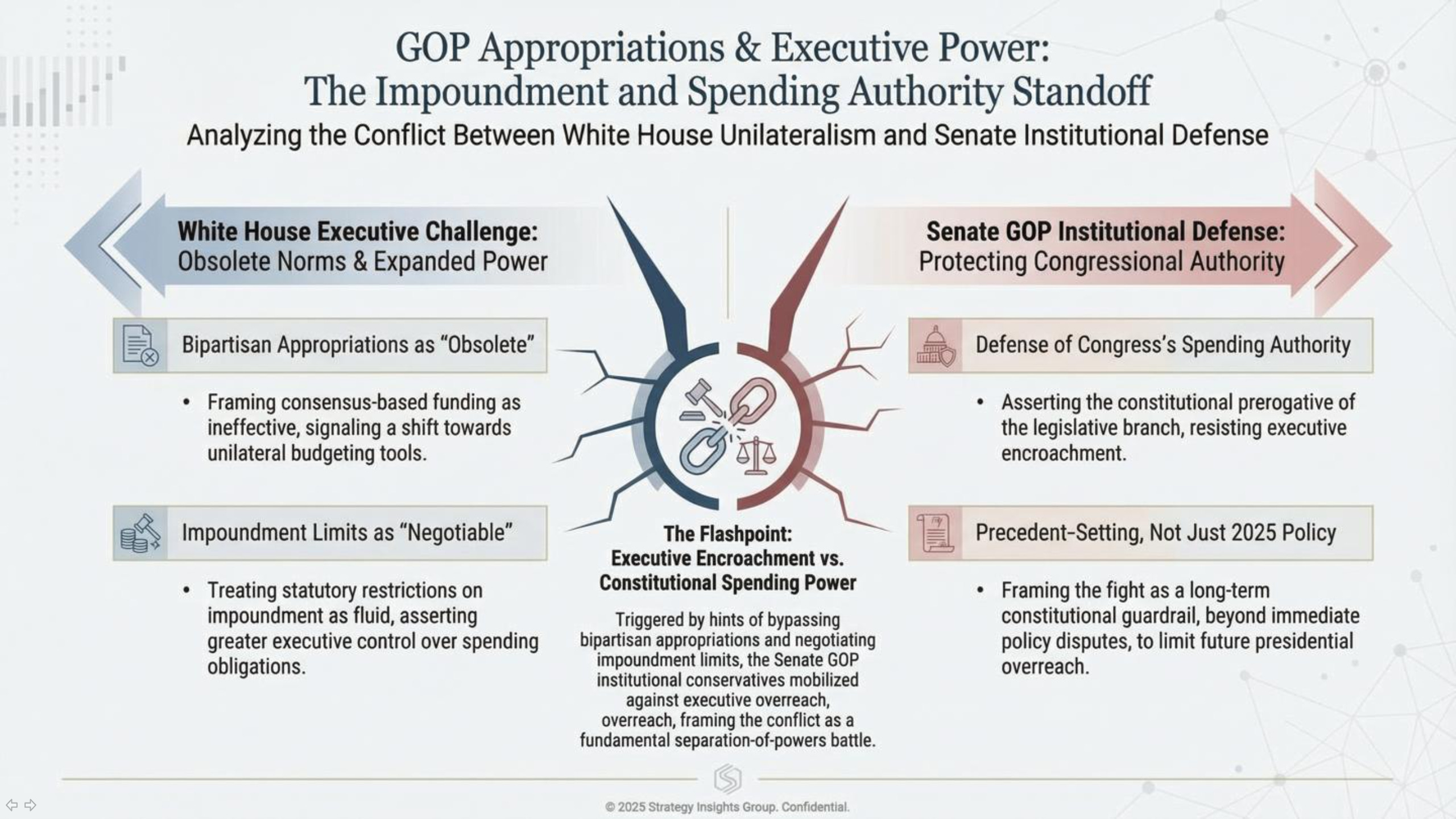
That split had been building for months through the rescissions strategy pushed by the administration and OMB leadership: clawing back roughly $9 billion in previously approved spending became a litmus test inside the GOP.
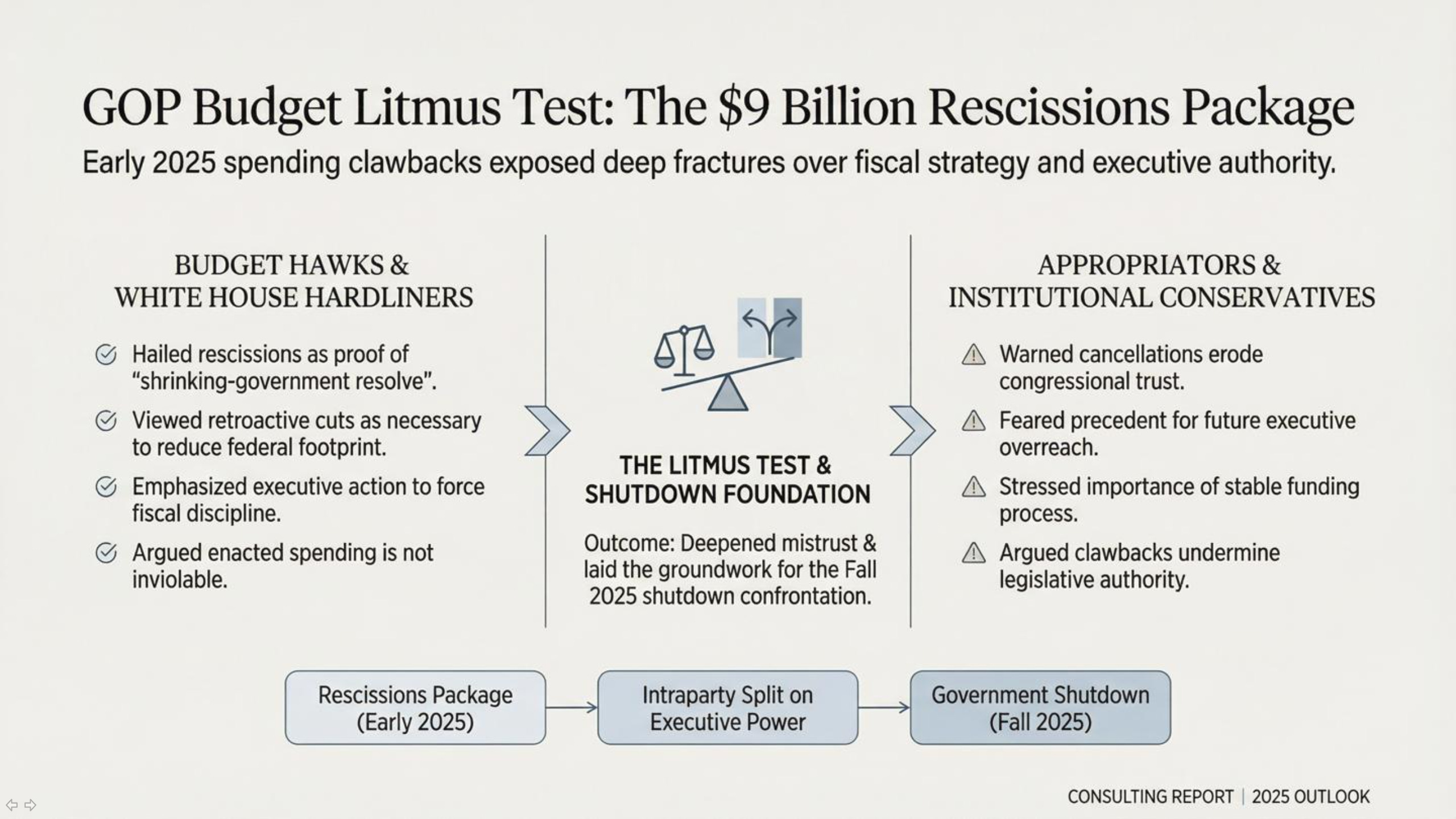
Budget cutters hailed it as proof that the party finally meant it about shrinking government; a smaller bloc of Republican senators and appropriations-minded Republicans resisted, arguing it undermined trust in the basic process of legislating and funding government.
When senior administration officials suggested the appropriations process should become explicitly less bipartisan—and even hinted at treating statutory limits on impoundment as negotiable—Senate Republicans who guard Congress’s spending authority bristled, seeing it as an executive encroachment that would outlast any single policy dispute.
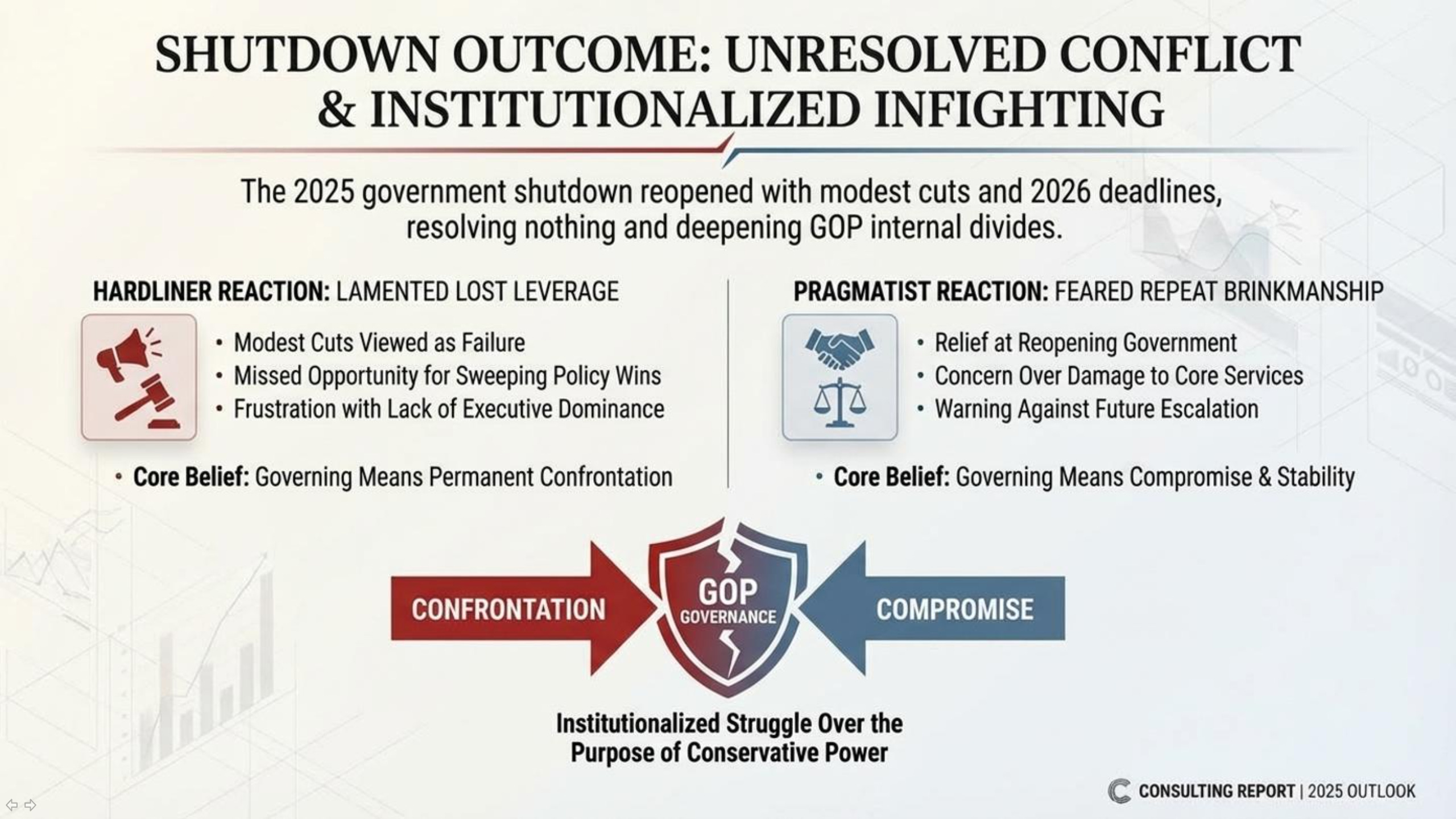
During the shutdown itself, the intraparty argument sharpened into a direct clash over escalation. Hardliners urged staying closed until maximal demands were met. Pragmatists and leadership figures, watching opinion turn and essential systems strain, pressed for an off-ramp.
The most explosive internal rupture came when the White House signaled it would use the shutdown not only to furlough workers but to tee up permanent reductions in force—mass layoff planning that previous shutdowns had not attempted. Conservatives who favor a “purge-the-bureaucracy” approach embraced this as a feature of the crisis; defense- and security-focused Republicans, along with institutionalists, warned that using a funding lapse as a pretext for lasting workforce cuts risked harming readiness, degrading essential capacity, and setting a precedent that courts would likely block.
The shutdown ended when the GOP’s governance faction effectively chose damage control over maximal leverage: a stopgap deal reopened the government and punted several fights into 2026, leaving hardliners unhappy that the crisis did not produce total victory and leaving pragmatists wary that the same internal showdown would repeat at the next deadline.
Battle with the “Deep State” and Civil Society — GOP “Purge & Punish” vs GOP “Rule-of-Law & Institutional Guardrails”
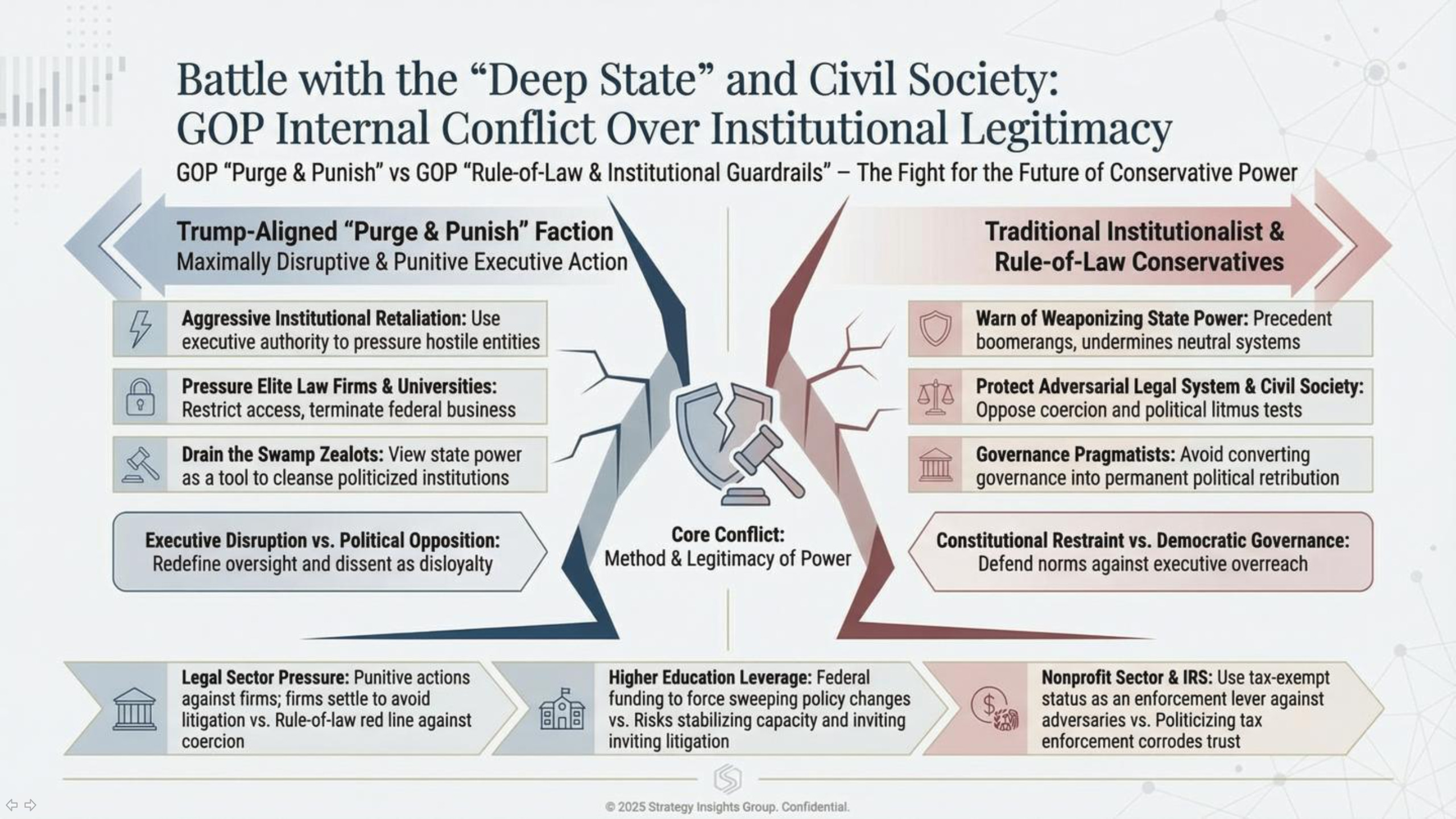
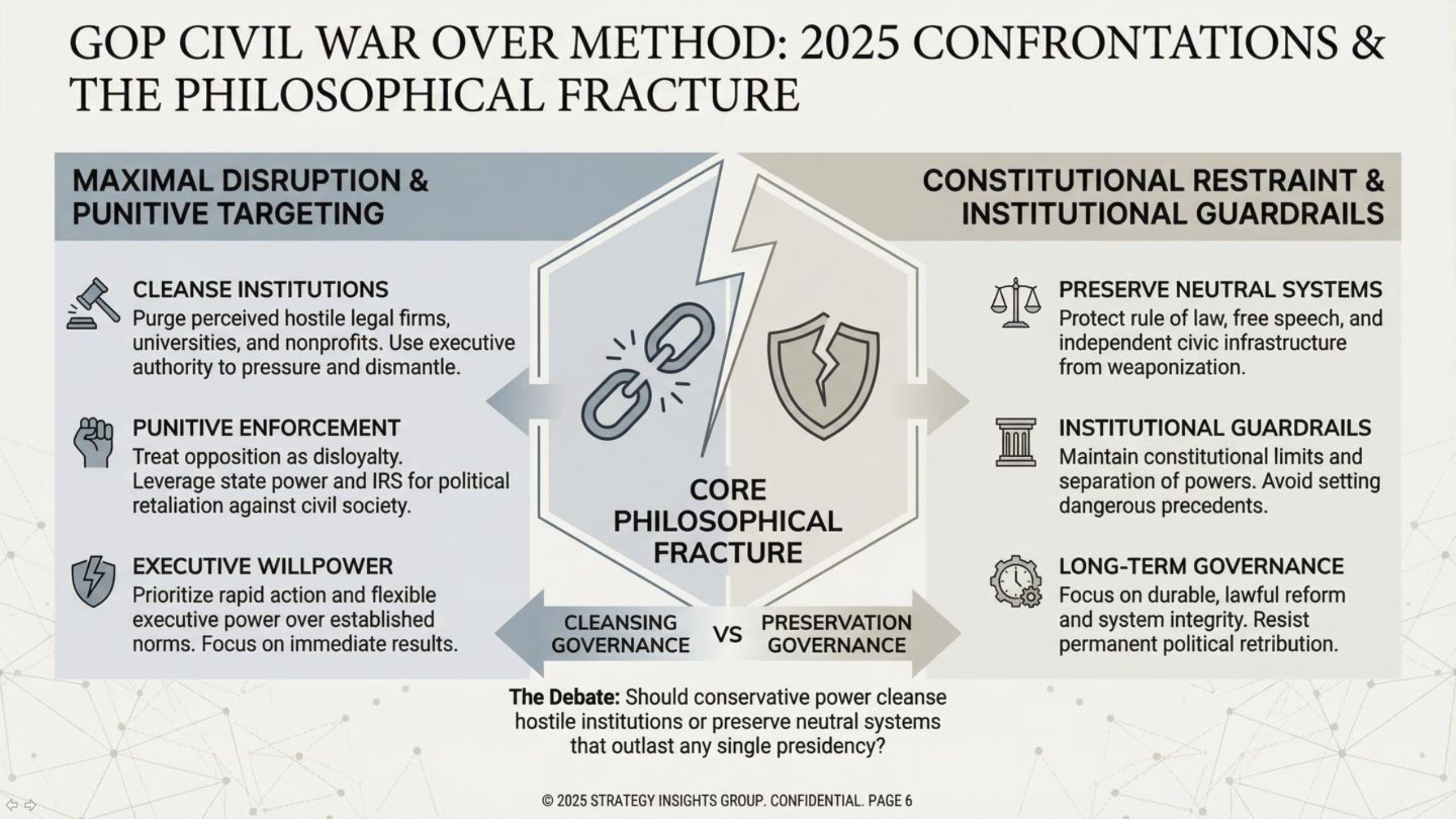
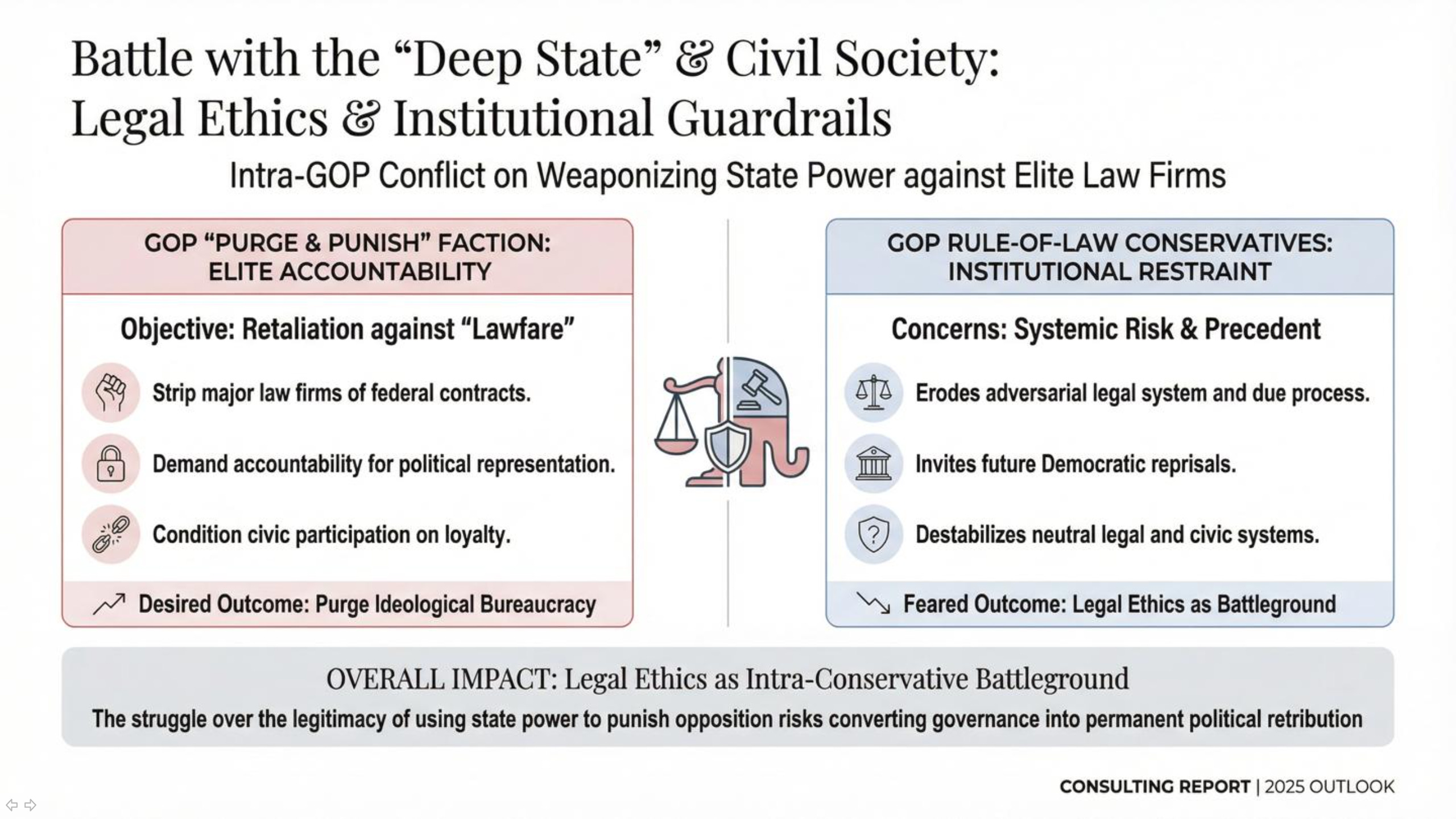
In 2025, Trump’s confrontation with institutions didn’t just polarize the country—it split Republicans into two competing instincts about how conservative power should be used. One faction, aligned with the “deep state” narrative, embraced aggressive institutional retaliation as a feature: use executive authority to pressure elite law firms, universities, and nonprofits that are seen as hostile to the administration’s agenda.
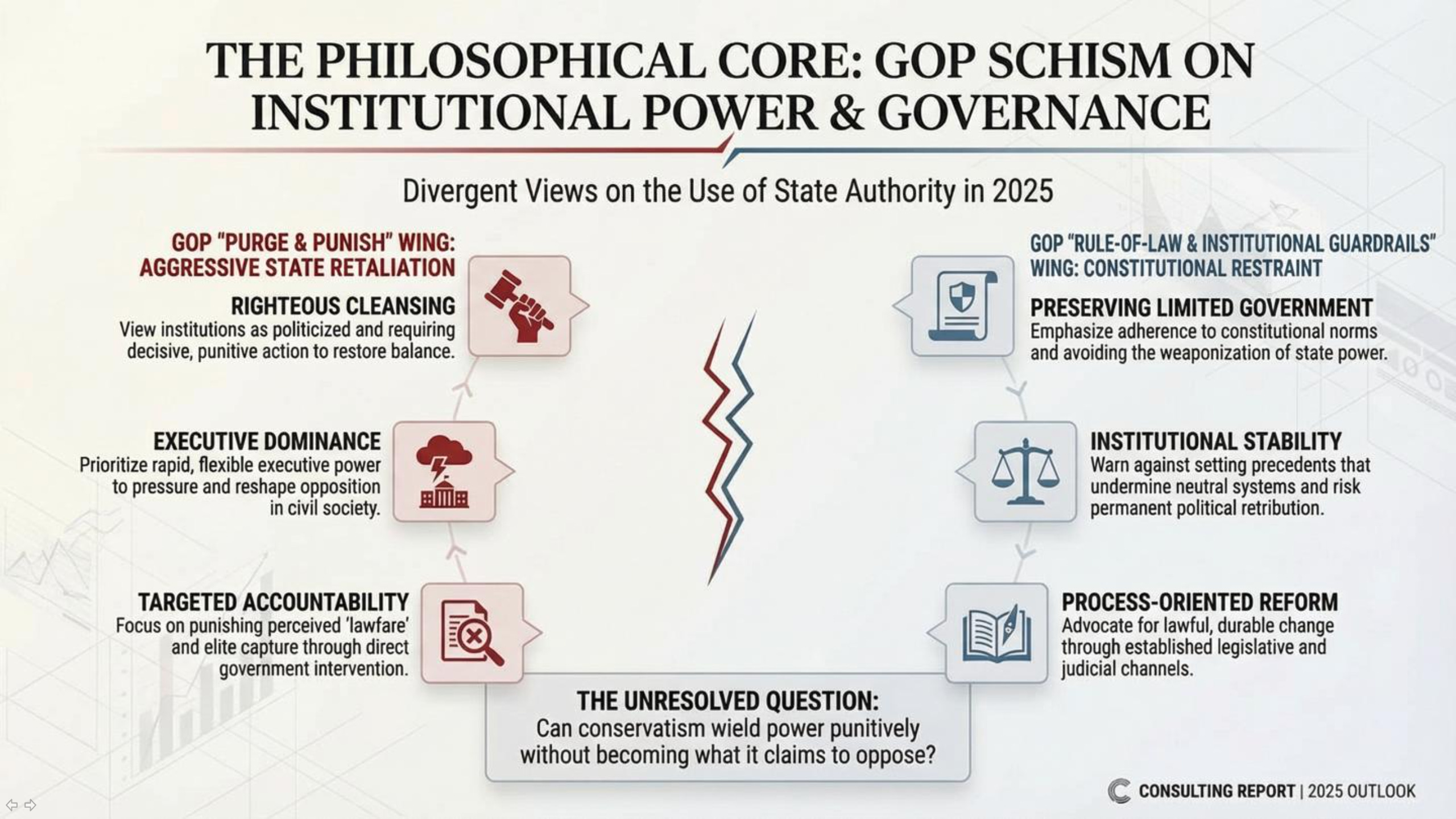
The other faction—often rooted in the conservative legal movement, institutional conservatives, and governance pragmatists—warned that weaponizing state power against civil society sets a precedent that can boomerang, undermines credibility of neutral systems, and risks turning conservative governance into permanent political retribution.
That fracture became visible in the legal world when the administration pursued punitive actions against major law firms, including efforts to restrict their access and reconsider or terminate federal business with them. Some Republicans celebrated this as overdue accountability for “lawfare” and elite capture. But other Republicans—especially those who prize the adversarial legal system—saw it as a constitutional and rule-of-law red line, arguing that the government should not coerce legal representation or punish firms for whom they represent. The fact that several large firms moved to strike accommodation deals rather than litigate sharpened the internal GOP dispute: one side saw capitulation as proof the pressure worked; the other saw it as a chilling signal that political loyalty was becoming a condition of normal civic participation.
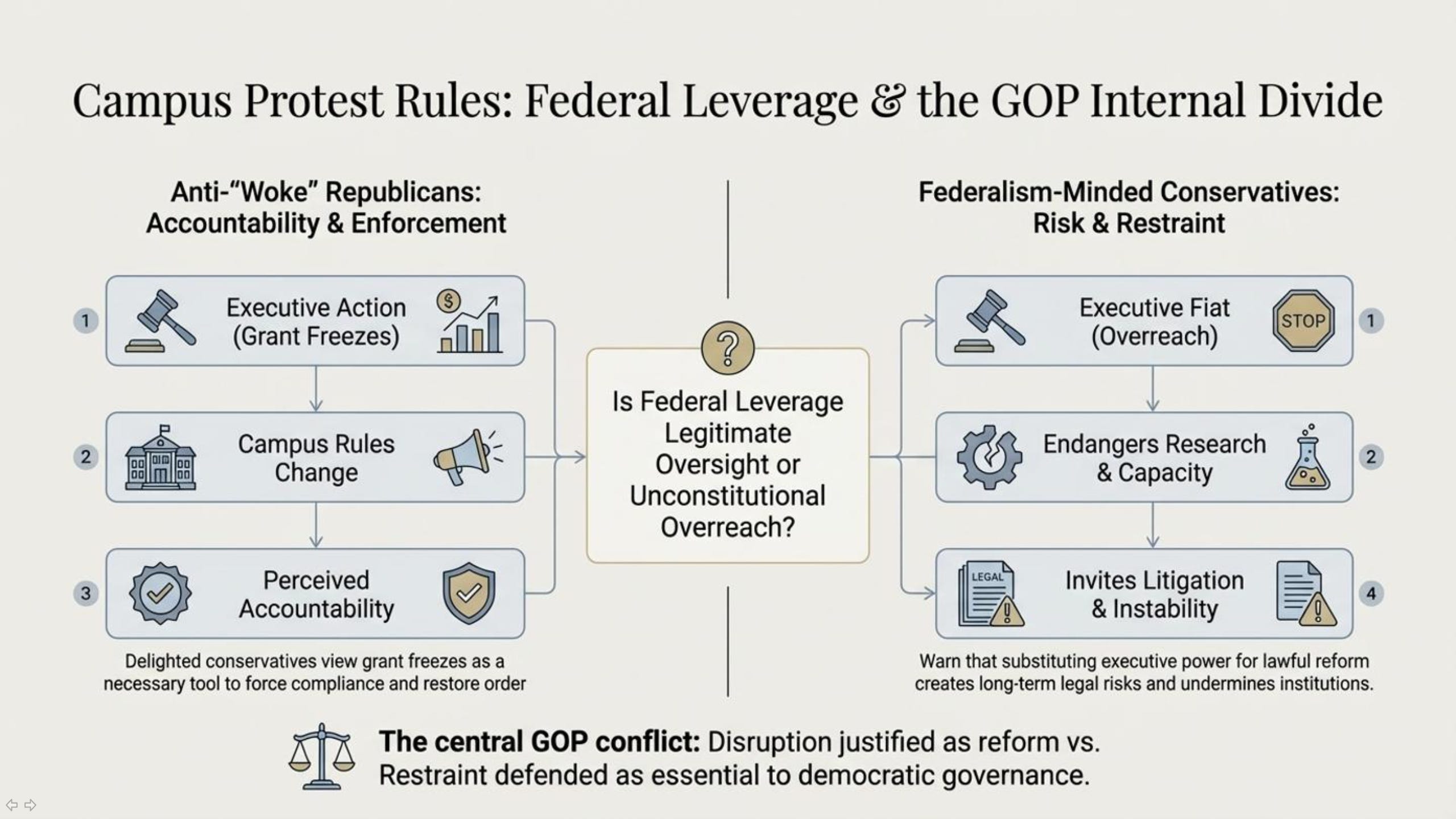
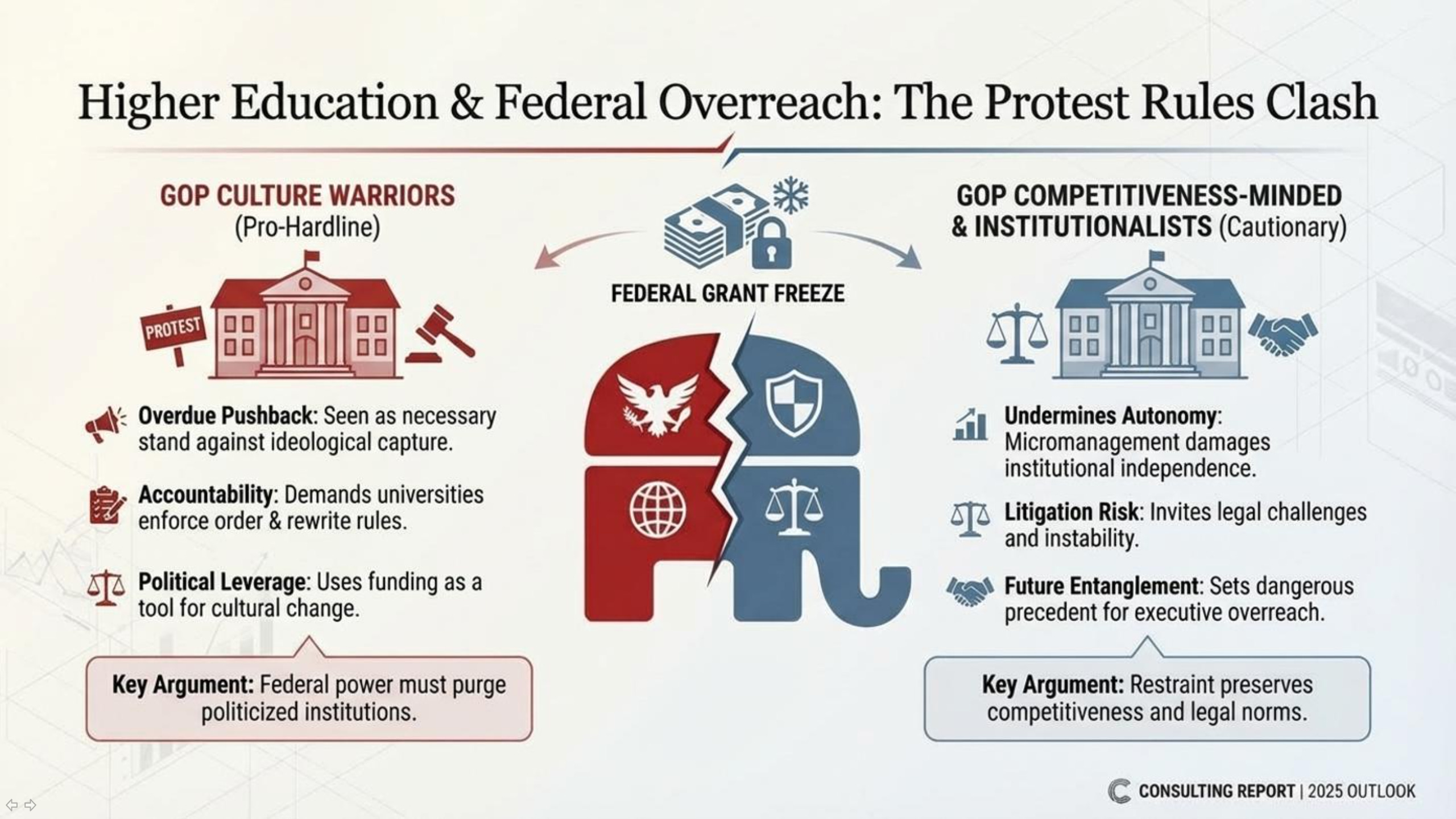
The same internal divide appeared in higher education. The administration used federal funding leverage to demand sweeping policy changes from universities over protest rules, disciplinary procedures, and institutional governance. Republicans who frame universities as ideologically captured applauded the crackdown as long-needed accountability and a rebuke to permissive campus disorder. But other Republicans—especially those sensitive to federal overreach and national competitiveness—warned that using grant freezes and tax-status threats to force institutional compliance risks substituting executive control for lawful, durable reform, while also destabilizing research capacity and inviting years of litigation.
Finally, the nonprofit arena exposed the deepest philosophical split: whether the IRS and tax-exempt status should be treated as neutral civic infrastructure or as an enforcement lever against political adversaries. Trump’s public suggestions that watchdog and advocacy groups could lose tax-exempt status were hailed by “drain the swamp” Republicans as a necessary strike against partisan activism hiding behind nonprofit privileges. Yet tax-policy conservatives and institutionalists warned that politicizing tax enforcement is corrosive—once the revenue system is viewed as a weapon, it damages trust, invites retaliatory cycles, and turns the basic machinery of civil society into a battlefield.
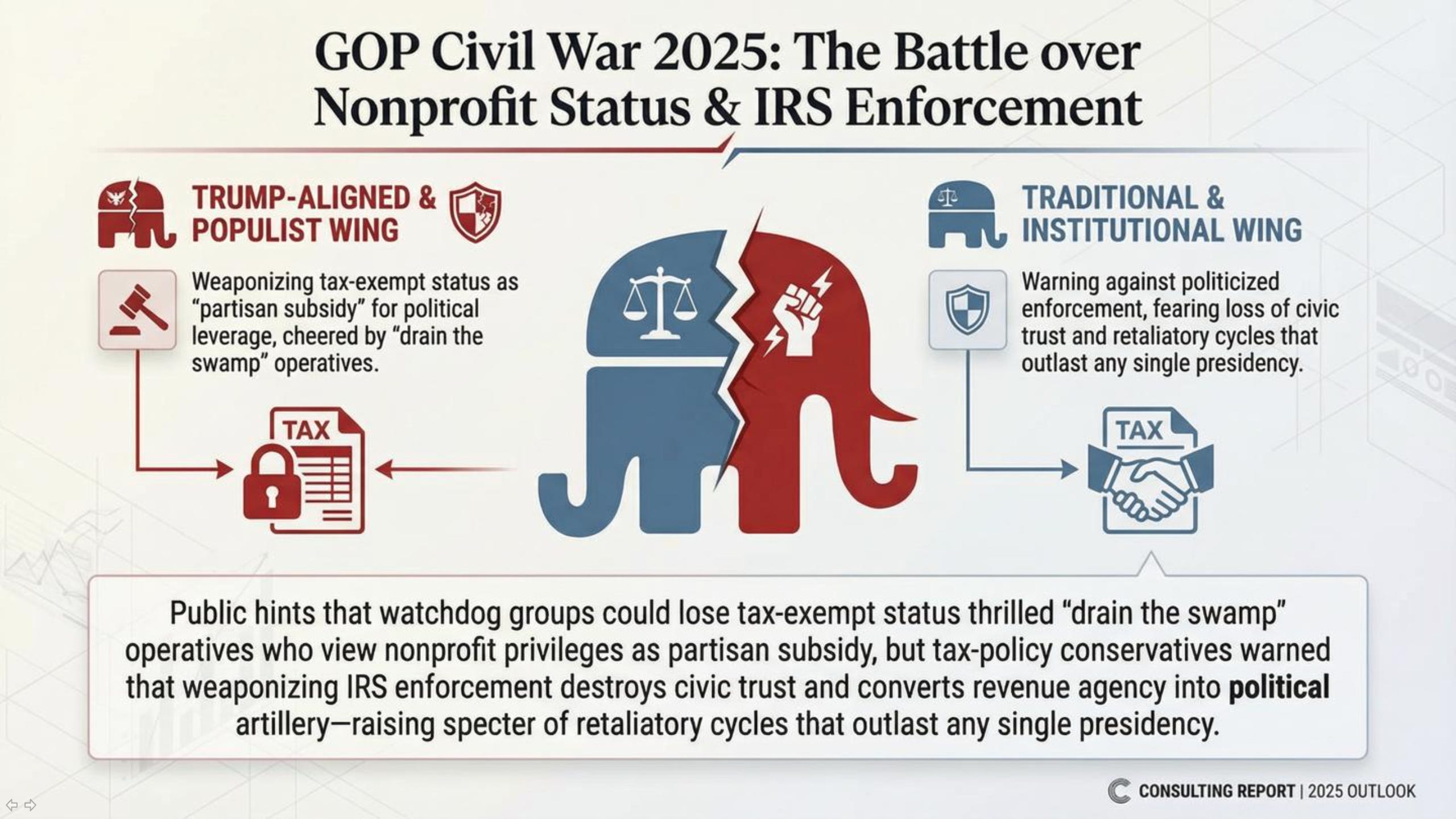
In short, this wasn’t merely a fight between Trump and institutions—it was a Republican civil war over method and legitimacy: whether conservative power should be maximally disruptive and punitive in the name of cleansing institutions, or restrained by constitutional norms and institutional guardrails to avoid converting governance into permanent political retribution.
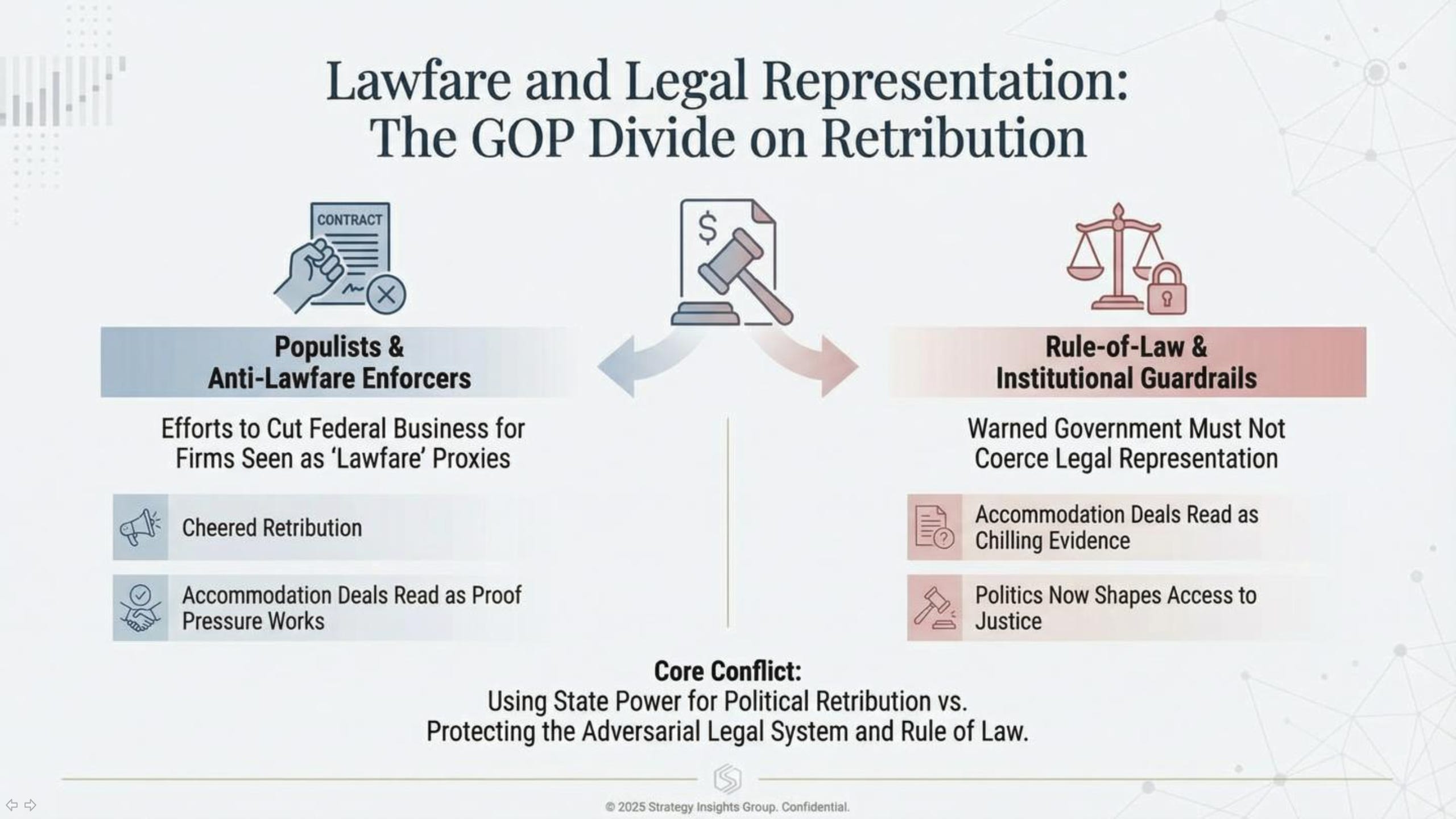
These confrontations with civil society were not isolated policy disputes, nor merely extensions of partisan conflict with Democrats. They exposed a deeper fracture within the Republican coalition itself—one over the legitimacy of using state power to punish perceived political opposition.
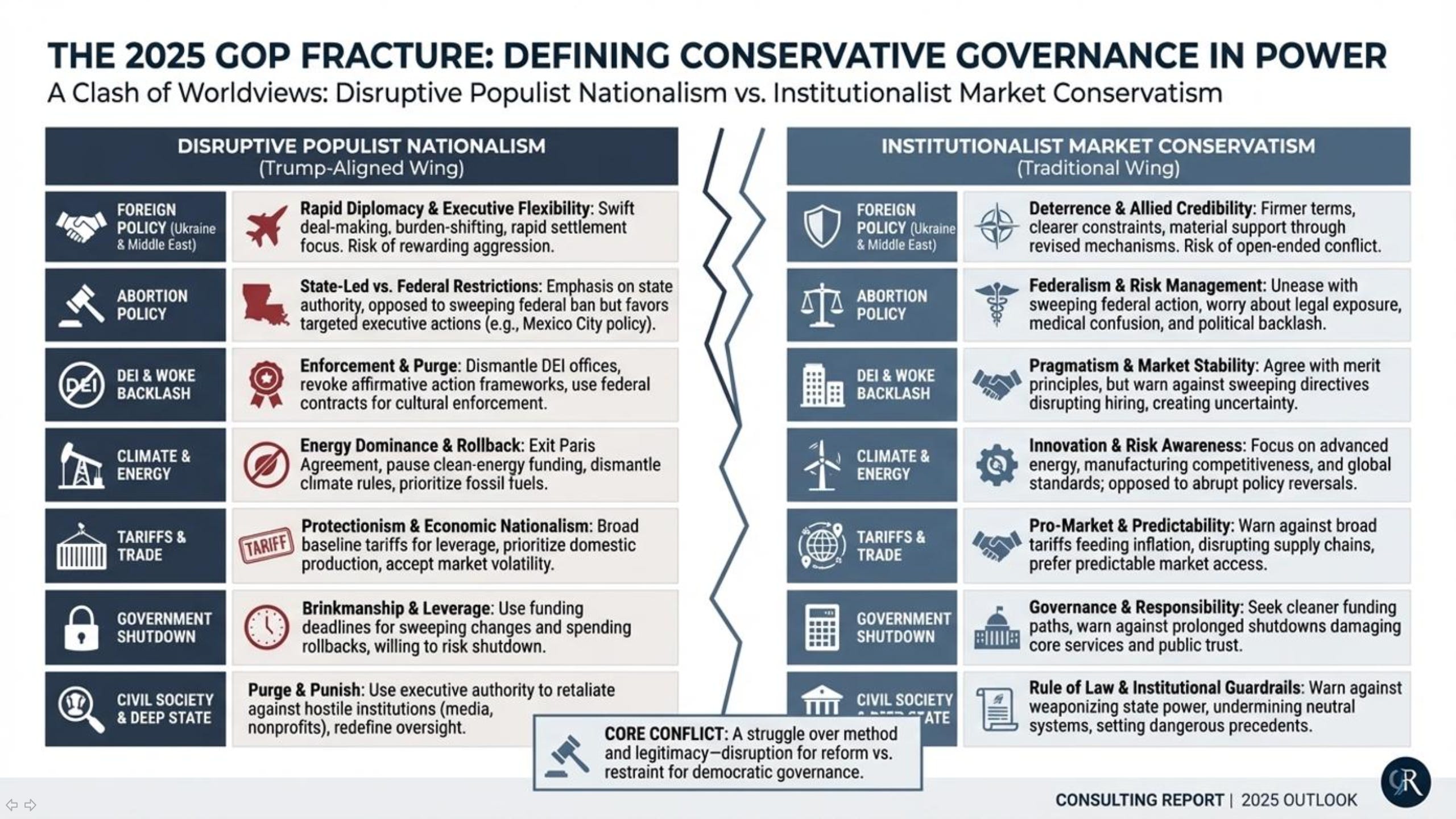
While some Republicans embraced this posture as a necessary purge of institutions they believed had become irredeemably politicized, others grew uneasy with the precedent it set: a presidency willing to redefine oversight, dissent, and independence as disloyalty. It was in this widening gap—between disruption justified as reform and restraint defended as essential to democratic governance—that the Republican conflict of 2025 came fully into view.
Here is what the Republican Civil War Really Is:
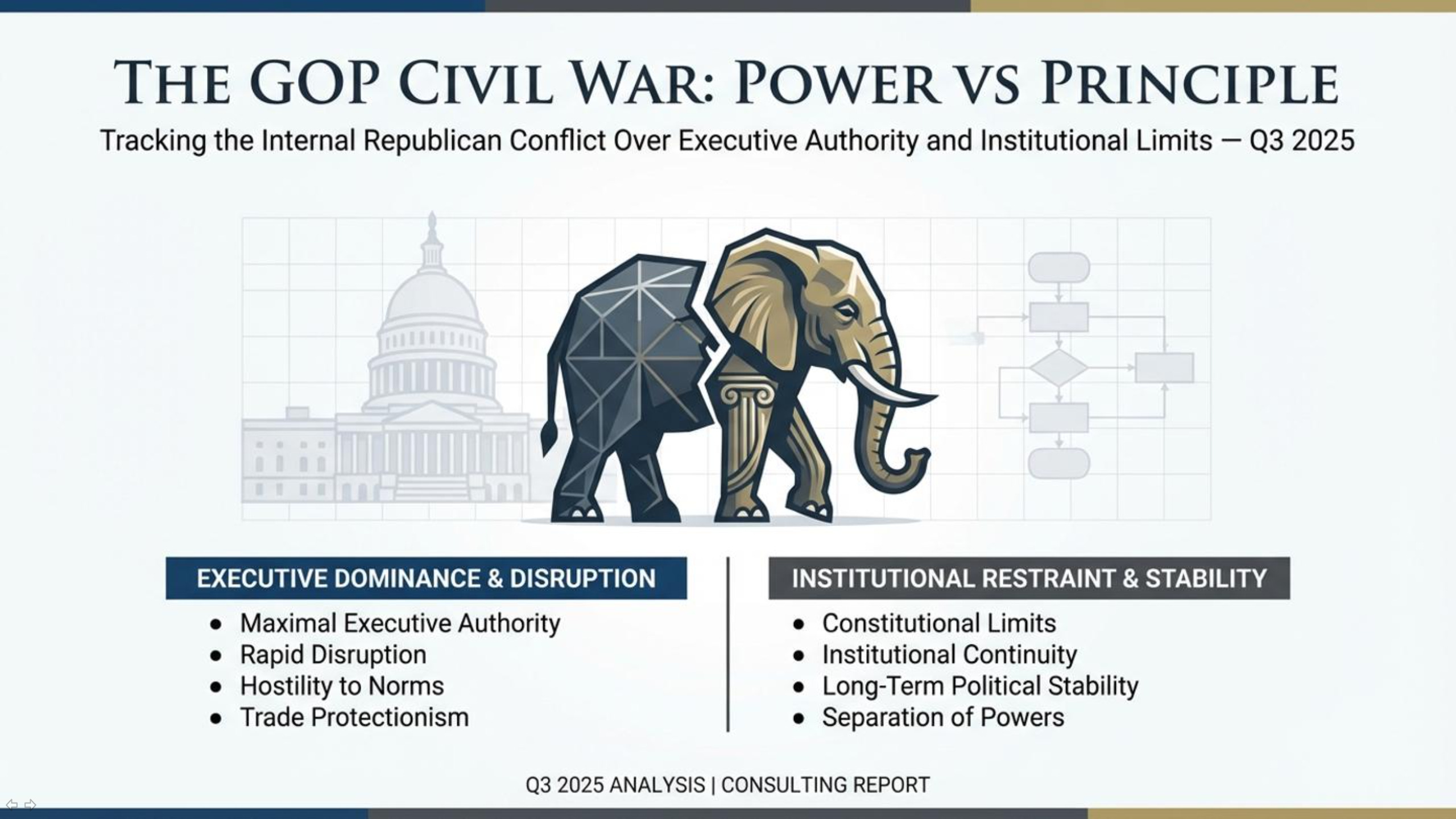
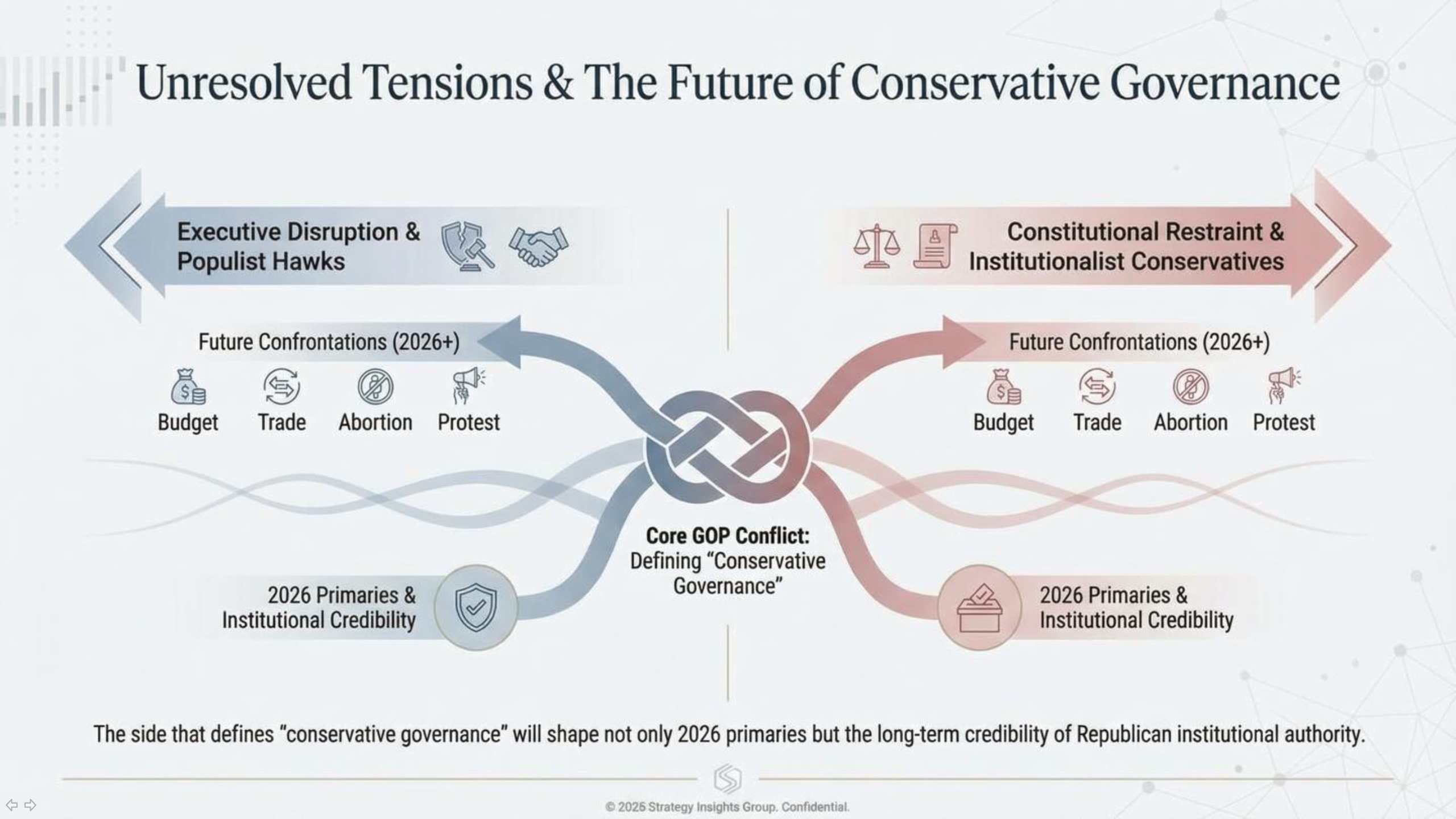
What emerges from the second half of 2025 is not a conventional partisan battle, but a Republican civil war over power, limits, and identity. The central divide is no longer simply conservative versus liberal, but between factions that prioritize executive dominance and rapid disruption, and those—often Republicans themselves—who remain anchored to constitutional restraint, institutional continuity, and long-term political stability.
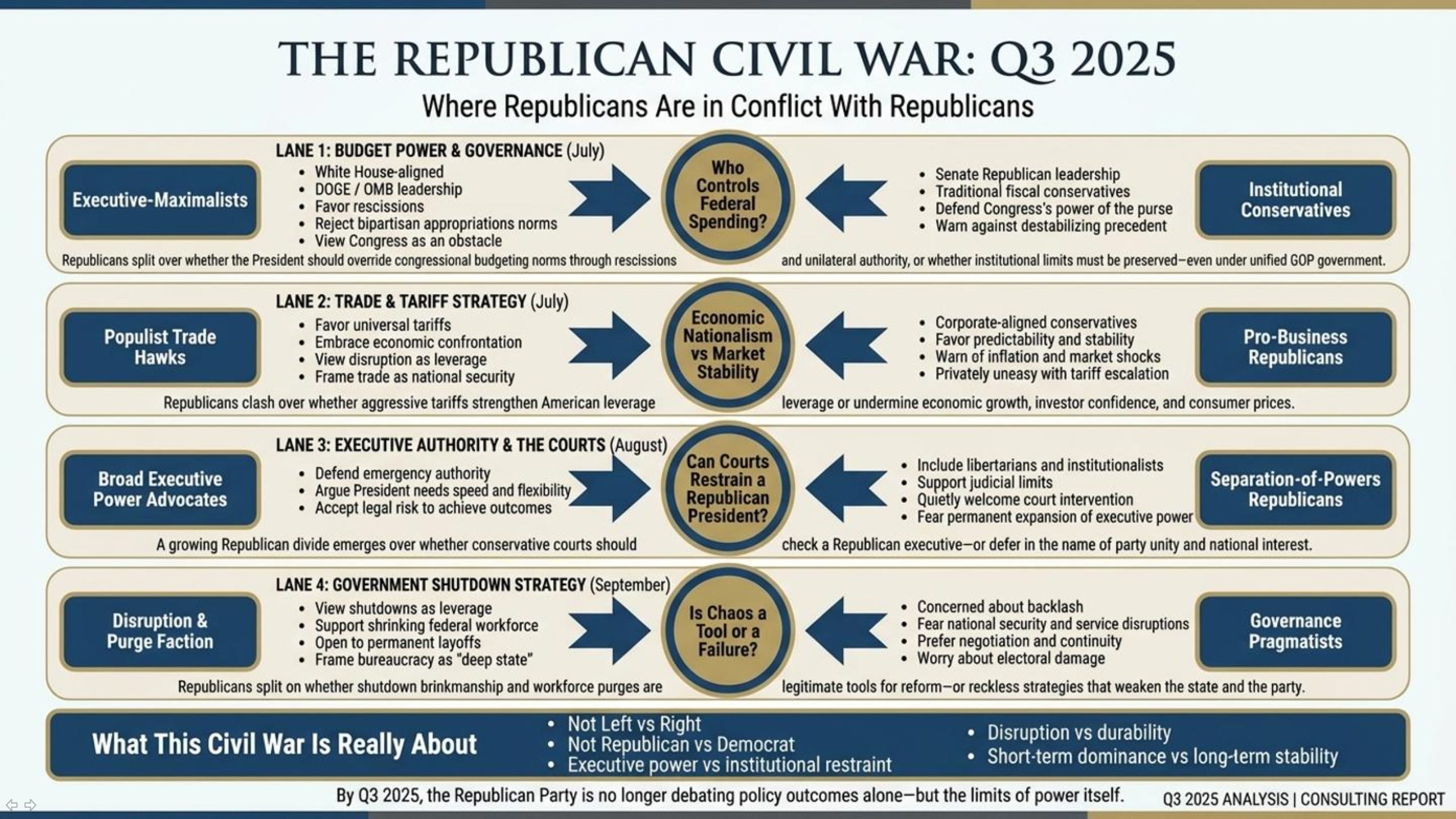
Hawks clash with restraint advocates over war powers; nationalists collide with libertarians over federal force at home and abroad; cultural enforcers confront traditional conservatives uneasy with state intrusion into private life; and party loyalists increasingly break with governors, courts, and even congressional leadership. These conflicts cut across ideology, geography, and branch of government, producing a party that often governs against itself. The result is a movement simultaneously empowered and unstable—capable of decisive action, yet fractured over how far power should go and what principles, if any, should constrain it.
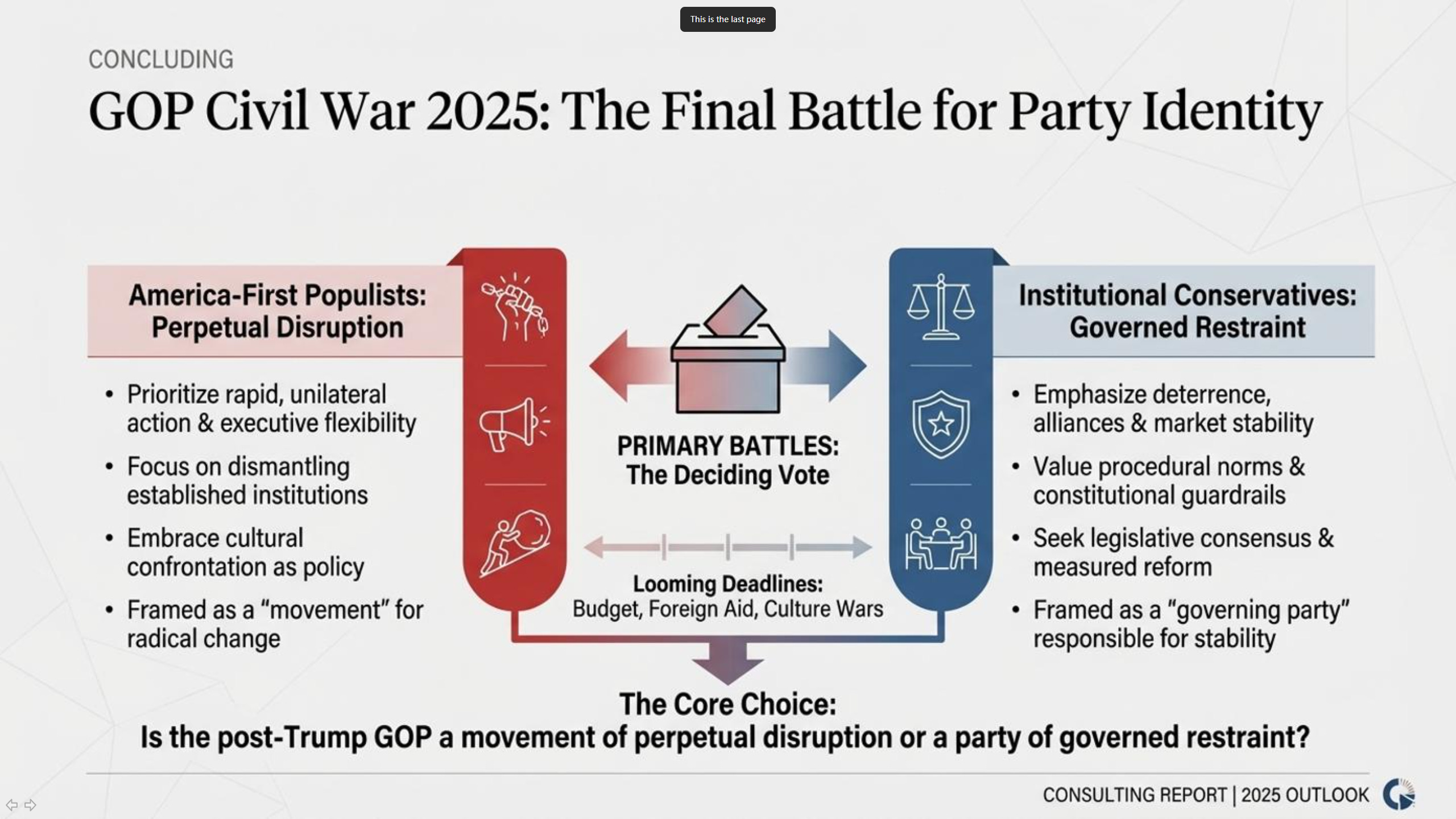
The Republican civil war of 2025 is ultimately a struggle over whether the party is transforming into a vehicle for maximal executive authority or remains tethered to the institutional and constitutional framework it once claimed to defend.
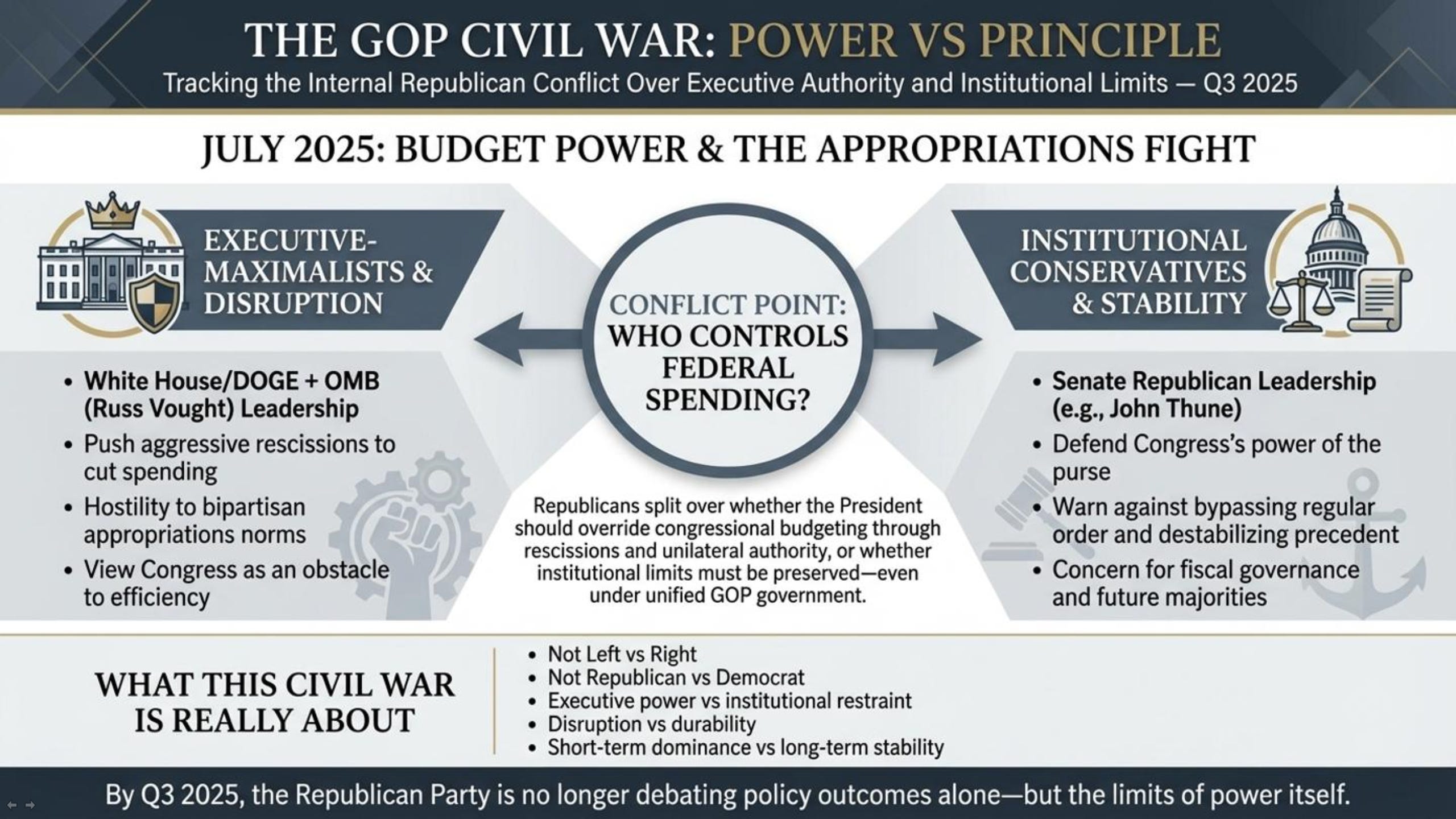
Budget power and “rescissions” vs traditional appropriations (July 2025)
Flashpoint: The White House/DOGE + OMB approach (Russ Vought) pushed aggressive rescissions and signaled hostility to bipartisan appropriations norms.
“Executive-maximalist / disruption” faction: aligns with the White House posture—use rescissions, weaken bipartisan budgeting.
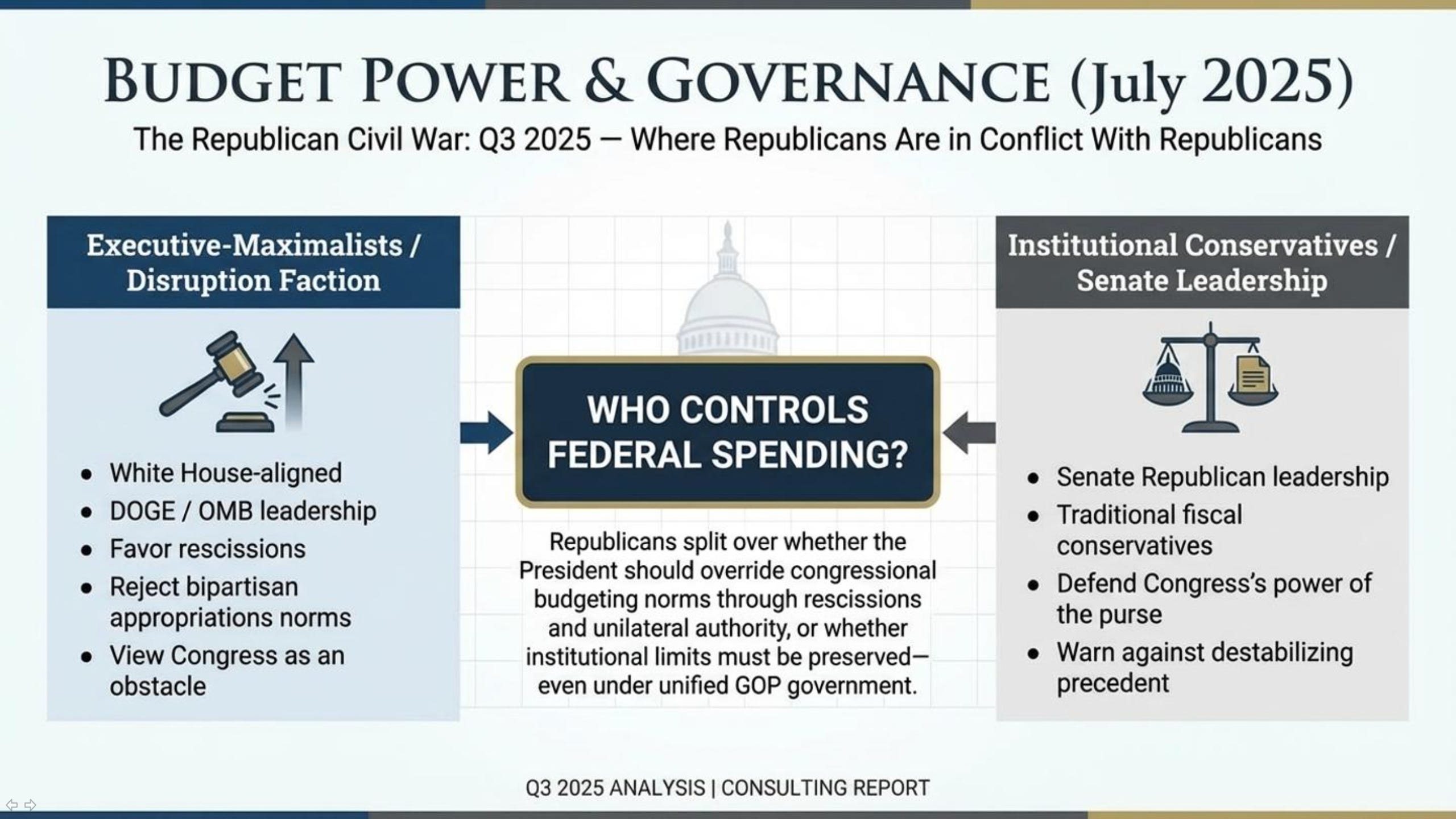
“Institutionalist / Senate leadership” faction: Republican Senate leaders (explicitly including John Thune in your text) pushed back against the idea that the White House would disregard Congress’s power of the purse.
Trade and tariffs: populist protectionism vs pro-business stability concerns (July 2025)
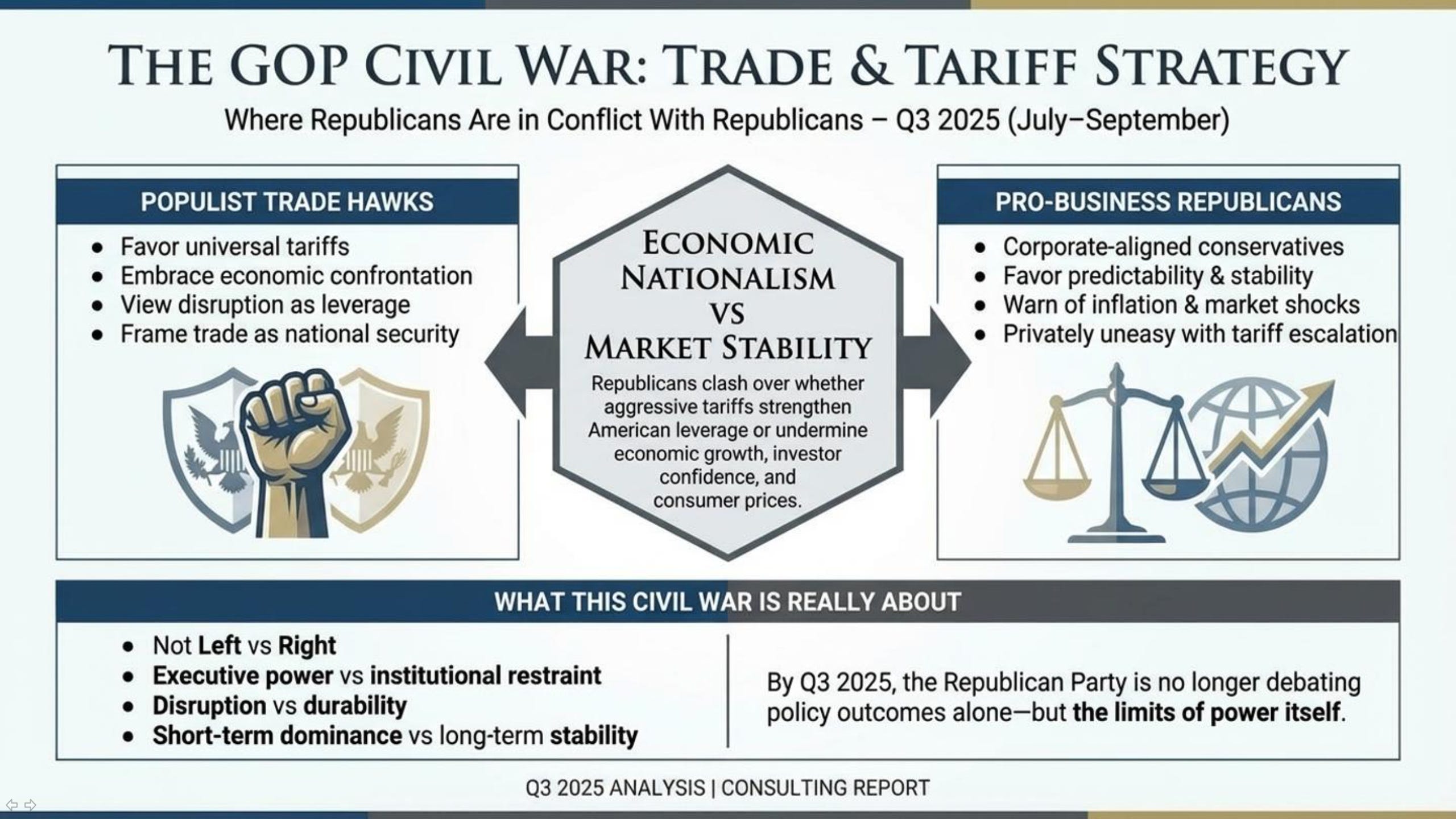
Flashpoint: The post–“Liberation Day” tariff politics continued into mid-year, while the administration touted deals (example given: a July EU deal with a tariff cap).
“Trade hawks / populists”: cheer tariffs + hardball deals as leverage and proof of strength.
“Traditional pro-business Republicans”: uneasy behind the scenes, worried the measures were destabilizing and inflationary.
Legal/constitutional authority over tariffs: executive latitude vs separation-of-powers restraint (August 2025)
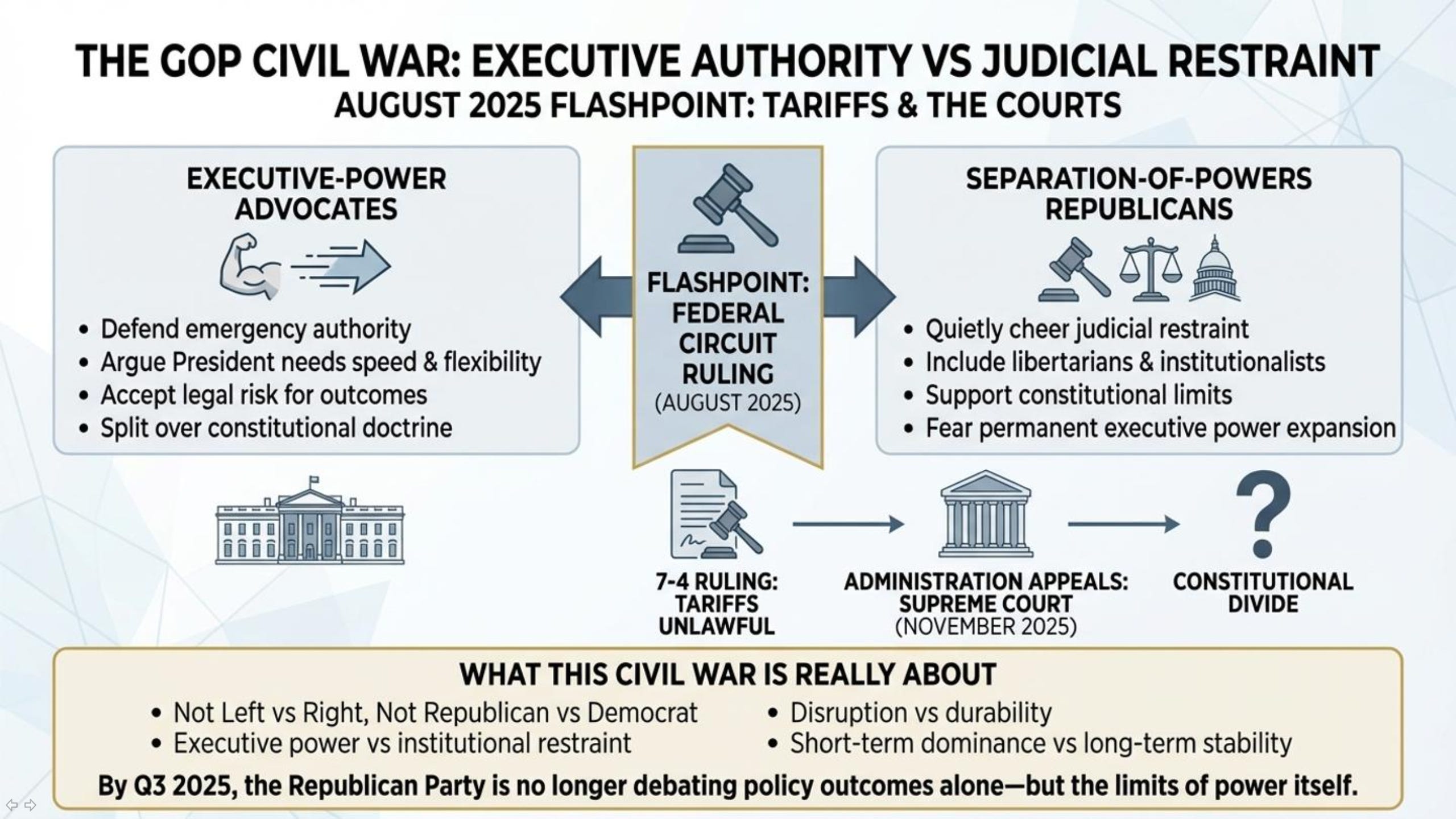
Flashpoint: A major legal clash when the Federal Circuit ruled 7–4 that many tariffs were unlawful under the asserted emergency authority framework described in the article, and the administration appealed (with Supreme Court arguments scheduled for November 2025).
“White House / broad executive authority” camp: argues the President needs latitude to act swiftly on trade for national security and resilience.
“Free-trade / Congress-reassertion” camp (including some Republicans): quietly hopes courts rein in the President’s trade powers.
Pre-shutdown escalation planning: shrinking the federal workforce vs governing stability (late September 2025)
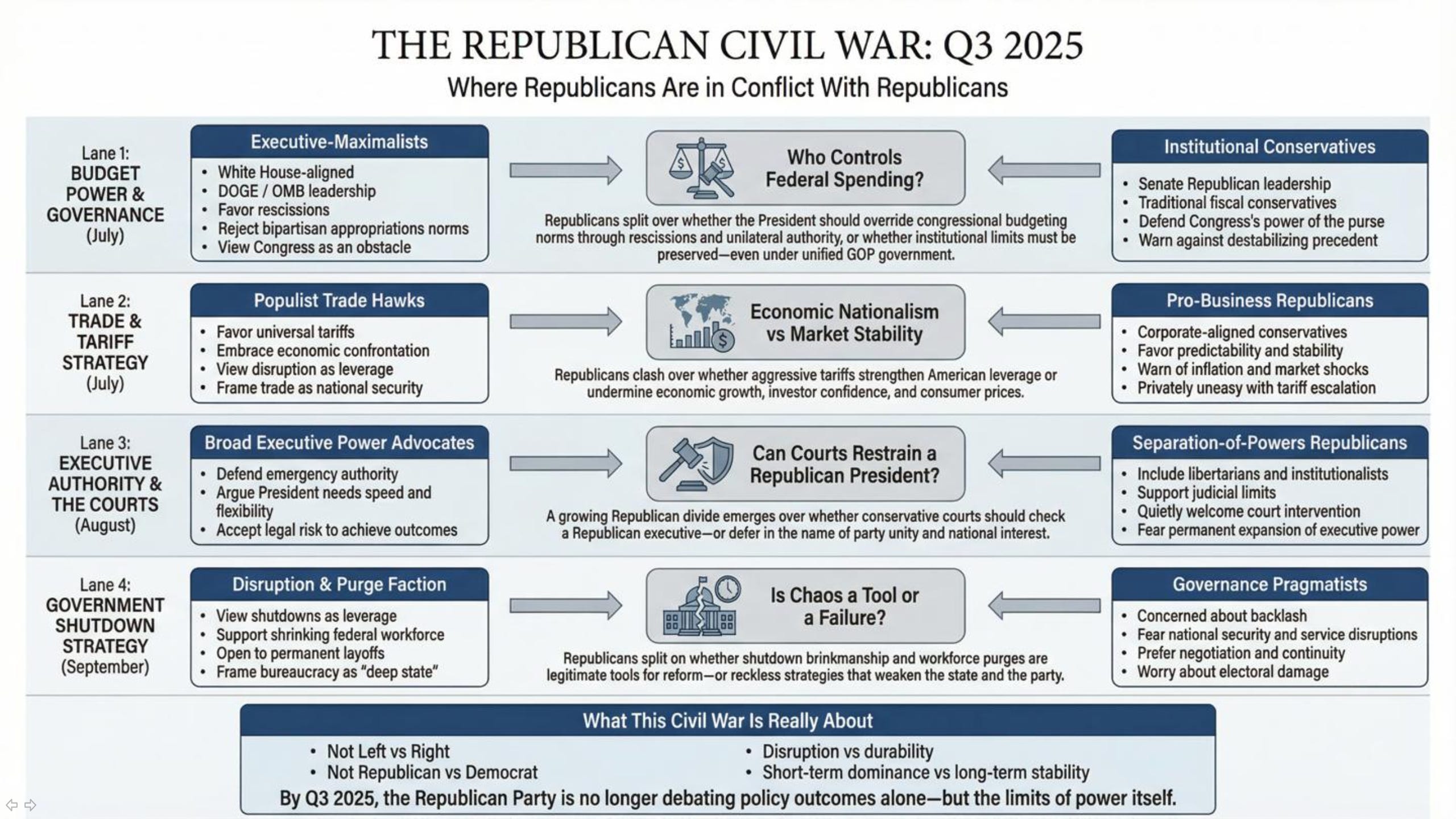
Flashpoint: Just before the Oct 1 funding lapse, the article notes the White House ordered agencies to prepare reduction-in-force (RIF) plans on Sept 30.
“Hardline / purge-the-bureaucracy” faction: treats shutdown leverage and workforce reduction as a feature, not a bug.
“Pragmatists / institutional conservatives”: alarmed by destabilization, backlash risk, and the precedent of weaponizing shutdown mechanics.
This internal split did not remain confined to Washington or to the mechanics of a looming shutdown. As the funding deadline approached, similar Republican fractures were surfacing at the state level, where GOP lawmakers faced their own tests of loyalty versus institutional caution. The same tension—between aggressive, top-down political strategies and concerns about legal exposure, public backlash, and long-term governance—began to play out in statehouses, revealing that the Republican civil war was not merely about federal budgeting tactics, but about how far power should be pushed across every level of government.
1. Republican State Lawmakers Reject Trump-Backed Redistricting (Domestic)
In Indiana, a majority of Republican state senators joined Democrats to defeat a Trump-backed mid-decade congressional map that would have eliminated Democratic seats. Over a dozen Republicans opposed the plan in the state Senate, highlighting a split between Trump-aligned redistricting efforts and GOP legislators wary of legal/political backlash.
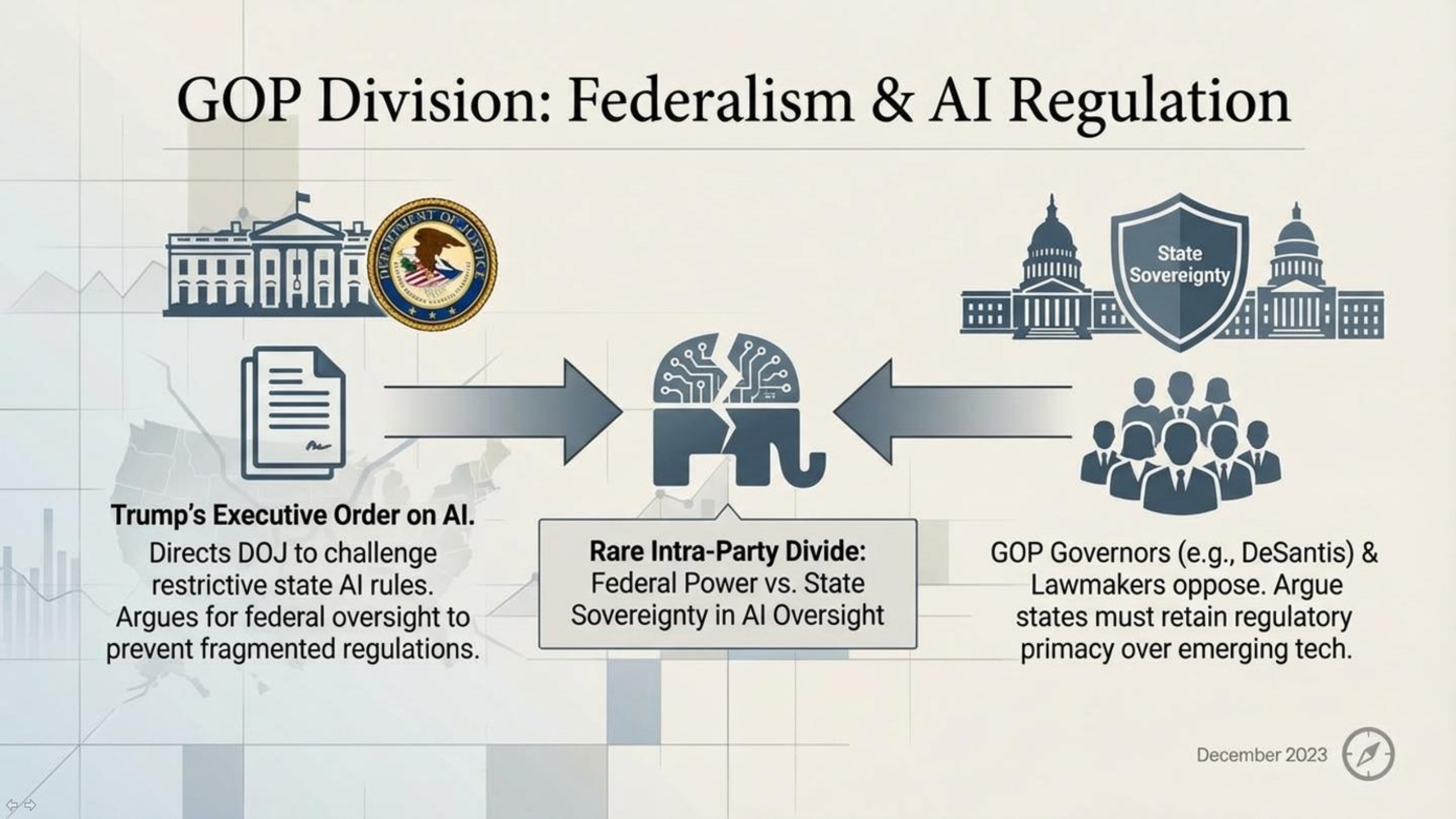
2. GOP Division Over AI Federalism (Domestic Tech Policy)
President Trump’s executive order directing the DOJ to challenge restrictive state AI regulations has sparked significant Republican opposition. Governors like Ron DeSantis and groups of GOP senators and representatives criticized it for federal overreach, arguing states should retain authority over AI policy — a rare GOP fracture over tech federalism and Big Tech influence.
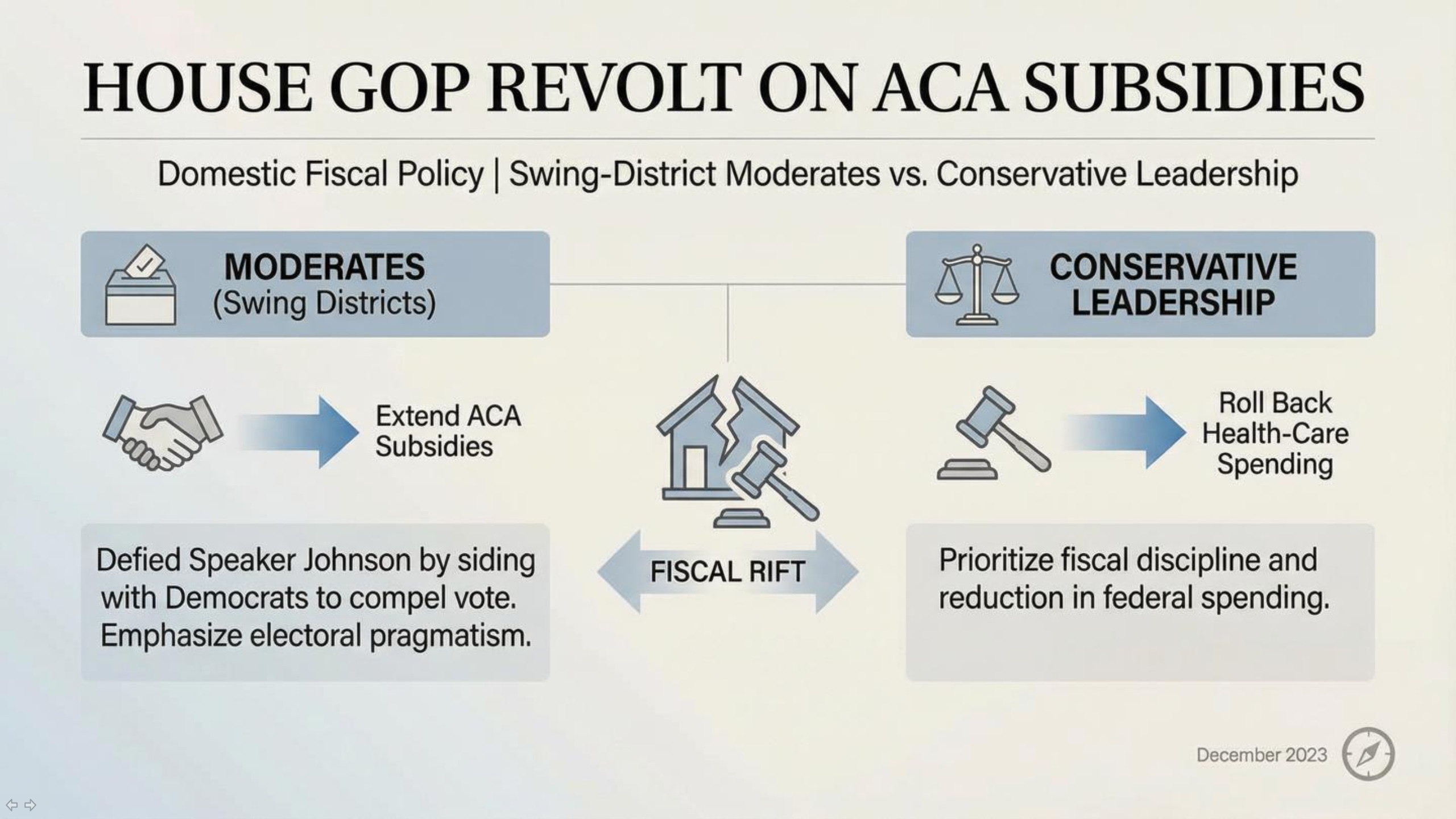
3. House GOP Revolt on ACA Subsidies (Domestic Fiscal Policy)
Moderate House Republicans broke with Speaker Mike Johnson and GOP leadership by joining Democrats to force a vote on extending Affordable Care Act subsidies, underscoring a clear rift within the party between moderates in swing districts and conservative leadership on fiscal priorities.
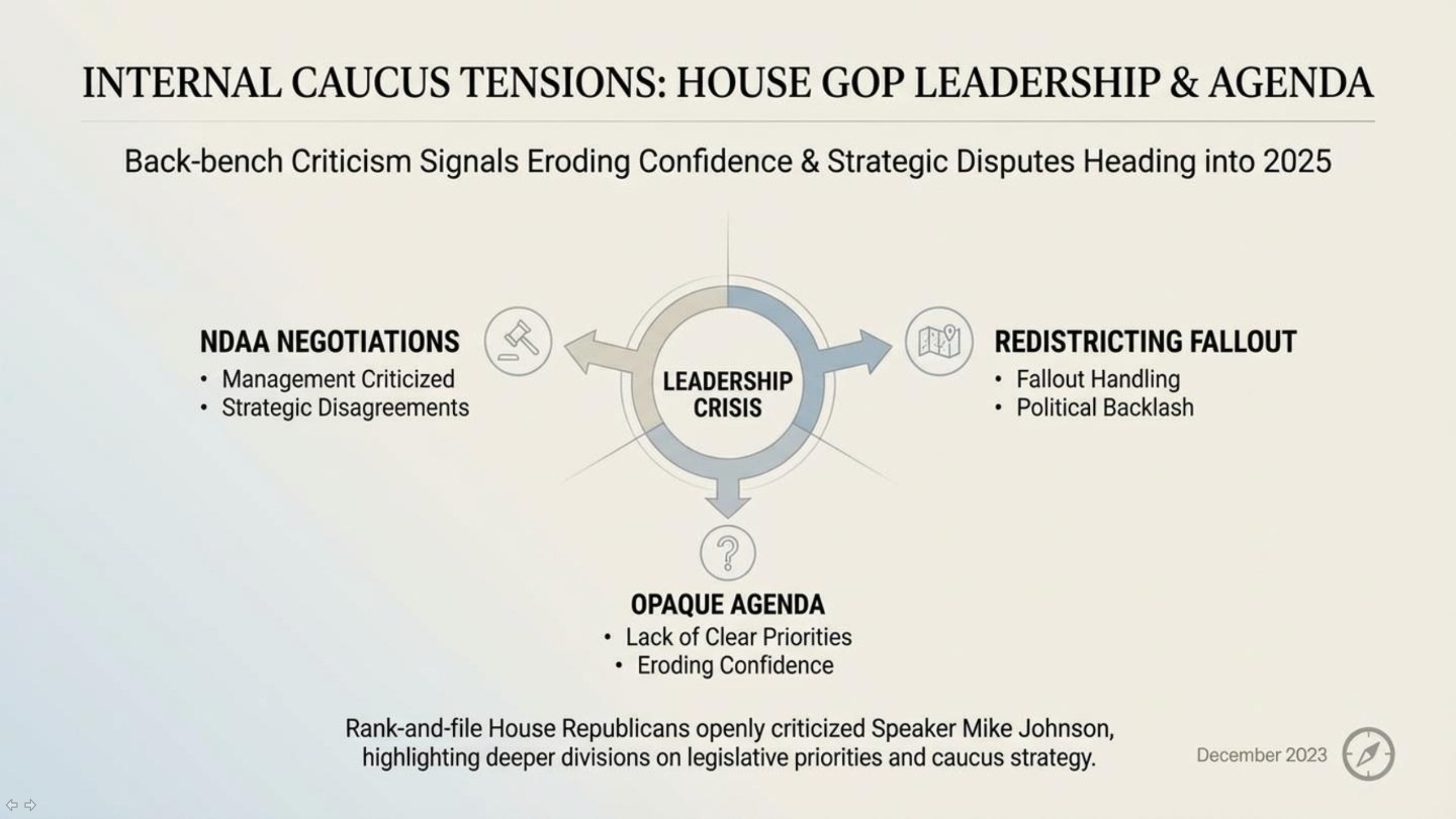
4. Split Within House GOP Over Leadership and Agenda (Internal Caucus Tensions)
Rank-and-file House Republicans publicly criticized Speaker Mike Johnson for handling of the agenda, NDAA negotiations, redistricting fallout, and lack of clear priorities, showing intra-party personal and strategic disputes among GOP lawmakers as the year ends.
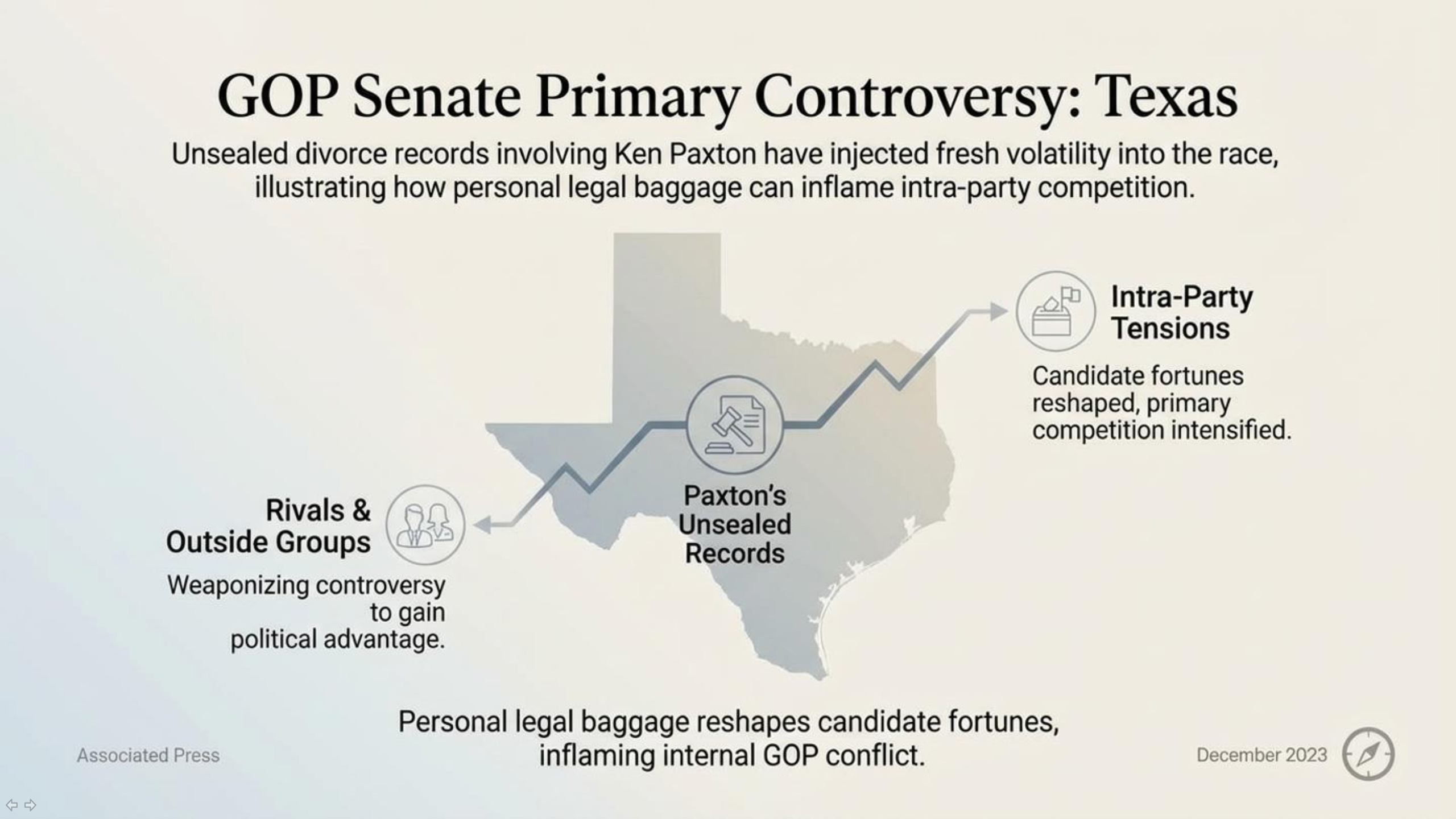
5. Republican Senate Primary Controversy (Domestic Political Conflict)
In Texas, unsealed divorce records involving Attorney General Ken Paxton have intensified a competitive GOP Senate primary and dramatized intra-party tensions as candidates (and interest groups supporting rivals like Sen. John Cornyn) capitalize on the controversy.
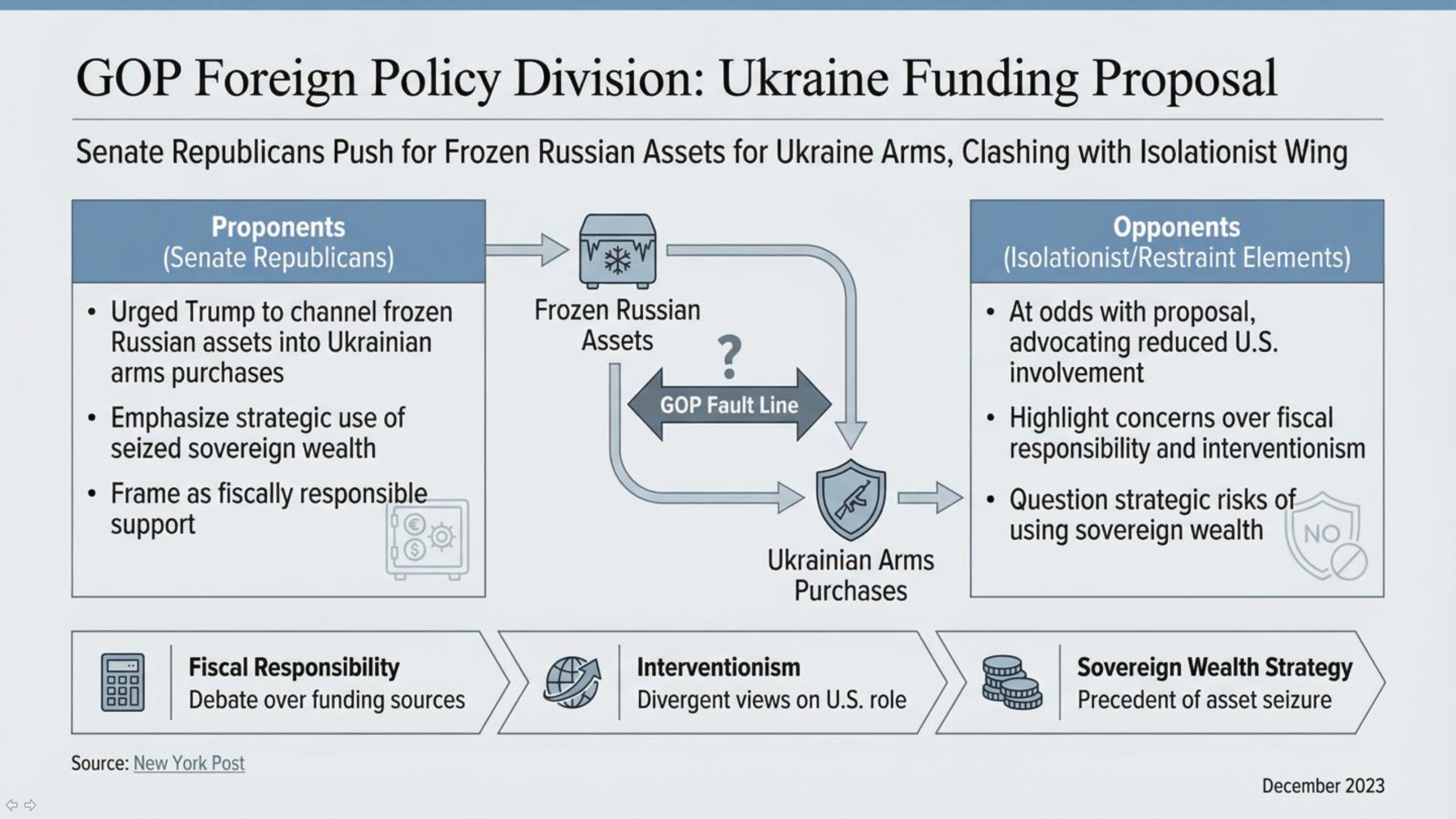
6. GOP Foreign Policy Division: Ukraine Funding Proposal (Foreign Policy Tension)
A group of Senate Republicans pushed President Trump to use frozen Russian assets to help fund Ukraine’s weapons purchases — a stance at odds with more isolationist or restraint-oriented elements of the party and potentially contrasting with the administration’s broader foreign policy posture
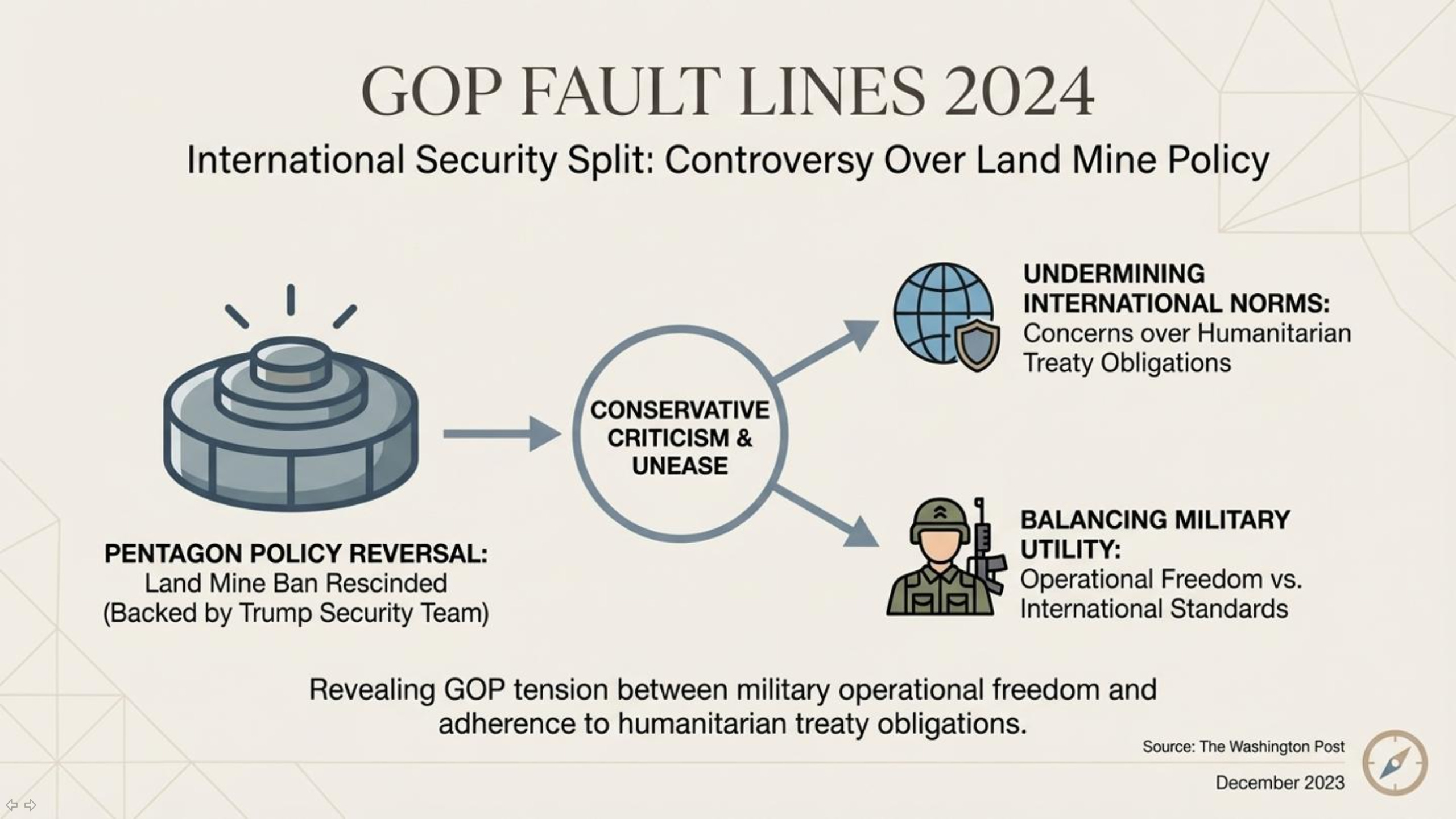
7. Controversy Over Land Mine Policy (International Security Split)
The Defense Department’s reversal of a ban on global antipersonnel land mines — a policy championed in Trump’s national security apparatus — drew backlash from human rights advocates and signaled disagreement among conservatives about adherence to international norms vs military utility.
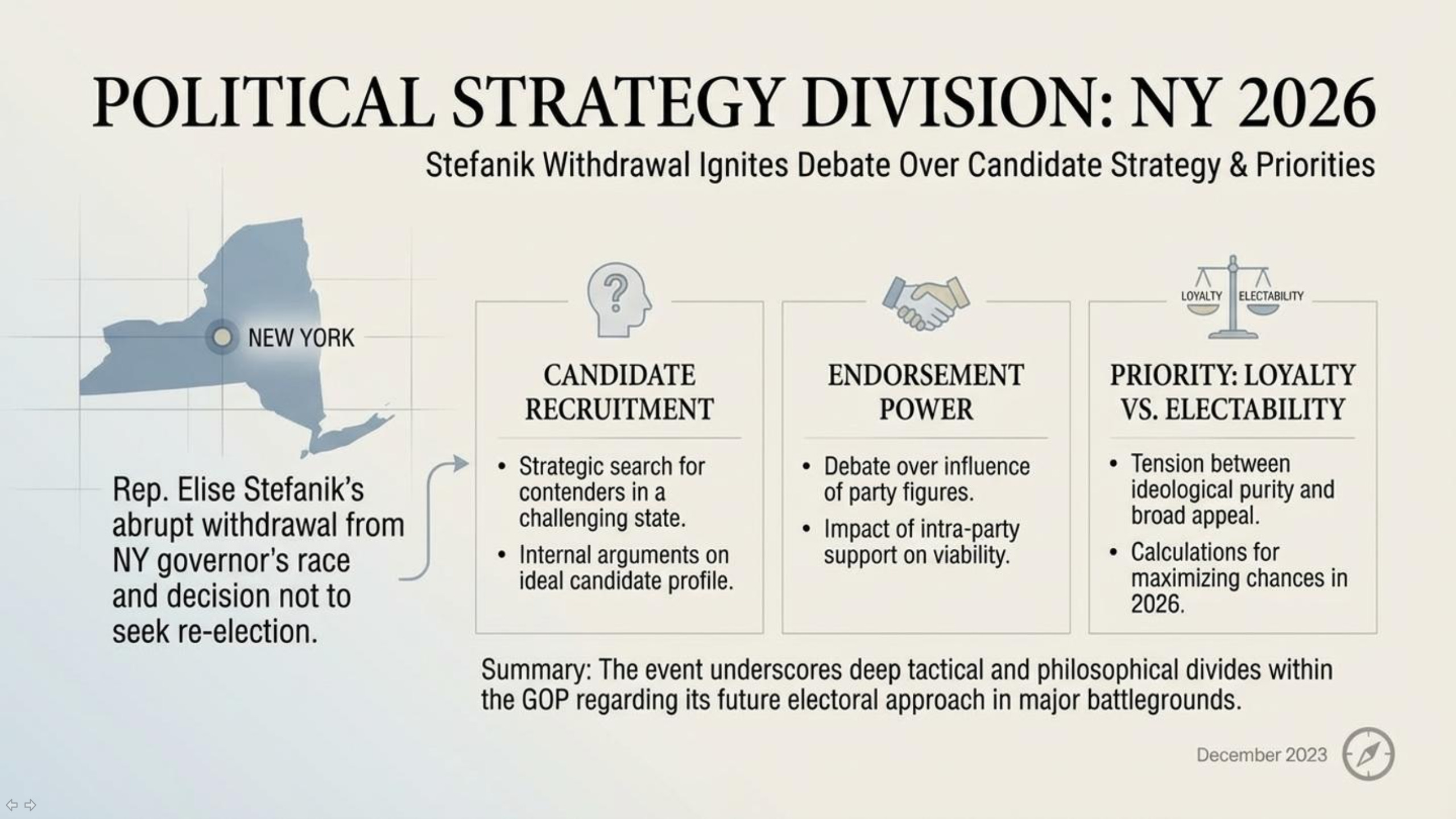
8. GOP Figure Stepping Back from Office (Political Strategy Division)
Rep. Elise Stefanik’s abrupt withdrawal from the New York governor’s race and decision not to seek re-election sparked debate within the GOP about candidate strategy, intra-party endorsements, and electoral calculations in a major state going into 2026.
Summary of Themes in Recent GOP Divisions
Domestic policy splits include fights over federalism (AI policy), health care subsidies, leadership credibility and legislative focus, state legislative strategy (redistricting), and intra-party primaries
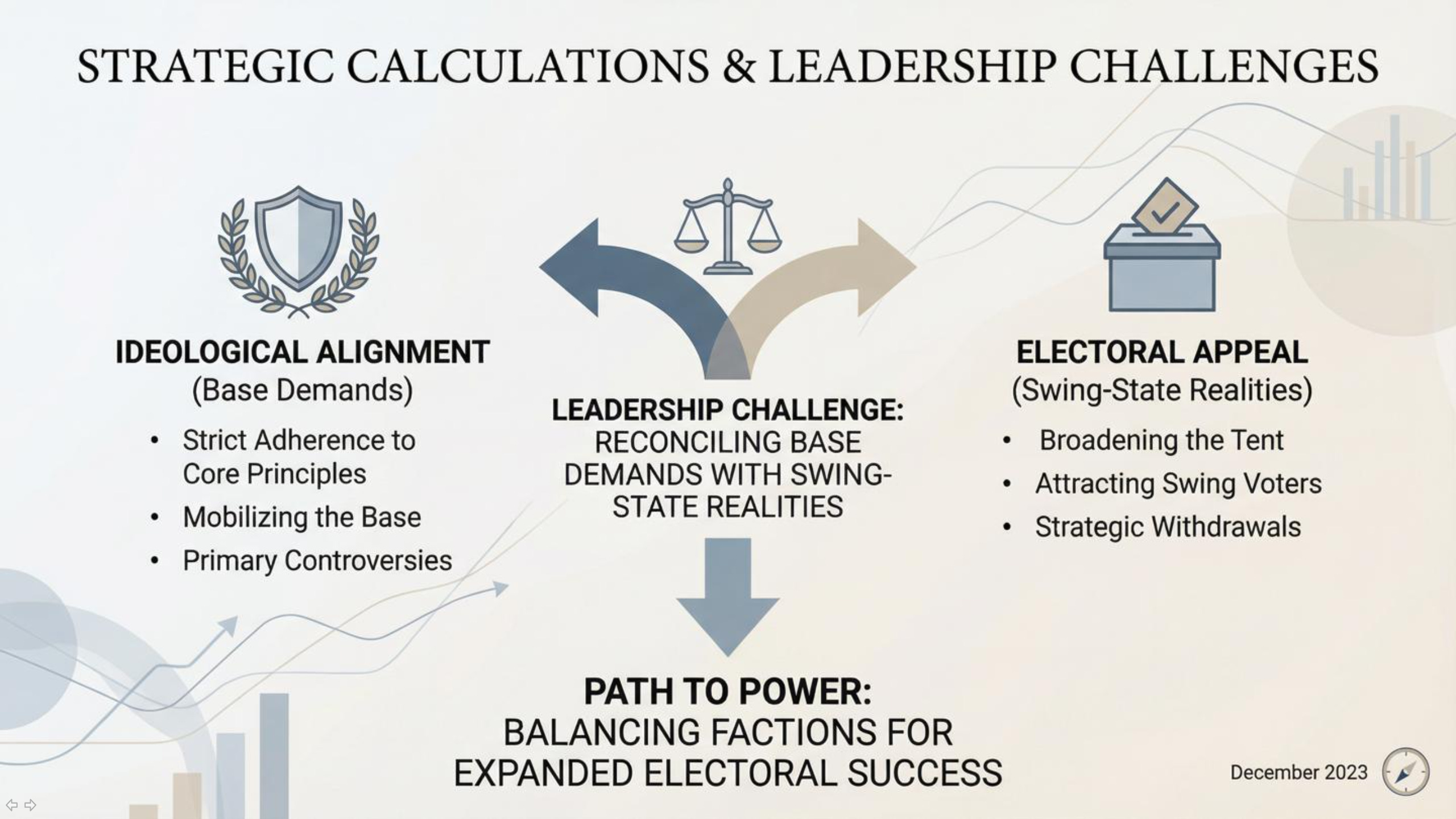
Foreign and security policy disagreements arise in approaches to Ukraine support and military norms (land mine reversal), showing GOP contention over how interventionist or rules-based U.S. foreign policy should be.
Conclusion
If 2025 felt like chaos inside the right, it’s because the argument stopped being “left vs right” and became a struggle over what the right even is: a movement built around maximal executive dominance and rapid disruption, or a party still tethered to constitutional restraint, institutional continuity, and long-term stability.
That fight is why the same names and factions keep colliding across totally different issues. The “do it now, break the system if needed” instinct shows up in war powers, immigration, budgeting, trade, and institutional retaliation; the “limits matter, process matters” instinct shows up as resistance—sometimes from Republicans themselves—warning that short-term wins can become long-term damage.
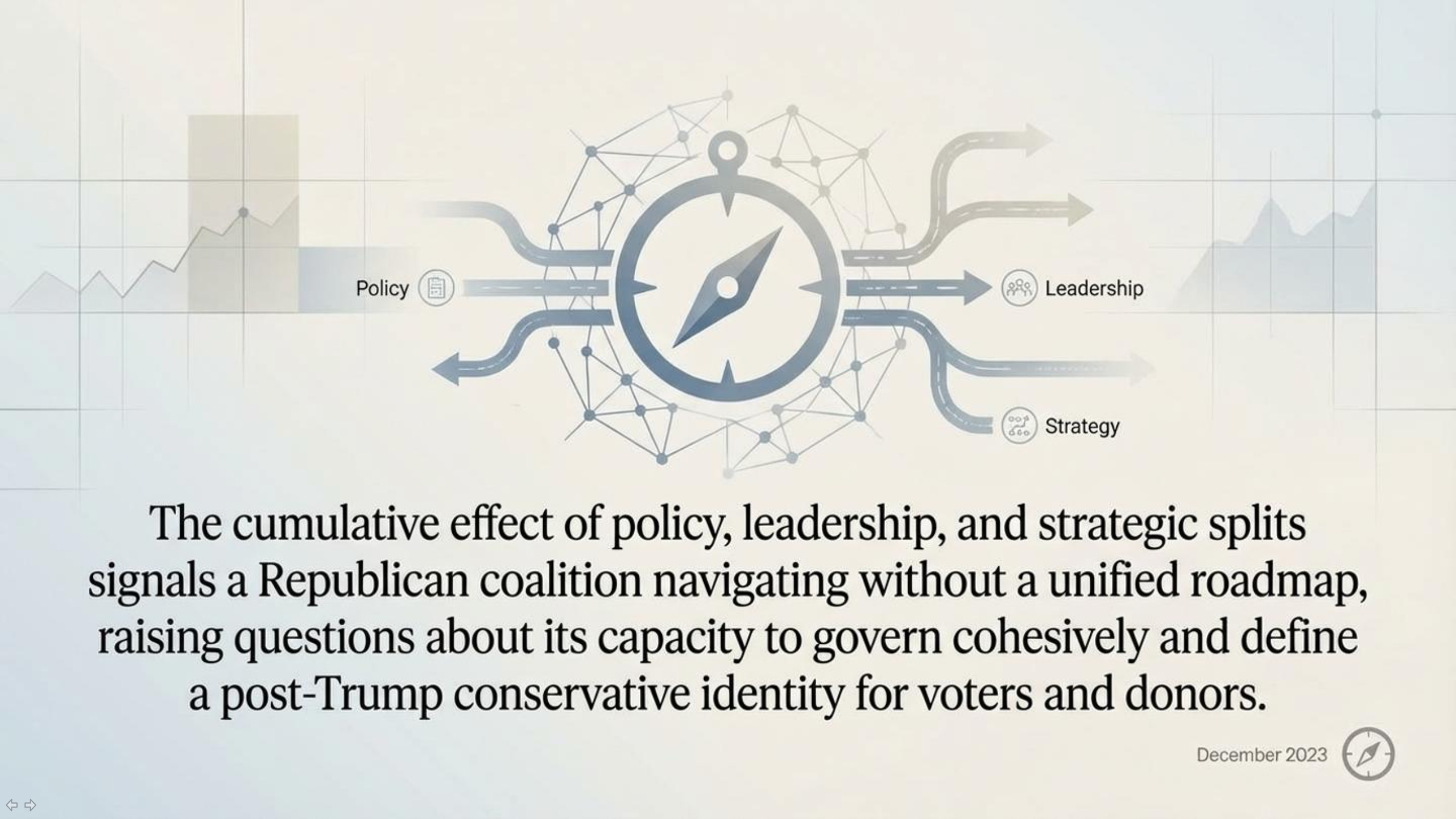
Seen this way, the Republican civil war isn’t a single schism—it’s a multi-front stress test. Hawks vs restraint advocates, nationalists vs libertarians, culture enforcers vs cautious conservatives, and Washington power-centrists vs governors and local realities all pull the coalition in different directions at once.
And that’s the real answer to the “diagram” problem: you don’t need one line separating two teams—you need a map of recurring fault lines that keep reappearing under new headlines. What looks like random infighting is actually a consistent argument about where authority lives, what limits bind it, and whether legitimacy comes from winning fights or from honoring guardrails.
So the question going into 2026 isn’t whether Republicans will stay divided—it’s which model of power becomes the party’s default: a vehicle for maximal executive authority, or a coalition that still believes its own rhetoric about constitutional boundaries.